
 Translate































 | Loading... |
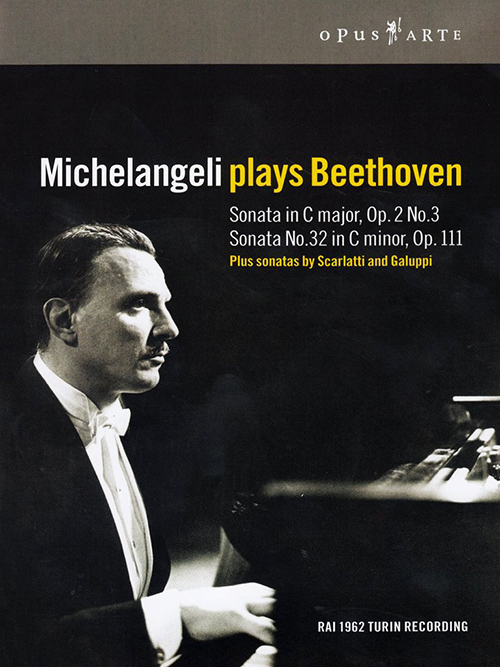
MICHELANGELI PLAYS BEETHOVEN (NTSC)
Michelangeli plays Beethoven
Gil Evans (piano), Billy Cobham (drums),
Tim Landers (bass), Dean Brown (guitar),
The legendary Italian pianist Arturo Benedetti
Michelangeli (1920 - 1995), playing at the height of his
powers, performs two Beethoven sonatas in an historic
recording now digitally restored and re-mastered. He also
plays earlier sonatas by Scarlatti and Galuppi.
Michelangeli's fine control and perfect clarity - always
present in his playing - have positioned him as one of
the most outstanding recording artists of any generation.
'His fingers can no more hit a wrong note or smudge a
passage than a bullet can be veered off course once it
has been fired...' Music critic Harold Schonberg
Picture Format: 4:3
Sound Format: LPCM Mono
Running Time: 84 mins
Region Code: All regions
Menu Languages: EN
Cat. No: OA 0939 D
PLUSLudwig van Beethoven (1770 - 1827): Sonata in C major, Op. 2 No. 3 & Sonata No. 32 in C minor, Op. 111
Domenico Scarlatti (1685 - 1757): Sonata in C minor, K11/L352, Sonata in C major, K159/L104,
Sonata in A major, K322/L483, Sonata in B minor, K27/L449
Baldassare Galuppi (1706 - 1785): Sonata in C major
- Adverts in Gramophone, Classic fM, BBC Music Magazine & International Record Review
- Rare archive recordings - few pianists can have achieved such an exalted reputation with so slender a repertoire as Arturo Benedetti Michelangeli � but then, everything he played was honed to perfection. Of the 32 Beethoven sonatas, he performed no more than a handful. In 1962 Michelangeli agreed to record a series of televised studio performances for RAI Turin, though not without laying down strict stipulations: the camera set-ups were to be minimal, and there were to be no facial close-ups. Those limitations explain the austere visual style of the recordings presented here, but the light they shed on Michelangeli�s artistry is in no way diminished � indeed, the restraint of the camera-work enables us to concentrate without distraction on the musical performances. Even between individual movements of the same work there is no edit, and it is clear that these are single-take interpretations.
Loading...