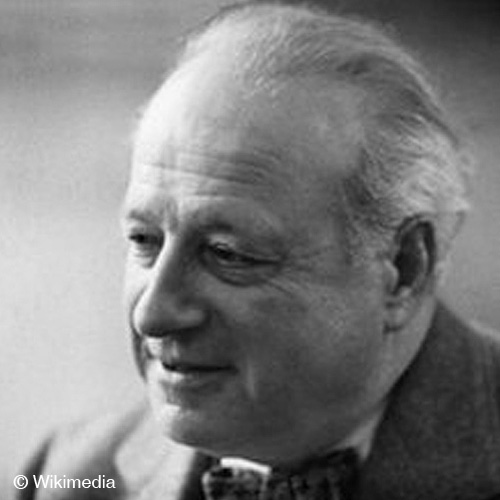
--George Rochberg
in his notes to Naxos American Classics release Black Sounds / Cantio Sacra / Phaedra
For the bulk of the first
half of the twentieth century, many composers seemed to decide that their works
should jettison all things beautiful. A key tool in their arsenal often was an
almost religious devotion to serialism. Composer George Rochberg has played a
watershed role both in challenging the straitjacket of sorts that serialism
placed on composers as well as in returning a quest for rich beauty and utmost
craftsmanship to music. In doing so, he blazed a trail that the musical
establishment of the day criticized soundly. To Rochbergs great credit, he
decided to march to a different drummer despite their attacks. He created works
that utilize a wealth of styles and truly created a musical language of his own.
His body of works features a satisfying and well-crafted use of tonality and
atonality that refreshes, engages, and challenges.
Could one consider Dr. Rochberg courageous and opinionated?
Yes, refreshingly so. Well-rounded and engaging? Indeed. A skilled artisan? Without
question.
We recently enjoyed a lively conversation with Dr. Rochberg
about his new and future Naxos recordings, books, painting, music critics, and
the arts in general.
***
Naxos: At the outset, let me say that its been a great pleasure
to experience your works. With the great diversity in our world today, your
musical diversity seems very appropriate indeed. I believe you refer to it as
speaking multilingually.
Rochberg: Yes, and I often refer to it as an all at once
world. The language has spread in so many different directions that a composer
who really is gifted and knows what works can utilize many things. However,
youve got to know what fits. Its not a grab bag. You cant just throw things
together and hope they settle into some kind of pattern that holds peoples
interest and attention. It has to be designed. After the age of thirty, when I
designed the form and the shape of my first major work, the First Symphony,
I cant remember a work that I have not designed carefully from first note to
last. This is not design as a set of meaningless objects. No, Im talking about
a design that takes into account first of all, and most importantly, the
functions that Im establishing for the performers. They are the people who have
to use eye, ear, mind, and soul, muscle and psyche to project what you put on
paper. If you can capture their interest, theyll give you the convincing
performance you want. And if you dont, youre sunk.
N: Some of the people reading this interview might have
never really embraced modern music . . . . And in turn, they havent yet
experienced the accessibility, passion, and excellence of your craft.
R: What is modern is merely what everyone has to deal
with nowadays. They may not think about it in that way. Take technology, for
example. The kind of technology that we have today didnt exist when I was a
young man. When I was a boy, the only technology that existed was the telephone
and the radio. Technology is part of the thrust of what is modern. Starting
with the first year of the twentieth century all of the arts simultaneously
took off like mad. There were so many young people who were anxious and eager
to break away from the traditional, but that doesnt mean the traditional died.
This is, of course, where I made certain decisions later on that put me on the
hot seat.
N: That it did!
R: There were many people who were strong believers in serialism.
You have to remember that an aesthetic idea or belief or conviction, like the
kind of thing you like to paint, or the kind of thing that you as a critic will
or wont praise, is a passionate conviction. They have something of the same
force as a religious conviction.
N: That is what I keep hearing over and over; that the use
of serialism was almost like a religion.
R: Absolutely.
N: If you didnt buy into it hook, line, and sinker, there
was something wrong with you, not with their scheme.
R: Exactly so, and of course I created a problem for
myself and for everyone else. But I could solve my problem, whereas they could
not. They certainly couldnt solve it for me. When I was in my thirties I began
to write twelve-tone music, which is the stage just before serialism. Serialism
is an advanced case of twelve-toneism! [chuckles]
N: You do realize that you sound like a physician diagnosing
an illness. [laughs]
R: Well, Ive been accused of being a doctor in this
case. I never earned a Ph.D., thank God. [Interviewers note: Rochberg has
four honorary doctorates from prestigious music schools.]
N: How interesting to hear you say that, since you were
involved in academia for some time.
R: Yes, I spent almost twenty-five years in teaching, and
eight years rebuilding the department at the University of Pennsylvania.
Then I retired into the woodwork to just teach and compose. Theres something
very oppressive to people who dont have a sufficiently strong and independent
personality, and mind, to resist the blandishments and the drying-out process
of the academic world. But it never got to me, Im happy to say!
At any rate, I reached the point where I decided total serialism
was out of the question. Serialism meant capitulation to nothing but
measurement and a quantity.
N: Perhaps that is why many people have found it cold or
cerebral.
R: Rightly so. It was over-rationalized to the point
where you didnt have to feel anything. Nor did you need much imagination,
except in relation to how you manipulated all the possible devices and
techniques of the relations between the twelve notes, dynamics, timbres and colors
of the instruments you were working with. You can quantify a beat; that is to
say you can put it up against a metronome and you can arrive at a precise value
for a note. It gives you the idea of the pace of the piece. But when you start
divorcing the pace of a piece of music from its movement forward, its
directionality, and you treat it instead as a quantity, a measurement of time,
and then associate that measurement with a particular pitch or pitch
configuration, and then associate those two with a particular
quantity of dynamicnow thats another problem. For example piano in
music means soft, of course. But nobody knows how soft soft is!
N: Its all relative!
R: Yes, its all relative. The same thing applies to
forte and the truth is that as you move from composer to composer, especially
after the middle of the nineteenth century; all these dynamic indications take
on particularly different personalities given the context of various composers.
What Im suggesting is that the piano for Mozart was not the same as the
piano for Stravinsky. What happened with serialism, however, was that there
was an assumption made, a purely rational assumption, that piano and all of
the other possible values of loudness and softness could be regulated on a scale
of quantitative measurements . . .
R: At its very best, music is a very strange combination
of very powerful feelings. When I say that Im talking about the great
composers: Beethoven, Bach, Mahler, and so on. A musical idea such as the
beginning of Beethovens Fifth is a germ from which things can grow. But if you
reduce that to a mathematical nodule, youve already broken its essence and
spirit. Now you can only operate by multiplication, whereas what Beethoven did
was pour that opening, that germ of an idea, into a giant, ferocious burning
furnace of musical energy.
N: Does this refer to some degree to a comment I read where
you described twelve-tone music as symmetrical music and tonal music as
asymmetrical? If I remember correctly you were saying that twelve-tone music
essentially dictated to a significant degree when one had to end a work. With
tonal music one had far more possibilities.
R: Yes, youre absolutely right. I read almost everything
that I could get my hands on and I recall that there was a lot of talk about
symmetry. But no one ever talked about asymmetrical music, which is actually
what we called, in the old language, tonal music. The diatonic scale is an
asymmetrical scale. The chromatic scale is, potentially, a symmetrical scale,
because everything is based on equal distances and equal element values. I
decided at a certain point, after writing quite a large number of twelve-tone
pieces (but never serial), that it was time to re-examine the old language.
That meant that I could not just confine myself to an expressionistic, tight,
angular music to which twelve-tone and serialism lend themselves. I wanted to
be able to express joyfulness, serenity, tranquility, strong feelings,
passionate feelings, but in a tonal way. I also then began to try to work out
for myself ways of modulating from one level of intensity to another, and
combining those two perhaps with a third. This is why the idea of designing a
composition became very important for me. It needed to have the sense of being in
a world that was not all one taste, one quality or quantity, or all one sound.
N: And as such, it addresses more appropriately, more fully,
how life is in this modern world, anyway.
R: Well, this is the problem: how to compose, in our
present day, music which remains fully human--music that has all the aches and
pains we all feel for one reason or another, whether physical, psychological or
spiritual. We live in a world of almost total uncertainty except for the fact
of religious convictions many people have. We dont know when something
destructive is going to appear on the horizon, like September 11, for example.
We were totally asleep, totally unaware that something like that was brewing.
Even before that, if you go back to the eighteenth century, in his letters
Mozart makes it very clear that he knows the agonies, problems, and
uncertainties of existence. In spite of all that, he says, Music must be
beautiful. It must be appealing to the non-musician., and then he adds,
Underneath it should have substance for the learned. In those days the
learned meant what we would call today the sophisticated, the knowledgeable, the
people who are professionals.
N: I would even go so far as to say that even a religious
conviction cannot be a certainty. Perhaps certainty at ANY level would be
considered a myth.
R: Well, I know what youre saying. As a composer I
worked from the notion of uncertainty and toward certainty. But I allowed
within that certainty, the design of areas in my work, such as in Black Sounds
or the Fifth Symphony, where things seem to get confused. Its as though
a cloud comes over the clarity of the situation, and then it can even translate
into virtual chaos. Then it clears.
R: People are uncertain, they feel under the cloud of not
knowing which way to go, which way to turnhow to solve this problem, what to
do about that problem. As you know, sometimes terrible things happen as a
result--the police blotter is full of them. But theres got to be room in my
music for these things, and there has to be room as well for what I call
the beautiful. And I dont mean pretty.
N: No, not at all!
R: Oh, but that is what has happened! A lot of critics,
commentators, even a lot of composers, talk about music now being more
accessible than it was. Well, so is Kelloggs Corn Flakes, in that sense,
because there are a lot of boxes available in your local supermarket, but were
not talking about the beautiful. Were talking about accessibility. Youre
only talking about something perfectly ordinary. The beautiful is, in the
fundamental sense, without getting too high-flown, something that is a very
rare occurrence. When you think about music, you cannot claim, even with the
diversity of tastes commenting on the question, that everyone who writes music
writes beautiful music. That is not the case; as a matter of fact, most music
that is composed is quite ordinary. The ideas are not particularly interesting,
and the way they are handled is not certainly beautiful. But if you start
talking about Bach, Monteverdi, Brahms, Beethoven, Schubert, or Mahler, then
you can start discussing what you mean by what is beautiful. That rarity, the
uniqueness of the beautiful moment or the beautiful work, is not something old
which can be put aside because it is on some timeline segment, and then
replaced with something newer. Oh, no! Its an eternal value that stays whether
you agree with it or not. A few years back I became fascinated with the ideas
of Luigi Russolo, who was part of the Italian
futurists. They were young firebrands that wanted to break tradition with
everything, all the arts. Russolo was essentially a painter, and knew nothing
about music. He decided he wanted to be a composer. Of what? Of noise.
N: Are we talking about a
forefather of John Cage here?
R: Yes. Chance music, music based on environmental sounds
and like, comes out of this movement. Russolo laid down the groundwork and
essential philosophy in this area. He said, The art of noise is going to
supercede the worn-out, hackneyed, tiresome music of Beethoven.
N: [chuckles] It reminds me of a Ned Rorem interview
I heard where he criticized some composers for seemingly thinking they had to
be completely original. He said in so many words that all composers stole from
one another, and the place where they proved their artistry was in how they
covered their tracks when they did so.
R: I dont believe in the idea of originality. That came
to be a counter in modernism; the idea that if you could find something that no
one else had thought of doing, you had learned how to be original! Of course,
in so doing you painted yourself into a corner. How could you be forever
original if you were forever doing the same thing? Take Mark Rothko and Jackson
Pollock, for example. They began to paint what I call the single image. You
had one idea, and you sort of put a brand name to it. Everyone said, oh, this
is great, this is wonderful, this is original. But original is rare,
like the beautiful is rare. Beethoven is original, even though he owes
everything to Bach, Haydn, Mozart, and other composers who are really second
and third-rank, because he scooped up their insight. If he found something
interesting, he used it. The originality is not in the thing that you find, the
new combination of pitches, or harmonies, or melodies. The originality is your
personality, how you think. Mozart sounds like so many of his contemporaries,
but as a musical personality he is unique. No one comes anywhere near him. The
idea of originality is a very dangerous road to go down; at least I denied
it for years. Now Ive been accused of being original, that is something
else entirely [chuckles]. The force of an idea interests me much more
than being original.
N: Surely.
R: For example, when I wrote Black Sounds I knew
it was going to strike a lot of people as somehow heavily influenced by Varese.
Well, that was only the most obvious thing in the world! You know, I mean, you
walk outside and the suns shining, so you say gee, its a sunny day. Thats
obvious. And all they did was announce was that I had absorbed Varese.
When I wrote Black Sounds I thought of it to myself as an homage, taking my hat
off to this fantastic man. I always refer to him as the last of the
romantics. That may strike you as an odd way to refer to Varese,
since the music doesnt sound like what we usually attach to the word
romantic. But Im talking about his attitude, because he was a staunch
individual with a powerful ego. All of the romantics are powerful egos with
great energy of expression, and theyre deeply human.
N: What a wonderful thing that you were able to spend time
with him.
R: Yeah, he was a great guy. I dont know to what extent
his work is known out there currently. There was a period when he came to the
fore. He had the kind of career that some friends of mine who are no longer
with us have had. I think my career takes the same shape. Its like a roller
coaster. You know, you have high points, and then you come crashing down at
fantastic speed and then you rise again. Have you heard of Wharton Esherick? [Interviewers
note: Mr. Esherick was a famed artisan and woodworker, and considered the dean
of American craftsmen.]
N: Yes, and I was going to ask you about him because I
understand you were good friends.
R: Yes, we were very close friends. Its taken about 35
years since Wharton died for his work to really finally come through. Hes now
acknowledged, as he should have been during his lifetime. His career was up,
and then it was way downlong periods of time when no one paid any attention.
Then something would happen, and hed be up again, because the stuff was
unique. Something of that is characteristic of my own work.
N: It made perfect sense to me that you would be friends.
R: Well, you know, spiritual kinship is interesting. Such
people always find each other.
N: Often its even stronger than a family kinship, perhaps.
R: Yes, sure, because its based on the deepest kind of
convictions, beliefs, loves and hates. For all his gentleness, and for all of
mine, he was able to hate certain things with a vengeance. And so am I! [chuckles]
N: Well, to have strong opinions either way is not common
any longer, and it stands out! Personally, I appreciate it.
R: Well, strong feelings are characteristic of real art.
In the end, Im interested in what survives. And what survives is the thing
that has a kind of organic intensity about it. Its alive in itself, and its
waiting for the time when enough people are hungry for that aliveness and will
recognize it. But it also has to have a beautiful surface. There has to be
something that pulls you in and you say to yourself, My God, this is
beautiful.
N: I can just imagine you as a composition teacher, keeping
folks on their toes.
R: I was a tough bird because I set very high standards.
One time one student said he had gone into a slump of depression for a couple
weeks because of some things I had said at a lesson and I asked him what I said
and he told me just precisely.
N: He had memorized it by that time, Im sure!
R: I said to him, those criteria were here long before
you or I were born. They are universal; theyll always be here. Human beings
who care about real values insist that there be real character, real quality,
real expression in art, something that moves them, something that they can live
with, take with them as they go through life, something that will survive
itself after the time it was created. Thats what I mean by survivability. The
ideas have to be strong. They have to etch themselves into your ears. If they
dont charm the ear the music is dead in the water.
N: I recall what you said about being able to sing what it
is youve written.
R: Yes, Ive always maintained that a composer has to be
first and foremost a musician. Of course, the piano is sort of the instrument
of common brotherhood among composers, but you should be able to sing as well.
I once had a student who brought me some of his music and I asked him to play
it for me. He said, Oh, I dont play the piano. I stopped for a minute and
said Well, could you sing it for me? He said, Oh, I cant sing. So I paused
a little longer, and frankly, Im getting a little puzzled. How can he be a
composer and not sing it? So I said, Can you whistle it? He said No I cant
whistle, either. I didnt want to insult the poor kid, because he already had
the look of someone who was ferociously upset. He was naturally a little bit
ashamed, I would think, that he was not a musician. I said to him, Well, I
dont know how you can write music at all if youre not a musician, so maybe
what you need is to get about the business of becoming a musician. Learn how to
play an instrument. Learn how to sing what you hear in your head.
R: Thats something of which people are not aware. They
think music is magic. Well, yes, of course it is. I mean, whos ever going to
deny that its not? Its absolutely wonderful magic, but it comes from us.
Were able to sing it. Ive been a singer all my life. I even studied
voice at one time and I sang in the college choir. That was one of my great
experiences in college; the other was finding my wife. The rest of college was
rather ho-hum! [chuckles] If youre going to take upon yourself the
responsibility of making work that you want to present to the public, you have
to take the responsibility that goes with what it means to be a composer.
Youve got to be a musician. I asked a class if they were familiar with the
Schoenberg Fourth Quartet. When I asked them to sing the tone row,
things broke down after six or seven notes. Well, if you cant sing it, then
you havent internalized it!
To be continued . . . .
Read the
conclusion of our interview with George Rochberg next week on Naxos.com.
For more
information on George Rochberg, read Joan DeVee Dixons "George Rochberg:
A Bio-bibliographic Guide To His Life and Works (Pendragon Press, ISBN:
0-945193-12-2) or visit his page at the Theodore Presser website.