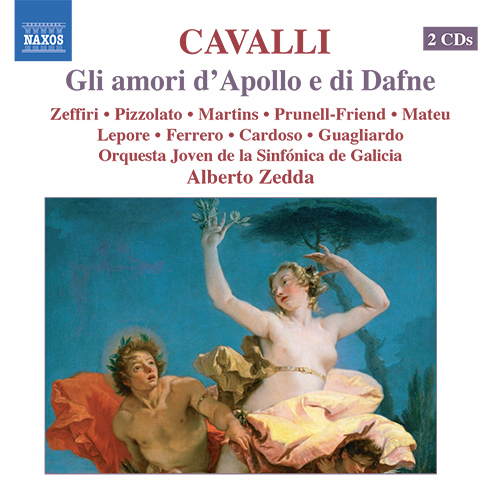
Click here to download the Libretto
- Francesco Cavalli. Opera in a prologue and three acts. 1640.
- Libretto by Giovanni Francesco Busenello.
- First performance at the Teatro S Cassiano, Venice, in 1640.
CHARACTERS
| Prologue: | |
| Sonno (Sleep) | bass |
| Morfeo (Morpheus) | tenor |
| Itaton | mezzo-soprano |
| Panto | bass |
| Opera: | |
| Apollo | tenor |
| Dafne (Daphne) | mezzo-soprano |
| Cefalo (Cephalus) | tenor |
| Aurora (Dawn) | mezzo-soprano |
| Titone (Tithonus) | tenor |
| Giove (Jupiter) | bass |
| Venere (Venus) | mezzo-soprano |
| Amore (Cupid) | soprano |
| Cirilla | tenor |
| Alfesibeo (Alphesiboeus) | bass |
| Filena (Philene) | soprano |
| Procri (Procris) | soprano |
| Peneo (Peneus) | bass |
| Pan | tenor |
| Three Muses | two sopranos & a mezzo-soprano |
| Two Nymphs | soprano & mezzo-soprano |
| Two Shepherds | tenor & bass |
In the Prologue Sonno (Sleep) calls on his ministers, Morpheus, Itaton and Panto, to help in bringing dreams to those who sleep. Tithonus, compelled to perpetual old age, complains of the infidelity of his beloved Aurora (Dawn), summoned by the god of light. The old woman Cirilla, living in happy simplicity, has had a dream of a young girl transformed into a tree. She seeks its meaning from the wise Alphesiboeus, who has had the same dream. Venus complains to Jupiter of Apollo, who had shamed her when he revealed her with Mars to her husband, Hephaestus. Jupiter tells Cupid to use his weapons against Apollo. Daphne is seen living in pastoral delight, rejecting love, in spite of Philene’s urging. Cephalus, husband of the jealous Procris, is in love with Aurora, who has pretended to her husband that she is riding with Apollo in the chariot of the Sun. Procris pleads for the return of Cephalus, lamenting his faithlessness. In the second act Apollo descends into Thessaly, summoning his Muses. Alphesiboeus, meanwhile, has forebodings. Apollo mocks Cupid, whose arrow pierces his heart, as he looks at the nymph Daphne, with whom he is now in love. Aurora bids Cephalus farewell. Daphne rejects Apollo’s advances, and appeals to her father, the river god Peneus. His only remedy is to transform Daphne into a tree, to Apollo’s grief. Apollo appeals to Pan, who advises him to make a garland from the tree, an attempt resented by Daphne, now a laurel tree, who nevertheless relents, adoring at last Apollo, the Sun, who ascends into the heavens.
The second of Cavalli’s operas and his first collaboration with the librettist Busenello, Gli amori d’Apollo e di Dafne has a plot of some complexity in its exploration of the ramifications of classical mythology, gods and mortals. The music reflects Cavalli’s long association with Monteverdi at St Mark’s in Venice, his first operas coinciding with Monteverdi’s last opera, a form that Cavalli continues and extends.
![CAVALLI, P.: Calisto [Opera] (Bandera, Da Ros, Frongia, Sonatori de la Gioiosa Marca, Moretti)](https://cdn.naxos.com/sharedfiles/images/cds/hires/str13606sd.jpg "CAVALLI, P.: Calisto [Opera] (Bandera, Da Ros, Frongia, Sonatori de la Gioiosa Marca, Moretti)")
![CAVALLI, F.: Ercole amante [Opera] (Opéra Comique, 2019) (NTSC)](https://cdn.naxos.com/sharedfiles/images/cds/hires/2.110679-80.jpg "CAVALLI, F.: Ercole amante [Opera] (Opéra Comique, 2019) (NTSC)")
![CAVALLI, F.: Giasone (Il) [Opera] (Sardelli)](https://cdn.naxos.com/sharedfiles/images/cds/hires/cds663.jpg "CAVALLI, F.: Giasone (Il) [Opera] (Sardelli)")