 Click here to download the Libretto
- Umberto Giordano. Dramma istorico in four acts. 1895.
- Libretto by Luigi Illica.
- First performance at the Teatro alla Scala, Milan, on 28th March 1896.
CHARACTERS
| Andrea Chénier, a poet | tenor |
| Carlo Gérard, a servant turned revolutionary | baritone |
| Maddalena de Coigny | soprano |
| La Contessa de Coigny, her mother | mezzo-soprano |
| Bersi, her mulatto maid | mezzo-soprano |
| Madelon, an old woman | mezzo-soprano |
| Roucher, a friend of Chénier | bass |
| Pietro Fléville, a novelist | baritone |
| Fouquier Tinville, public prosecutor | baritone |
| Mathieu, a waiter turned revolutionary | baritone |
| Dumas, president of the tribunal | baritone |
| Schmidt, gaoler at St Lazare prison | baritone |
| Incredibile (Incroyable), an informer | tenor |
| The Abbé, a poet | tenor |
| Major-domo | baritone |
The first act is set in pre-revolutionary France, where Charles Gérard, a servant to the de Coigny family, reveals his contempt for his employers and his love for their daughter. The poet André Chénier is present at a party at the Château Coigny and is induced to recite, at the request of Madeleine de Coigny, but in doing so criticises the injustices of inequality he sees around him. The second act takes place after the revolution has started. Chénier sits in a café, with the servant Bersi at another table, both observed with suspicion by the informer Incroyable. Roucher enters with a passport for Chénier, urging him to escape, but he is both confident and, at the same time, intrigued by letters he has received from a woman, whom he now seeks. She is revealed as Madeleine, also the object of the now revolutionary Gérard’s search. Gérard and Chénier meet and fight. The former falling wounded warns Chénier of his danger but denies knowledge of his assailant when questioned by the police, summoned by Incroyable. Chénier is to be arraigned, and Gérard is persuaded to sign the indictment. Madeleine promises her love to Gérard, if he will intercede for Chénier with the tribunal. He does so, but in vain, and Chénier is condemned to death, joined on the scaffold by Madeleine, who has changed places with a woman prisoner.
Andrea Chénier offers a fictional account of the French poet, who took part in the French Revolution and was later executed. It is an example of Italian verismo, operatic realism, and contains musical allusions to the ancien régime in the first act and to music associated with the revolution in acts. Particularly well known are Chénier’s two arias, the so-called Improvviso di Chénier, his revolutionary song in the first act, and his Come un bel dì di Maggio (As a fine day in May), a poem written in prison. When Madeleine encounters Gérard in the third act her La mamma morta (Mother dead) starts her account of her family’s suffering in the revolution.
![GIORDANO, U.: Andrea Chénier [Opera] (Corelli, Tebaldi, E. Bastianini, Vienna State Opera Chorus and Orchestra, Matačić)](https://cdn.naxos.com/sharedfiles/images/cds/hires/c682062i.jpg "GIORDANO, U.: Andrea Chénier [Opera] (Corelli, Tebaldi, E. Bastianini, Vienna State Opera Chorus and Orchestra, Matačić)")
![GIORDANO, U.: Andrea Chénier [Opera] (La Scala, 2017) (NTSC)](https://cdn.naxos.com/sharedfiles/images/cds/hires/757308.jpg "GIORDANO, U.: Andrea Chénier [Opera] (La Scala, 2017) (NTSC)")
![GIORDANO, U.: Fedora [Opera] (D. Dessì, F. Armiliato, Antoniozzi, D. Kovalenko, Genoa Carlo Felice Theater Chorus and Orchestra, Galli)](https://cdn.naxos.com/sharedfiles/images/cds/hires/cds7772.02.jpg "GIORDANO, U.: Fedora [Opera] (D. Dessì, F. Armiliato, Antoniozzi, D. Kovalenko, Genoa Carlo Felice Theater Chorus and Orchestra, Galli)")
![GIORDANO, U.: Fedora [Opera] (Teatro Carlo Felice, 2015) (NTSC)](https://cdn.naxos.com/sharedfiles/images/cds/hires/dyn-37772.jpg "GIORDANO, U.: Fedora [Opera] (Teatro Carlo Felice, 2015) (NTSC)")
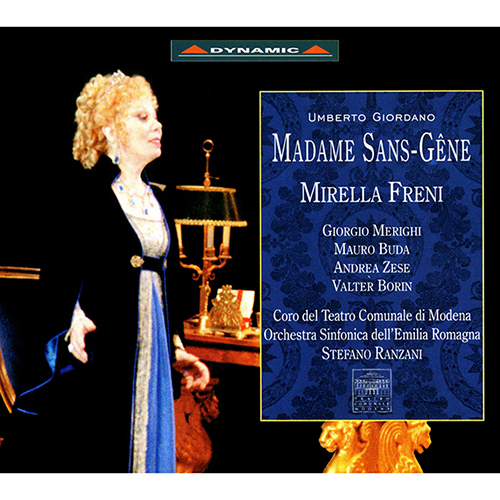
![GIORDANO, U.: Marcella [Opera]](https://cdn.naxos.com/sharedfiles/images/cds/hires/cds573.jpg "GIORDANO, U.: Marcella [Opera]")
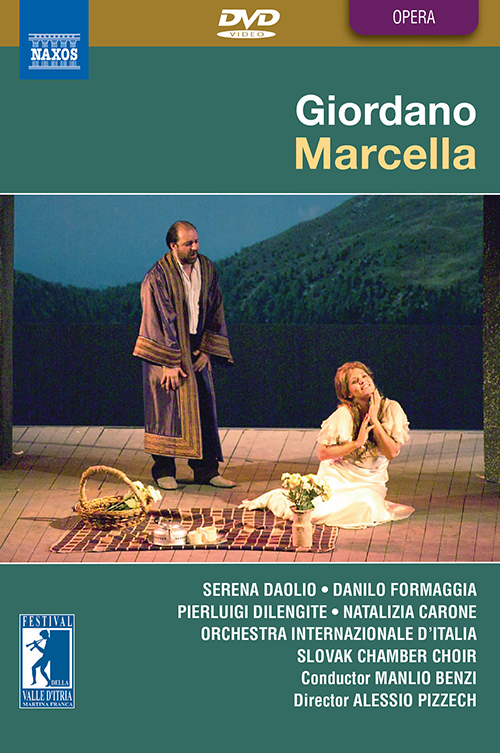
![GIORDANO, U.: Re (Il) [Opera] (Yoshimi Tatsuno, Irina Muratbekova, Masami Fujikawa, Porcelli, Morozov, St. Petersburg Philharmonic, Gorkovenko)](https://cdn.naxos.com/sharedfiles/images/cds/hires/str33466sd.jpg "GIORDANO, U.: Re (Il) [Opera] (Yoshimi Tatsuno, Irina Muratbekova, Masami Fujikawa, Porcelli, Morozov, St. Petersburg Philharmonic, Gorkovenko)")
![GIORDANO, U.: Siberia [Opera] (Festival della Valle d'Itria di Martina Franca, 2003)](https://cdn.naxos.com/sharedfiles/images/cds/hires/cds444.jpg "GIORDANO, U.: Siberia [Opera] (Festival della Valle d'Itria di Martina Franca, 2003)")