
 Translate
































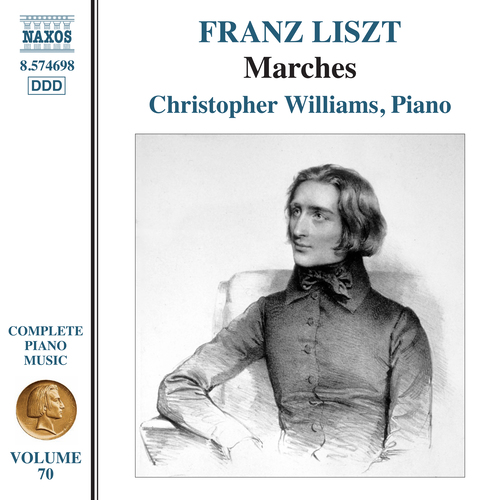

Composer(s): Liszt, Franz
Artist(s): Williams, Christopher
Label: Naxos
Series: Liszt Complete Piano Music
Genre: Instrumental
Period: Romantic
Catalogue No: 8.574698
Barcode: 747313469871
Release Date: 08/2026
 | Loading... |
LISZT, F.: Marches (Liszt Complete Piano Music, Vol. 70) (Christopher Williams)
Franz Liszt’s lifelong engagement with the March is the focus of this volume. The March form offered a medium laden with public meaning allied to the possibility of reinvention and harmonic adventurousness. The symphonic depth of the Goethe-Festmarsch, for example, is elevated far above a mere commemorative work, and the Marche funèbre, composed two days after the death of his father, is a sombre, restrained elegy that foreshadows the austere style of Liszt’s later compositions. Whether exploring stylised folk elements or national pageantry reflecting Hungarian nationhood, the March drew from Liszt bold architectural design, rich harmonies and stirring thematic material.
Tracklist

Liszt, Franz
Williams, Christopher (piano)
|
 |
1 | Festmarsch zur Säcularfeier von Goethes Geburtstag (Goethe-Festmarsch), S521/R48b (2nd version) | 09:47 |
Williams, Christopher (piano)
Williams, Christopher (piano)
|
|
2 | Marche funèbre, S226a | 02:06 |
Williams, Christopher (piano)
Williams, Christopher (piano)
|
|
3 | Seconde marche hongroise (Ungarischer Sturmmarsch), S524/R54b (2nd version) | 05:29 |
Williams, Christopher (piano)
Williams, Christopher (piano)
|
|
4 | Marche hongroise, S233b | 00:56 |
Williams, Christopher (piano)
Williams, Christopher (piano)
|
|
5 | Ungarischer Geschwindmarsch (Magyar Gyors induló), S233/R56 | 03:10 |
Williams, Christopher (piano)
Williams, Christopher (piano)
|
|
6 | Heroischer Marsch im ungarischen Styl, S231/R53 | 06:24 |
Williams, Christopher (piano)
Williams, Christopher (piano)
|
|
7 | Vom Fels zum Meer (Deutscher Siegesmarsch), S229/R50 | 06:38 |
Williams, Christopher (piano)
Williams, Christopher (piano)
|
|
8 | Bülow-Marsch, S230/R52 | 05:35 |
Williams, Christopher (piano)
Williams, Christopher (piano)
|
|
9 | Ungarischer Marsch, S229a | 03:08 |
Williams, Christopher (piano)
Williams, Christopher (piano)
|
|
10 | Siegesmarsch-Marche triomphale, S233a/R56a | 05:03 |
Williams, Christopher (piano)
Williams, Christopher (piano)
|
|
11 | Seconde marche hongroise (Ungarischer Sturmmarsch), S232/R54a (1st version) | 05:50 |
Williams, Christopher (piano)
Williams, Christopher (piano)
|
|
12 | Huldigungs-marsch, S228/R49 (2nd version) | 06:10 |
Williams, Christopher (piano)
Williams, Christopher (piano)
|
|
13 | Ungarischer Marsch zur Krönungsfeier in Ofen-Pest am 8ten Juni 1867, S523/R55 | 04:58 |
Williams, Christopher (piano)
Williams, Christopher (piano)
|
|
14 | Festmarsch zur Säcularfeier von Goethes Geburtstag, S227/R48a (1st version) | 07:27 |
Williams, Christopher (piano)
Total Playing Time: 01:12:41
Loading...