
 Translate
































 | Loading... |
WEBBER, A.: Adjust / THOMSON, K.: Uneasy (Anzû Quartet)
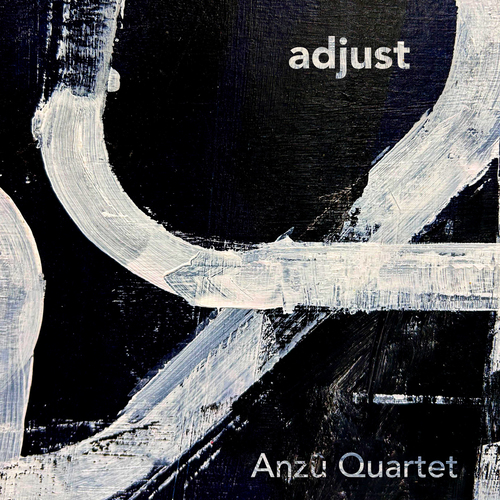
Anzû Quartet: adjust
Karl Larson
A catalyst and a reaction, a stimulus, a response, unease and adjustment. Our entire world follows these patterns, from the chemistry of our beings to the physics of the universe and the patterns of our societies. This album of new works, written for the Anzû Quartet by composers Ken Thomson and Anna Webber, explores these phenomena. Composed between 2017 and 2022 and recorded between 2020 and 2023, the entire creative process behind these pieces occurred during a period of global strife. Thomson’s Uneasy, composed in New York City between 2017 and 2019, reflects an undercurrent of anxiety that rippled through our communities at the end of the decade, a source of unease that, in hindsight, foreshadowed the series of global and local calamities of 2020. Anna Webber’s adjust, composed in 2022, was conceived in a world markedly different from the era that inspired Thomson’s work, despite their chronological proximity. Webber’s adjust can be heard as an examination of the massive societal upheavals of the two years prior and the transformations they engendered. As COVID-19 numbers ebbed, the immediate ramifications of the global pandemic and the surrounding events were in the past, and the world had begun to reemerge as something new. Far from resolved, adjust is inspired by this reconfiguration, exploring our new landscape, the chaos of the adjustment, and the new sense of unease from the process.
Uneasy
A fitting opening work for the Anzû Quartet’s debut album, Ken Thomson’s Uneasy (2017/2019) was the first piece written for the ensemble. True to Thomson’s hallmark style, this three-movement work is an intense, fervent composition with equal rewards and demands for performers and listeners alike. The title, like many of Thomson’s other compositions (Me Vs., Restless, etc.), plays with a double meaning. The emotional content of Uneasy is reflective of its title; often fraught, hectic, or on edge, the music reflects Thomson’s impression of the atmosphere in New York City between 2017 and 2020. The musical content of Uneasy is also befitting of the title – plainly put, the music is not easy, challenging the ensemble at every turn and generating its own unique tension within each performance.
Thomson, also the clarinetist for the Anzû Quartet, is a prolific composer of both jazz and contemporary classical music, though the boundaries between disciplines are rarely explicit. Early in his career, Thomson developed an aggressive, biting style, most exemplified in his saxophone/guitar/bass/drums quartet Gutbucket, who honed their craft during multiple residencies at New York’s legendary Knitting Factory. Entering the scene in the late 90s, an era dominated by the downtown experimental jazz community in NYC, Thomson’s work from this era reveals an early penchant for the postmodern. In his work with Gutbucket and other musicians, Thomson began blending sounds from seemingly disparate artists from Charles Mingus to Deerhoof to Ivo Papasov, combining a strong basis in the jazz canon with influences from the contemporary punk scene including the underground band World/Inferno Friendship Society, with whom he also toured.
During this fertile era for avant-garde jazz, the NYC new music community was going through a similar punk-influenced revolution. By 2000, Michael Gordon, Julia Wolfe, and David Lang of Bang on a Can had already introduced rock, jazz, funk, and experimental pop influences into the classical contemporary mainstream, which in turn fostered a rich period of experimentation and crossover works from smaller groups across the community. Thomson, who has been affiliated with Bang on a Can since the early 2000s, quickly began to exhibit this influence in his own music. Initially consisting of broadstroked juxtaposition of style and instrumentation (Gutbucket’s rendition of Messiaen’s “Danse de la fureur, pour les sept trompettes” from the Quatuor pour la fin du temps comes to mind), Thomson has spent the past decades cultivating a unique style that pays unmistakable homage to his jazz and contemporary classical roots while remaining singular to his own voice.
Composed nearly two decades after Gutbucket’s debut in the late 90s, Uneasy is exemplary of Thomson’s fully developed musical language. Along with the aforementioned Me Vs. (2012) and Restless (2014), Uneasy is the culmination of a rich, virtuosic triptych. These two earlier works share both style and personnel with Uneasy; Me Vs. (solo piano) and Restless (cello and piano) were composed for and recorded by Karl Larson (piano) and Ashley Bathgate (cello), and can be heard on our UFFDA Records/Cantaloupe Music 2016 release, Restless. Thomson’s jazz influence remains on full display in Uneasy, particularly in the bop-esque lines passed throughout the ensemble in the first movement, and the unmistakable staggering rhythmic patterns present in all of Thomson’s jazz records. The form and scope of this music, however, is significantly broader and more fluid than Thomson’s earlier works. In Uneasy, Thomson embraces a longer form more reminiscent of a quasi Sonata-Fantasia than the angular, quick shifting music of his early career. “It’s not a punk thing anymore,” Thomson acknowledges. On a macro level, each movement of Uneasy is a series of long, extended gestures, sometimes crashing into one another, sometimes ebbing into a near stasis before growing once again.
adjust
Anna Webber places her work within the overlapping spaces between avant-garde jazz and new classical music. Acclaimed for her work as a composer, improviser, and multi-instrumentalist by colleagues and critics alike, Webber is well known for her work with her own bands (Simple Trio, Shimmer Wince, and the Webber Morris Big Band), as well as collaborations with a long list of master jazz musicians, including Roscoe Mitchell and John Hollenbeck.
Anna Webber’s adjust, composed for the Anzû Quartet in 2022, is a five-movement work reacting to themes of artistic and musical identity and the thawing of the COVID-19 pandemic, which was in the midst of a regression during the composition of this work. Described by Webber as a suite-like series of related musical ideas heard through a variety of compositional lenses, she describes adjust as “musical material that is sonically or harmonically connected, but with different treatments and contextualization.”
While her music has routinely exhibited the sensibilities and aesthetics of modern classical music, adjust represents new territory for Webber. Though she routinely works with musicians from both experimental jazz and contemporary classical backgrounds, adjust is Webber’s first composition with such a stark delineation between composer and performer. “This may be the first piece that I’m not writing for myself to play in, or at least actively participate in after the writing is finished,” says Webber. “From a compositional perspective, a lot of it felt similar to how I would approach writing for my own groups, but the fact that I’m not there when it’s being performed or put together is new for me.”
Improvisation and individual agency amongst the performers is an integral element in adjust, and one of many devices Webber employs to varying degrees. Throughout the piece, there are multiple sections of music that allow the performers a certain amount of freedom in decision making. The most common instance, occurring in movements 1, 3, and 5, is the use of a ‘range clef,’ in which gestures are written with specific rhythms but no pitches. While the general shape of the gesture is visually outlined by floating noteheads (ascending vs. descending shapes), the performer is free to choose his or her specific pitches. Further freedom for the performer is introduced in the third movement, which, in addition to the ‘range clef,’ includes several sections in which Webber requires individual performers to blend “primary material” and “secondary material.” During the “primary material” sections, performers are instructed to “improvise polyrhythmic pushing and pulling with these [written] lines, starting together but otherwise not synchronized.” After a specified duration of time, the performers are then instructed to begin interpolating the “secondary material” into the primary material at will, disrupting the established texture. Lastly, the most conventional use of improvisation in adjust occurs during the extended clarinet solo in the fourth movement, during which Webber instructs Ken Thomson to “improvise freely” over the gently repetitive chords traded between the violin, cello, and piano.
Throughout adjust’s five movements, Webber takes the music to a variety of extremes. At times, these contrasts are explicit, nearly crashing into one another (i.e. the abrupt shifts between the chaotic, polyrhythmic gestures and unison rhythms in the first and fifth movements), while other instances display slow, almost imperceptible shifts (i.e. the glacial growth across the entire third movement). These musical twists and turns are often heightened by a unique approach to texture. Webber employs a variety of instrument preparations and extended techniques, adding another layer of sonic dimension and enhancing the varying degrees of tension within the music. From standard techniques such as multiphonics in the clarinet or scratch tones in the strings to more novel approaches like a clothespin affixed to the violin’s G-string or “a narrow ‘boat’ fashioned out of tinfoil… filled with approximately 15 coins of various sizes” placed on the piano’s lowest strings, Webber employs these textural affectations to heighten drama and atmosphere throughout adjust.
Much like the title of Thomson’s work, Webber’s title harbors a double meaning, simultaneously encompassing an emotion much of the world was collectively experiencing along with a more introspective statement about her own work. adjust was composed in 2022, and while we were still grappling with a global pandemic, case numbers were dropping and the world was beginning to open up to a new, “post-COVID” reality. Webber remembers this feeling during her composition process: “One of the things I was thinking of during that time was coming out of COVID and what the new reality is – we were returning to normalcy, but it’s a different kind of normalcy.” Webber’s title also reflects the new nature of this piece from her perspective as an artist – the adjustments required of her as she composed in this new way, and the adjustments required of the Anzû Quartet as we interact with her musical language.
Tracklist

|
 |
1 | I. — | 05:58 |
|
|
2 | II. — | 06:29 |
|
|
3 | III. — | 06:19 |
|
|
4 | I. — | 02:52 |
|
|
5 | II. — | 03:58 |
|
|
6 | III. — | 05:35 |
|
|
7 | IV. — | 07:03 |
|
|
8 | V. — | 02:39 |
Loading...