
 Translate
































 | Loading... |
MUSSORGSKY: Pictures at an Exhibition / St. John's Night on Bald Mountain
Composer’s Note
by Daniel Hass
These two quartets were written in the summer of 2021. There was a pandemic going on, and I spent most of the summer in my apartment, reading books and feeling the momentum of life melting away in the heat.
Early that summer, I read Haruki Murakami’s first novel, “Hear the Wind Sing,” and in the introduction he tells an anecdote from a baseball game:
”In the bottom of the first inning, Hilton slammed Sotokoba’s first pitch into the left field for a clean double. The satisfying crack when the bat met the ball resounded throughout Jingu Stadium. Scattered applause rose around me and in that instant, for no reason and based on no grounds whatsoever, it suddenly struck me: I think I can write a novel.”
This story had an effect on me similar to the crack of the bat, as I’d never written concert music but had always wanted to.
My only idea of how to start composing was to improvise at the piano. There are parts of the piano quartet that are direct transcriptions of these sessions, such as the cadenza-like development section of the first movement. But even the most structured-sounding passages began as improvisations before being arranged into an almost naively typical sonata structure. The piano quartet, while clearly an “early” piece, introduced me to my own language, and got me addicted to composing.
I started writing Love and Levity, my first string quartet, immediately after finishing the piano quartet. The Renaissance Quartet wasn’t even really a thing yet, but I knew who I was writing it for. I consider the piece to be, at its core, Beethovenian: in its thematic and structural tautness, but even more so in its motion towards excess–staying on an idea for too long, playing something too fast or too slow, too quiet or too loud. The title came from this anachronistic romanticism, this desire to talk about big feelings, but always with a bit of humor, always a bit weird.
Jazz and contemporary songwriting are as important to this music as the classical tradition. The scherzo movement, “Hermit’s Waltz,” is a jazz piece, complete with a transcription of an actual solo taken by guitarist Jacob Drab. The outer movements feature chords, melodies, and instrumental techniques taken from American folk musics such as rock, bluegrass, and the blues. These musics are not only emblems of New York, the city I call home, but contain the DNA of virtually all contemporary music. I leave it to you to discover what any of that means, and how it all came out.
I want to thank my quartet mates, as well as Valerie, Brian, and Han, for making this music so much better than it is on the page.
Program Notes
by Lev Mamuya
What does it sound like when an artistic polyglot finds their unified voice? What characterizes music borne from deep love, friendship, and collaborative understanding? What are the sounds, themes, and aesthetics of those composers adding themselves to the canon of American concert music in 2025?
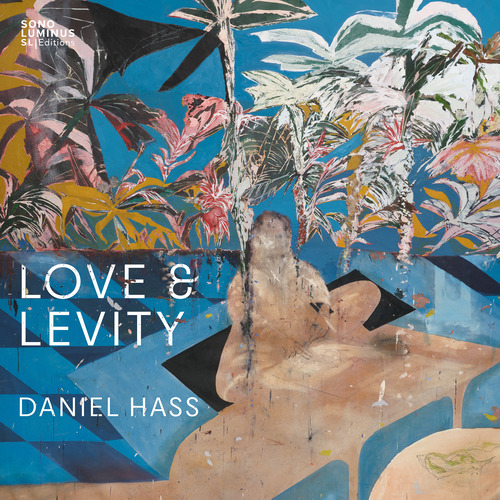
These are some of the questions answered across “Love and Levity,” the first album of original concert music from composer and cellist Daniel Hass. Comprised of two chamber works, ”Love and Levity” marks the addition of a new voice to a vanguard of American composers operating at the intersection of genres, vernaculars, and traditions.
Hass’ sound was forged in New York, where he has studied and lived for over a decade. A fixture of the city’s classical, jazz, rock, and literary scenes, Hass appears uptown, downtown, and around the fringes–as a sought-after classical cellist and consummate studio musician for ambitious contemporary jazz and indie rock alike. Daniel’s musical sensibilities are deeply rooted in diverse influences, drawing inspiration from legends like Jimi Hendrix and Steve Reich to contemporary talents XXYYXX and Paul Wiancko.
His concert music is a product of this experience–it is planted firmly in the tradition of the composers which grounded his early musical education, but casts its gaze outward.Crucial to the realization of this sound are his longtime friends and collaborators in the Renaissance String Quartet–violinists Randall Goosby and Jeremiah Blacklow, and violist Jameel Martin. Friends since childhood summers spent together at the Perlman Music Program, they’ve been forged in similar crucibles of influence. In many ways, this music is for them–Hass’ chosen family could not be better poised to comprehend, plumb, and highlight the nuances of his unique voice. Violinist Valerie Kim, violist Brian Hong, and pianist Han Chen bring similar expertise to his Piano Quartet.
Love and Levity, Hass’ first string quartet, unfolds across a four-movement sonata structure. The Impressionistic harmonies of the first movement’s Adagio introduction bloom irrepressibly in shades which range from modal consonance to the chromaticism of neo-soul. The opening movement’s oscillating motoric textures recur with a broader, jauntier sensibility in “Hermit’s Waltz,” and with asynchronous solemnity which occasionally punctuates the “Largo.” In the finale, grooves both contrapuntal and unified undergird solo lines tailored to each ensemble member’s sensibility.
The Piano Quartet shares with the string quartet a commitment to drive, but prioritizes edge and dissonance over ebullience. The first movement’s Bartokian harmonic tensions give way to the full-throated agita of the second movement–the strings erupt into overpressure to match the piano’s cacophony in the sections which frame the movement’s dreamlike midsection. Even the slow movement’s newfound placidity is drawn back towards a more strained keening through groaning microtonal utterances in moments of emotional heat. Hass waits until the piece’s final movement to resolve this tension–the quietly uncanny aspect of the piano’s opening scales is transformed into something more assured as the strings take over the figures and urge the piece towards its declamatory conclusion.
Tracklist

|
 |
1 | I. Love | 11:31 |
|
|
2 | II. Hermit's Waltz | 04:19 |
|
|
3 | III. Largo | 07:40 |
|
|
4 | IV. Levity | 09:22 |
Hong, Brian (viola)
Hass, Daniel (cello)
Chen, Han (piano)
|
|
5 | I. Allegro moderato | 09:34 |
Hong, Brian (viola)
Hass, Daniel (cello)
Chen, Han (piano)
|
|
6 | II. Con fuoco | 05:42 |
Hong, Brian (viola)
Hass, Daniel (cello)
Chen, Han (piano)
|
|
7 | III. Rubato - Con moto | 08:02 |
Hong, Brian (viola)
Hass, Daniel (cello)
Chen, Han (piano)
|
|
8 | IV. Allegro leggiero | 06:06 |
Hong, Brian (viola)
Hass, Daniel (cello)
Chen, Han (piano)
Loading...