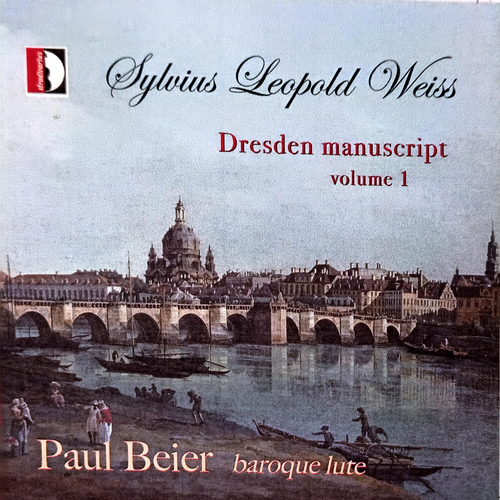
Sylvius Leopold Weiss was born in the then-Bohemian province of Silesia (now in Poland) in 1687. Growing up, Weiss was greatly influenced by Losy, and this influence is clearly reflected in his early compositions. Following his Italian sojourn (1710–14), Weiss became deeply involved with the Prague musical scene. According to numerous documents, he spent considerable time there even after being invited by Augustus the Strong on the 23rd of August 1718 to become an Electoral Saxon and Royal Polish Chamber Musician at his court in Dresden. Between 1717 and 1724, Weiss collaborated with Prague lute maker Thomas Edlinger to enhance the standard 11-course instrument by adding two bass courses to extend its range. Together, they devised an innovative design that expanded the lute’s capabilities, resulting in a unique instrument. This is the kind of lute used for this recording, embodying the craftsmanship and innovation of its creators. It’s worth noting that the lutes were traditionally strung with gut rather than metal, as is often the case today, and this recording continues this tradition.
The Dresden manuscript features several of Weiss’s best-known works, also found in other manuscripts, alongside a selection of expansive sonatas composed later in his life that are exclusive to this source. While some of these sonatas are handwritten by Weiss himself, the majority were likely copied by Friedrich Wilhelm Raschke, the Saxon minister for war. According to Crawford, Raschke ‘seems to have gained access to what must have been Weiss’s personal archive of music.’

 Translate