
 Translate

































 | Loading... |
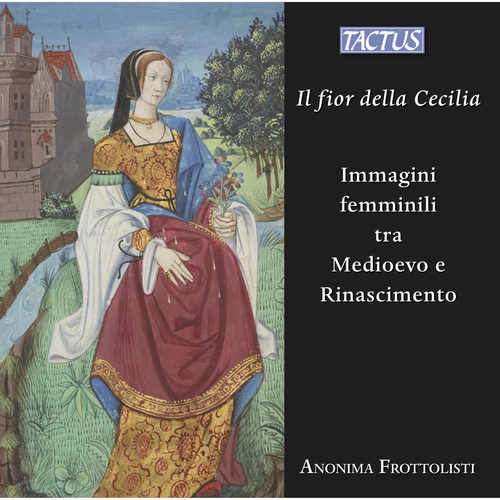
FIOR DELLA CECILIA (IL) - Immagini femminili tra Medioevo e Rinascimento (Anonima Frottolisti)
The production by the ensemble Anonima Frottolisti, which by now needs no introduction thanks to its specialization in the interpretation of medieval and Renaissance music, focuses in this work on the theme of the female figure as it has been handed down to us from the late fifteenth century. La Cecilia represents a story of life that is entirely feminine: “lament and pity, despair, the condition of women and their redemption,” jealousy, the renunciation of nobles and knights in defense of one’s love and dignity, and the “Comedy”–that is, the representation that dramatically depicts reality.
The song has very ancient roots in Western music, from the earliest monodic forms of the 15th century in France, where the protagonist is Pernette–also present in Italy in the Aosta Valley tradition at the end of the 19th century–or in the case of Jeannette, still used in children’s stories in French-speaking areas; or in the 15th-century example La belle se sied by Guillaume Dufay and the three-voice version by Josquin Desprez; or in the narrative song from the oral tradition of the “three sisters/ladies who come from Liun”; as well as in the sacred realm, influencing the composition of the Missa la Belle se sied in the Trent Codex 1377, or the Missa La Belle se sied composed by Mambriano de Orto and printed by Petrucci in 1505.
The disruptive force of this tradition–that is, the branches that radiated from it starting from the European Middle Ages–remains evident and inherent in every musical and literary domain.
Tracklist

Traditional - Lyricist
|
 |
1 | Ne pleure pas Janette | 01:19 |
|
|
2 | Franchoise nouvelle [Bibliothèque Royale Albert I, MS 9085, f. 22v, Bruxelles] | 03:44 |
|
|
3 | La Pernette se lève | 01:22 |
|
|
4 | La belle se siet au pied de la tour | 04:20 |
|
|
5 | Belreguardo [Libro dell'arte del danzare, MS Capponiani 203] | 03:11 |
|
|
6 | Missa La belle se siet: Kyrie [Trento Castello del Buon Consiglio, MS 1377, olim Trento 90, f 447v-456r] | 03:32 |
|
|
7 | A Franceschina | 02:17 |
|
|
8 | Filles a marier ne vous mariez ja | 02:18 |
Maganza, Giovanni Battista - Author
Rustichello, Bartolomeo - Author
|
|
9 | La Quarta parte delle rime alla rustica | 00:38 |
|
|
10 | La bella Franceschina | 02:54 |
|
|
11 | Poi chel ciel e la fortuna [Frottole Libro VII, Venezia, 1507] | 03:34 |
|
|
12 | Ruzante | 01:14 |
|
|
13 | Rosina | 02:07 |
|
|
14 | Quando lo pomo [Apografo Miscellaneo Marciano, Venezia] | 03:01 |
|
|
15 | Mon mary m'a diffamée | 03:24 |
|
|
16 | La pastorella [Bayerische Staatsbibliothek, MS 1503, Munich] | 02:30 |
Piccioni, Luca (lute)
|
|
17 | Non peccando altri che il core | 02:44 |
Piccioni, Luca (lute)
|
|
18 | Vale diva, vale in pace | 04:38 |
|
|
19 | Danza [MS 757, Verona] | 02:05 |
|
|
20 | Trista che spera | 02:54 |
|
|
21 | La Cecilia [Umbria, Italy] | 01:48 |
Loading...