
 Translate
































 | Loading... |
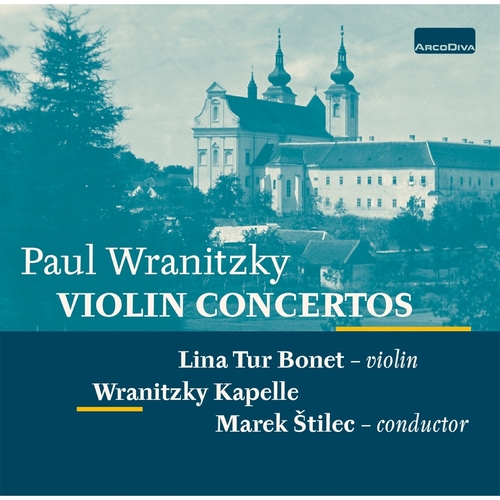
WRANITZKY, P.: Violin Concertos (Bonet, Wranitzky Kapelle, Štilec)
Paul Wranitzky – a Moravian in Vienna
Paul Wranitzky (1756–1808) was born in Nová Říše, Moravia, into a middle-class family of landowning innkeepers. The family must have been musically inclined as his younger half-brother, Anton Wranitzky (1761–1820) also became a noted composer and violinist. Both brothers received their first formal music instructions at the local Premonstratensian Monastery (in the hall of which some 250 years later this CD was recorded).In 1776, after studies in Jihlava and Olomouc, Wranitzky moved to Vienna and enrolled at the theological seminary of the university. He quickly became involved in Vienna’s busy musical scene, soon becoming music director of the seminary and getting a reputation as an excellent violinist. It was during this time Wranitzky made his first forays into composition, producing a large number of canons and part-songs for the student circles.Wranitzky eventually abandoned any plans on a church career, and in 1783 he became music director to count Johann Baptist Esterházy of Galantha. The count, a distant relative to Haydn’s employer, was a talented amateur oboist – and a freemason. Upon the count’s suggestion Wranitzky joined the Viennese Masonic Lodge Zur gekrönten Hoffnung. At the lodge he met the visiting Swedish kapellmeister, Joseph Martin Kraus (1756–1792). Kraus, the same age as Wranitzky but already a well-established composer, recognized his new friend’s talents for composition and offered encouragement and possibly some lessons.The lodge had an active musical life for which Wranitzky composed masonic songs as well as symphonies. In 1785, when three lodges merged, Wranitzky became masonic brothers with Mozart. Wranitzky became orchestra director at the Kärntnertortheater in 1785, and in 1787 also at the Burgtheater. He would keep the position of first orchestra director for both court theatres until his death. In 1789 Wranitzky’s first opera Oberon, premiered to great success. In 1794 Wranitzky became secretary of the Tonkünstler-Societät, the musician’s society. He quickly resolved an old dispute regarding Haydn’s membership application and welcomed Vienna’s most famous composer into the society. As a sign of gratitude, Haydn insisted that Wranitzky would lead the orchestra in the society’s fund-raising performances of The Creation. Beethoven also admired Wranitzky’s skill as an orchestra leader and requested Wranitzky to direct the premiere of his First Symphony.When Wranitzky died in 1808, Vienna lost one of its most central musical profiles. Despite the popularity and quality of his composition, his legacy was soon overshadowed by that of his friends Mozart, Haydn and Beethoven. In the realm of purely instrumental genres, Paul Wranitzky primarily directed his attention towards Symphonies and chamber music for various string ensembles. Nonetheless, Wranitzky authored at least twelve concertos, some of which, regrettably, appear to be lost in the present day. Aside from the three works that were published – the flute concerto op. 24, the cello concerto op. 27, and the concertante for flute and oboe, op. 39 – Wranitzky’s concertante compositions were not widely circulated and now survive solely in a few manuscript copies. Five works for violin survive today: four complete violin concertos, and a fragment of an early concertante for two violins (1782). While no composition date is known for the violin concertos, the works in C, F, and G are clearly earlier works (1780s), and the one in D a later essay in the genre (early 1790s?). The three earlier concertos presented on this CD are all similar in scope and conception and are, in addition to the solo violin, scored for oboes, horns, and strings.
Violin Concerto in F major
The Violin Concerto in F major survives as a set of parts in the music collection of the Lobkowicz family, as well as copy in Brno. The opening Allegro begins softly, like a serenade, with a melody in the first violins supported by staccato chords in the orchestra. The energy then quickly intensifies with tremolos and syncopated rhythms, building momentum toward the soloist’s entrance. After a lyrical treatment of the main thematic material, the solo part explores the violin’s full range throughout the movement, from its lowest G to the highest notes on the E string. Dispensing with the winds, the central Adagio recalls the serenade-like opening of the first movement, allowing the soloist’s delicate filigree lines to be accompanied solely by the strings.The Finale, a lively rondo with a contradance flavor, brings the concerto to a cheerful and satisfying close as the soloist dances through various violin figurations and techniques.
Violin Concerto in G major
Like the preceding work, The Violin Concerto in G major also survives in copies in the Lobkowicz music archive and in Brno. After the extended opening tutti of the Allegro, the soloist enters with an embellished version of the primary theme, unexpectedly coming to a halt on a fermata the end of the phrase. A restatement of the opening phrase leads into some passagework before the piece again halts on a fermata. Picking up with the secondary theme, Wranitzky then lets the movement flow mostly uninterrupted. At the end, there is a traditional buildup toward a cadenza for the soloist; however, Wranitzky cheekily opts to omit it.The central Adagio is a relaxed and lyrical serenade in ternary form with a contrasting Minore middle section.Rounding off the concerto, the perky final Rondeau, marked Allegro, explores various soloistic techniques, such as double stops and arpeggios.
Violin Concerto in C major
The Violin Concerto in C major survives in the music collection of Ferdinand III of Tuscany. During his exile in Vienna due to the Napoleonic wars, the Grand Duke frequently employed Wranitzky as a composer and performer. Once again, Wranitzky begins the opening Allegro moderato quietly with the strings alone, soon joined by the winds amid upwardly rushing scales.
Again, Wranitzky starts off the opening Allegro moderato quietly with the strings alone before the winds soon joins in amid upwards rushing scales. Throughout the movement, the soloist has ample opportunity to showcase both lyrical expression and technical prowess, exploring the violin’s full register through rapid figurations and wide leaps.A stark unisono statement by string alone opens the Adagio, Wranitzky’s only known concerto movement in a minor key. Its plaintive character vividly reflects Christian Schubart’s description of the affective key characteristics of C minor in Ideen zu einer Aesthetik der Tonkunst (1806): 'A declaration of love, and at the same time, the lament of unrequited love. All the languishing, longing, and sighing of the love-sick soul lies in this key.’Dispelling any lingering sadness, the final Rondeau unfolds as an infectiously lively Gigue, brimming with grace and sunshine.
Adagio from Symphony in C, P. 9
Symphonies appear to have held particular significance for Wranitzky, who composed them throughout his career. With 45 surviving works, he ranks among his era’s more prolific composers. Uniquely among these works, the Poco Adagio slow movement of the early Symphony in C (Poštolka 9) includes a concertante violin part. Unfortunately, the only known manuscript, today at the Austrian National Library in Vienna, lacks the second violin and viola parts. However, an anonymous violin and piano arrangement also survives for most of the work, enabling a reasonably accurate reconstruction of the reconstruction of the missing string parts.
Tracklist

Wranitzky Kapelle (Ensemble)
Štilec, Marek (Conductor)
|
 |
1 | I. Allegro moderato | 10:32 |
Wranitzky Kapelle (Ensemble)
Štilec, Marek (Conductor)
|
|
2 | II. Adagio | 07:04 |
Wranitzky Kapelle (Ensemble)
Štilec, Marek (Conductor)
|
|
3 | III. Finale | 06:13 |
Wranitzky Kapelle (Ensemble)
Štilec, Marek (Conductor)
Wranitzky Kapelle (Ensemble)
Štilec, Marek (Conductor)
|
|
4 | I. Allegro | 10:30 |
Wranitzky Kapelle (Ensemble)
Štilec, Marek (Conductor)
|
|
5 | II. Adagio | 04:55 |
Wranitzky Kapelle (Ensemble)
Štilec, Marek (Conductor)
|
|
6 | III. Rondeau: Allegro | 05:21 |
Wranitzky Kapelle (Ensemble)
Štilec, Marek (Conductor)
Wranitzky Kapelle (Ensemble)
Štilec, Marek (Conductor)
|
|
7 | I. Allegro moderato | 09:19 |
Wranitzky Kapelle (Ensemble)
Štilec, Marek (Conductor)
|
|
8 | II. Adagio | 07:02 |
Wranitzky Kapelle (Ensemble)
Štilec, Marek (Conductor)
|
|
9 | III. Rondeau | 04:39 |
Wranitzky Kapelle (Ensemble)
Štilec, Marek (Conductor)
Wranitzky Kapelle (Ensemble)
Štilec, Marek (Conductor)
|
|
10 | Symphony in C Major: Poco adagio | 04:47 |
Wranitzky Kapelle (Ensemble)
Štilec, Marek (Conductor)
Loading...