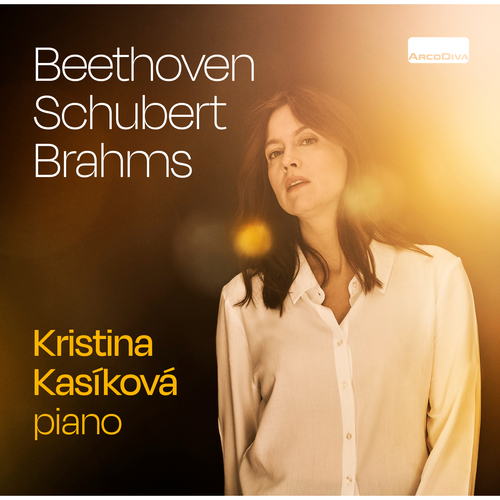
The realm of German Romantic piano music has always held a special fascination for me. Perhaps it is because the very first piano piece I ever heard was Schubert’s Impromptu in A-flat major, Op. 90. My mother used to play it, and I remember vividly how, in my early childhood, I was captivated by the union of that enchanting music and the image of her seated at the piano, her hair illuminated by the sunlight streaming in from the window. It was at that moment that a world opened up to me–a world that has often seemed more profound than reality itself, for it can reveal the mysteries hidden within the human soul and at the same time ennoble them through beauty. This union of beauty and wisdom–this capacity to look deeply within oneself and discover truths about life, expressed with a gentleness rooted in true humanity–is what I value so deeply in Beethoven, Schubert, and Brahms. Engaging with the works of the great composers of the past feels as though a bridge stretches across time, allowing one to meet them in profoundly intimate conversations, to follow their thoughts, and to experience their emotions. In their hands, music becomes a material so malleable that the deepest states of the soul are reflected with extraordinary precision, including all their ambiguities–and we are limited only by the sensitivity and talent we ourselves bring to them. Every performer who devotes long periods of life to a particular repertoire forms a genuinely intimate bond with its creators, as though they were personal friends, because they have lived through so much together. At the same time, there is a longing to share these experiences with others. This was one of the principal reasons for creating this recording, and it is my sincere hope that it will bring listeners moments that are equally profound and enriching. All the pieces I have chosen for this recording belong to the late works of their composers. They represent a certain looking back over life, or they are marked by an intuited nearness of death, and are characterized by a high degree of subjectivity. For the performer, they offer an exhilarating world, for their secrets are inexhaustible. Much can certainly be said about them from an objective standpoint, but since such information is readily available elsewhere today, I have decided instead to share some of my own thoughts, images, and feelings that shaped my interpretation.
Ludwig van Beethoven’s Sonata in A-flat major, Op. 110 possesses a unique form shaped by the narrative it conveys. It is the story of Beethoven’s own life–his struggles, his suffering, and his triumphs. Yet its message may extend far beyond the personal; it can be understood as “the story of the human condition.” I often find myself contemplating parallels with the life of Christ.The first movement, marked Sanft con amabilità, reflects the mystical power of love–a force that not only gives rise to life itself but nourishes every act of creation. For me, its cascading arpeggios evoke snow falling softly from the sky, bringing a quiet and shimmering blessing to a newly born hope.The Scherzo expresses the struggle with the external world, revealing Beethoven’s combative, defiant, revolutionary spirit. Yet at the end, it unexpectedly dissolves into a noble transcendence of conflict.The Third movement speaks of an inner battle–of deep suffering, of the effort to reconcile oneself with the wounds of fate, and of the necessity of sacrifice. Redemption emerges through creative work, driven by titanic willpower. The movement encompasses wisdom shared by contemplative spirits across cultures: that the greatest peaks may be followed by the deepest falls, and that victory may be born from the abyss. The final transcendence, symbolized by the second fugue descending like divine grace, embodies Beethoven’s lifelong motto: Per aspera ad astra–through suffering to the star
Franz Schubert composed his Impromptus, Op. 90 only a year before his premature death. His imagination is lighter and more spontaneous than Beethoven’s or Brahms’s, yet these works seem overshadowed by an awareness of mortality. Even in their sunlit passages, sudden chills flicker–smiles through tears, longing touched by the knowledge of the unattainable. The first Impromptu in C minor is the most serious, openly reflecting the theme of death. The impersonal order of existence collides with the vulnerable individual, escalating into terror reminiscent of Schubert’s Erlkönig. Yet the ending brings acceptance and trust. The second Impromptu in E-flat major evokes a carefree summer’s day that slowly darkens until a storm breaks. In the coda it becomes a whirlwind that sweeps everything away. The third Impromptu is its poetic counterweight–a meditation on love, suffused with tenderness, melancholy, and the soft glow of G-flat major. The fourth, in A-flat major, mirrors the second: instead of a darkening summer, it is a winter’s day that gradually dreams of spring. Its despairing middle section yields to affirming, jubilant chords at the end.
Johannes Brahms’s Op. 117 consists of three intermezzi he called “the lullabies of my sorrow.” Formally simple yet expressively the darkest, they stand close to late Romantic pessimism. If they were to bear titles, I would call them Birth – Love – Death. The first intermezzo is a lullaby whose tenderness is overshadowed by hardship; yet it ends with the triumph of maternal love. The second, in B minor, is turbulent and restless, tossed by grief and longing. Brief moments of warmth appear, but it closes with a bitter sense of irretrievable loss. The third, in C-sharp minor, breathes desolation. Its heavy-hearted melody never takes flight. I imagine the slow sway of a horse carrying its rider through a spectral landscape toward the gates of death. No reconciliation comes at the end–the protagonist is overcome by tragic ruin and sorrow.
Acknowledgements
I would like to express my heartfelt gratitude to all who contributed to the creation of this recording–through their work, advice, or encouragement–and above all to my family and friends.
Kristina Kasíková began her musical studies at the Elementary School of Arts in Opava, first in the class of Dana Pešková and later with Mgr. Oriana Šenfeldová. She graduated from the Janáček Conservatory in Ostrava, where she studied with Mgr. Monika Tugendliebová, and from the Academy of Performing Arts in Prague under the guidance of Prof. Ivan Klánský.
She is a laureate of the international piano competition Beethoven’s Hradec. In addition to performing throughout the Czech Republic, she has appeared in France, Spain, Germany, Switzerland, Austria, Latvia, the United States, and China.An important part of her artistic activity is chamber music, particularly her piano duo with her husband, Martin Kasík. Together they recorded a critically acclaimed CD of Antonín Dvořák’s Slavonic Dances.
Since 2005, she has been a faculty member at the Jaroslav Ježek Conservatory in Prague.

 Translate