
 Translate





























 | Loading... |
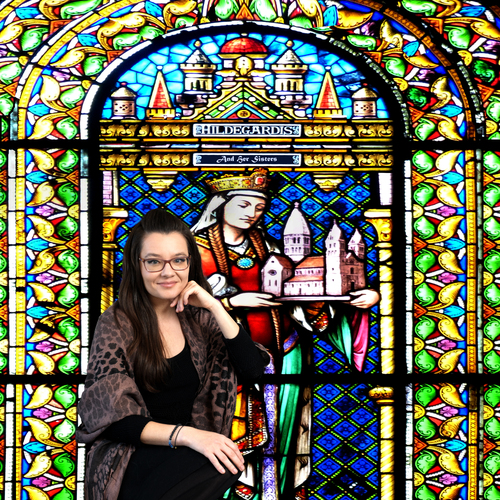
Piano Recital: Bouska, Katelyn - HILDEGARD OF BINGEN / BEACH, A. / SCHOENTAL, R. / VORLOVÁ, S. (Hildegard and Her Sisters)
Liner Notes:
Hildegard And Her Sisters, Katelyn Bouska, piano
After our first success with Women and War and Peace, Katelyn Bouska put a big smile on my face when she mentioned a second project she wanted to do with Yarlung Records. Kate can play any genre, and we discussed an album celebrating the great composer, mystic, poet, philosopher, scientist, rabble-rouser and visionary abbess Hildegard von Bingen. Hildegard is the first composer for whom we have a definite name in the European canon. She was born in 1098 and died in 1179 at 81 years of age. I was even more enthusiastic when we discussed that Kate and Yarlung would commission new music for the project in Hildegard’s honor. To help place Hildegard in wider European history, she was born a mere 32 years after the Battle of Hastings, 47 years before the start of construction of Chartres Cathedral, and Henry IV was Emperor of the Holy Roman Empire after inheriting Charlemagne’s throne in Aachen.
Kate wanted to return to Samueli Theater at Segerstrom Center for the Arts where we made our first recording together. Aaron Egigian was able to secure dates over Easter Weekend, March 29th, 30th and 31st, 2024, when the concert hall, Kate and our team were available. My fellow recording engineer Arian Jansen and I set up for the recording before Kate arrived, and while I do not believe in frequent divine intervention for such things, we asked Hildegard to “bless the more than 50 vacuum tubes” that we would need to be working perfectly for the recording. With or without Hildegard’s intercession, all vacuum tubes worked beautifully for the duration without hiss, pop or crackle.
Because Hildegard is best known for her vocal music, we decided to record this album as if Kate’s piano were a full choir, stretching from far left to far right in the soundstage. Thanks to the superb acoustics in Samueli Theater, you may hear ambience and extreme high and low notes on Kate’s keyboard expanding outside your speakers in your listening room. Unconventional as this may be for a solo piano recording, this was intentional such that the listener can experience more of the sound Kate enjoyed sitting at the piano, as if our ears are Kate’s ears while she plays.
To celebrate Hildegard’s relevance today, Yarlung commissioned four new pieces for this project, three composed by Kate herself responding to Hildegard’s music directly, and one work from Maya Miro Johnson, responding to the larger vision of the Night Journey so important in our interpretation of Hildegard’s transcendent and transformative thinking. Kate expanded further on this theme, envisioning the entire album as a journey through the Dark Night of the Soul, opening with Amy Beach’s Hermit Thrush at Eve and ending with Beach’s Hermit Thrush at Morn. Yes, this would be a little too much “on the nose,” except for the extreme beauty of Amy’s writing for the piano, and the underrepresentation of this repertoire in the libraries of contemporary recordings.
After Amy’s opening piece signifying the beginning of the night follows Kate’s composition inspired by Hildegard’s O vis aeternitatis, which comments on the nature of reality as envisioned before Time and the creation of the universe. Clearly this is not going to be a Night Journey for the faint hearted.
After envisioning the cosmos, Kate yanks us back to reality on earth with Maya Miro Johnson’s bruises paraphrase, which took inspiration from and expanded upon Maya’s piano concerto yellow, green and purple, which Kate premiered in early 2023 in Philadelphia. Please see Kate’s comments about this work below. Kate returns to her own composition and reimagining of Hildegard’s O quam mirabilis est after the last notes (bruises, perhaps) fade from Maya’s writing low on the keyboard. Kate’s homage to Hildegard’s antiphon for the creator returns to Hildegard’s idea before Time that the creator of the universe knew and loved creation even before inspiring it with life or breathing it (and us) into life with pneuma, the spirit and breath of creation. O quam mirabilis est explores and takes heart in the idea that human beings somehow encompass and mirror the entire plan of creation. This interlude proves reassuring after Maya’s journey through misery, healing and redemption.
Next Kate returns to our beloved Ruth Schönthal (whom we met in Women and War and Peace) with Ruth’s Canticles of Hieronymus, which describe the famous triptych by Hieronymus Bosch titled “The Garden of Earthly Delights.” The three wooden panels are on exhibit at Museo del Prado in Madrid. Not only is this painting a personal favorite of Kate’s but the topic offers a bridge between the natural and the spiritual worlds explored in this album. In the middle of Ruth’s Canticles, and also intentionally in almost the exact center of the music on this album, Ruth gives us my favorite melody in the recording, which Kate describes as “a melody of absolute simplicity and poignancy that seems the turning point of the ‘Dark Night of Soul.’ This melody weaves and morphs in hypnotic weaving.”
After that follows Kate’s final Hildegard commission, Karitas habundat, a psalm which reminds us that underpinning everything in the universe is love, a love perhaps of a slightly broader nature than so graphically represented in Bosch’s 15th Century “Garden of Earthly Delights.” This enormous contrast continues in The Power of Light, or Sila světla in Czech, by the 20th Century composer Sláva Vorlová who wrote this transcendent work as part of her recovery after watching her husband shot by the Gestapo. Vorlová succeeds, somehow, miraculously, in clinging to light and hope despite extreme pain. Kate helps us perceive brilliant waves of light scattering through the piano, somehow a new dawn despite disaster, presaging the first rays of sunshine returning to the world in Amy’s Hermit Thrush at Morn. The Dark Night of the Soul is over, at least for a few daylight hours, and we have survived our journey with Kate’s unerring guidance. I think I may start using “Virgil” as Kate’s nickname, or at least thinking of Kate as an excellent guide worthy of Virgil, as she and her music at the keyboard help us navigate turbulent times.
As Yarlung fans know, we record complete takes of movements and don’t like to surgically correct or “improve” the music created by our artists. Kate thrives with this approach, challenging as it might be. I greatly appreciate her achievements; we recorded each movement in one unedited take.
Kate and I want to thank our friend Douglas Sietsema and V-Square® Photography for his help and superb eye in this project. Doug used a Hasselblad 503CX camera, lenses ranging from 40 to 250mm and a CFV 100C digital back to capture Kate at Samueli Theater and afterward in Doug’s studio in Laguna Niguel, California. You can view more of Doug’s work at vsquarephotography.com
Kate joins us in thanking our executive producer Randy Bellous. We also greatly appreciate album underwriters Aaron Egigian, Chip and Sharyn Moore, Bobbie Fleming and Paule Marx. You are terrific friends and visionaries and we are grateful to you for making this great music available to the public. Kate and I owe additional thanks to new music titans Raulee Marcus and Don Pattison for underwriting Maya Miro Johnson’s commission, and to Stratton-Petit Foundation for enabling us to commission our three Hildegard pieces from Kate.
Fellow recording engineer and equipment designer Arian Jansen and I used SonoruS Holographic Imaging technology in the analog domain to refine the stereo image, Yarlung’s SonoruS ATR12 to record Agfa-formula 468 analog tape, the Merging Technologies HAPI to record 256fs DSD in stereo and surround sound and the SonoruS ADC to record PCM. We used our friend Ted Ancona’s AKG C24 microphone previously owned by Frank Sinatra, and Yarlung Audio vacuum tube microphone amplification designed and built for us by Elliot Midwood. It is always a pleasure to record in Samueli Theater at Segerstrom Center for the Arts in Costa Mesa, with beautiful and adjustable natural acoustics which enable us to capture our musicians’ brilliance just as they create it. Many thanks to our friends Casey Reitz and Aaron Egigian at Segerstrom Center for enabling us to work in this space. When you play this album, you can hear what Kate and Arian and I heard in the hall during our recording sessions. We “mix and master” using microphone placement and hall adjustments. This means that no post production is necessary in a concert hall this beautiful when working with musicians and friends of this caliber.
Thank you!
--Bob Attiyeh, producer
Notes on the Album –-Kate Bouska:
I began teaching music history at Philadelphia’s Curtis Institute in the autumn of 2023. I had taught a variety of music history seminars throughout my eight years at Curtis, but this was different; this course is required for all incoming first-year students. In developing these lectures I remembered my own first music history course as a student, a life-changing event that transferred my latent passion for archaeology into music research, “uncovering and preserving bones,” so to speak.
One of these “bones” revealing past civilizations in the realm of music for me is Hildegard’s O ecclesiasia, about Ursula, martyred in Cologne. Whether I return to this music academically or for personal enjoyment, I feel Hildegard’s inspiration without fail. When in one of my “Hildegard reveries,” I feel utterly and delicious alone, surrounded by waves of resonance. In a conversation, Bob Attiyeh had suggested I spend some more time with Hildegard’s music and see what might transpire for a future concert program and possible recording project. As the winter break began, I was in a particularly sensitive musical frame of mind, open and prepared to explore. I spent the next semester teaching and re-discovering this ancient yet familiar world from a professor’s stand point, enjoying the process as my students experienced it for themselves, sometimes for the first time.
But on December 21st, 2023, this particular music took on different meaning for me. Breaking news revealed there was an active shooter at the Filosofická fakulta at Univerzita Karlova, the Faculty of Arts at Charles University in Prague where I have spent a great deal of time. I immediately reached out to friends and colleagues who were gathering with music students for a Christmas celebration. Most reassured me they were okay, but Lenka Hlávková, renowned specialist in 15th-century polyphony serving as Director of the Institute of Musicology. My heart broke when I heard my friend and colleague had been killed and darkness enveloped me. Somehow, Hildegard and her music came to my rescue, providing a refuge for me during this period of mourning. Prior Hildegard melodies that had lifted me up and sent me soaring became a lifeline. As I grappled consciously and unconsciously with this tragic event, missing Lenka and trying to find a way out of the darkness, traveling through my own Dark Night of the Soul, the trajectory of this album took shape. Hildegard “blessed” me in much more important ways than she “blessed” the vacuum tubes for this recording, but I am grateful for that kindness too. Hildegard’s music led me on a path of recovery and held my hand as I stumbled. She felt like a sister to me, not an 12th Century legend, and I will always be grateful.
Hildegard was equally at home in the realm of the spirit as she was in the earthier matters of the body and the natural world. Despite her role in the church, Germany credits Hildegard as the founder of natural science. And her interests were broad. Hildegard writes for the first time in history about the use of hops to brew and preserve beer… talk about the way into a German’s heart (or a Czech’s!)…. But Hildegard was equally groundbreaking as a composer. Hildegard’s contemporaries tended to set random texts to music and sign them “Anonymous.” Instead, Hildegard wrote her own texts and set them soaring to music that pushed the limits of Gregorian chant. Instead of creating more of the standard improvised chant, without rhythm, she used recurring motifs that held the listener’s attention, and created strong feelings of form and shape in the music. As a result, more music by Hildegard survives than music written by any other composer in the Middle Ages.
Blessed with an unusually long life by medieval standards, she also wrote extensively on diseases and their cures. In her nine books, Physicae, Hildegard focused on the practical applications of herbs and other medicines. Causaue et Curie contain, as the name would suggest, nearly 300 hundred chapters on the causes and cures of known medieval diseases. And in her spare time, Hildegard created a language too, perhaps connected with her mystical experiences of The Divine. She called it Lingua ignota, a hidden language or a secret language, such that it reminds some people of Tolkien’s development of languages such as Quenya and Sindarin, or more recent experiments with Esperanto. As with Esperanto, some scholars believe Hildegard was hoping to develop a universal language. Lingua ignota takes inspiration from Latin of course, but also from Middle High German.
With great pleasure, and to fulfill my Yarlung commission underwritten by Stratton-Petit, I selected three chants from Hildegard’s Symphonia armonie celestium revelationum (“Symphony of the Harmony of Heavenly Revelations”). This is the main collection of her works, including 77 chants and one musical drama. As her life drew to a close, Hildegard oversaw the collection and copying of this official canon. O ecclesiasia, which I mentioned earlier, is part of this breathtaking collection.
I felt like I should compose with quill and velum, but before sitting down with pen and paper, I spent time with the three texts by themselves, trying hard not to hear Hildegard’s magical melodies. After considering the texts carefully over many weeks, I began singing Hildegard’s melodies to myself, walking along the Delaware River or sitting under my favorite tree in Rittenhouse Square. I was careful to sing these melodies the way I imagined Hildegard would have heard them, before more “modern” musicians developed such a strong sense of rhythm and motoric drive, both of which were alien to Hildegard’s ear. The new pieces, inspired so strongly by Hildegard, began to take shape.
In O vis aeternitatis (The Power Within Eternity), Hildegard conjures a dark swatch of distant blue in my mind. I felt the large dark soaring pillars of the cathedrals and the play of the various light beams through stained glass. And Amy Beach and her beloved thrush lingered in my ear, connecting the natural world I know so well with Hildegard’s perception of The Divine. O quam mirabilis est (How wonderful it is) proved the simplest of the three melodies, in C Major, which is the most primal of keys for me on the piano. I wanted the simple sweetness of plucked string to fill in the spaces around me, reducing the percussiveness of the instrument to help create simple awe and appreciation of the goodness and prescience around us. In Karitas habundat in omnia (Divine Love overflows into everything), the pure fifths and the golden hue of its central pitch (re), I wanted to sustain Hildegard’s expression of sweetness and stability.
Renowned for her visions throughout Hildegard’s life, she termed these visions Umbra viventis lucis, or the reflection (or shade) of the living light. Late in her life, Hildegard included in a letter to her secretary Guibert of Gembloux, “From my early childhood… I have always seen this vision in my soul…. In this vision, my soul, as God would have it, rises up high into the vault of heaven and into the changing sky and spreads itself out among different peoples…. And because I see them this way in my soul, I observe them in accord with the shifting of clouds and other created things. I do not hear them with my outward ears, nor do I perceive them by the thoughts of my own heart or by any combination of my five senses, but in my soul alone, while my outward eyes are open. So I have never fallen prey to ecstasy in the visions, but I see them wide awake, day and night…. The light which I see thus is not spatial, but it is far, far brighter than a cloud which carries the sun. I can measure neither height, nor length, nor breadth in it; and I call it “the reflection of the Living Light.” And as the sun, the moon, and the stars appear in water, so writings, sermons, virtues, and certain human actions take form for me and gleam.” Thank you Hildegard, for sharing your gleam so powerfully with us 840 years later.
Amy Marcy Cheney Beach (1867–1944)
Picture New England in 1874. The then 7-year-old Amy March Cheney is preparing her first public recital, playing Beethoven, Chopin and several of her own compositions. Remarkable as this may have been for the outside world, Amy’s tight-knit community knew she has been composing for three years already, and had been singing in harmony with her mother since the age of 2. Amy married the conservative and restrictive Dr. Henry Beach when she was 18. Her husband “allowed” Amy to compose, but perform only rarely. Amy did not give up music, studying Bach’s fugues and creating the first English translations of seminal orchestration texts by Gavaert and Berlioz. By the age of 27, she became the first American woman to write a symphony, premiered by the Boston Symphony just two years later.
When her husband died in 1910, the 44-year-old composer and pianist left for Europe where she played to great acclaim. Ferdinand Pohl, writing for Hamburger Nachrichten in 1913 declared “we have before us undeniably a possessor of musical gifts of the highest kind; a musical nature touched with genius.” The onset of World War I sent her eventually back to New York where she devoted significant time to supporting music education. “Beach Clubs” popped up throughout the United States educating young people in music. She also served as leader for many organizations including the Society of American Women Composers. Amy’s long career, support of young composers, strong humanity, sharp intellect, discipline and drive changed the course of American music. Amy grew up within the conservative dictates of her era, but like Hildegard, Amy resisted the domination of the predominately male culture and its expectations. Amy’s humanity draws me to her music as much as her representation of nature in her writing. She was not the first to be entranced by the song of the hermit thrush. Walt Whitman termed the hermit thrush the symbol of the American spirit. Remarkably, it turn turns out that the hermit thrush tends to sing in whole steps and half steps, mirroring the mathematical ratios of traditional western harmony instead of the micro-tones sung by most other birds.
Maya Miro Johnson (2001– )
I am grateful to Raulee and Don for underwriting Yarlung’s commission of bruises paraphrase. People often mention that pianists are solitary. They comment on the hours one must spend alone with one’s instrument but I have never felt alone at the piano. These hours are rich with interaction, spent in dialogue (in fact or in my mind) with the composer. The notes on the page spring into three-dimensional time. Best of all is the intensified richness working with a vibrant living composer like Maya with whom one can also talk in person or on the phone as one grapples with a musical idea.
When Maya first asked me to collaborate with her on an “anti-concerto” I knew it would be groundbreaking and I thought often about how Hildegard expanded her musical universe by breaking boundaries so many years earlier. Maya’s atypical use of instrumental forces intrigued me as much as her use of new technology. In our case, we used Steinway’s Spirio piano (a sophisticated “player piano”) for the live performance. Working together week-by-week over drafts, I watched a deeply evocative composition emerge, drawn from Maya’s life. The concerto is titled yellow, green, and purple.
The first movement, yellow, features orchestra only. Musicians begin without instruments, exhaling together in long, unfulfilled breaths before gradually growing into sound. yellow symbolizes the color of bruises during the final stage of healing from a blow (10–14 days).
The second movement, green, pairs orchestra with the mechanical relentlessness of the Spirio. The musical material was first recorded by me, then expanded into chords and textures beyond human ability to play (imagine the force of an 88-key cluster as all keys are rapidly depressed). Green bruises are in their middle healing stage, 5–10 days after an initial wound.
The final movement, purple, is the freshest color of the bruise appearing in the first day. The orchestra sits silent. The soloist begins to play, projected on a screen behind the Spirio. The audience cranes to hear, but the soloist plays in silence. The only sound is the interspersed fragmented outcries of the Spirio material leftover from the middle movement. The healing process is completed and the audience is left in a perfect circle, drawn back into itself. yellow, green, and purple is an anti-concerto, indeed.
After we premiered this concerto in January of 2023, the piece has gone through several metamorphoses. This new commission, bruises paraphrase, is a fresh solo piano version which takes inspiration from the full-length concerto. The anti-concerto elements, with its machine-like brutality, breathing orchestra, and silent soloist are condensed into a single-movement.
Maya wrote, “Ultimately, invisible wounds are the hardest to heal because they are the least likely to be believed. We invented machines to try to capture and record these inner traumas, manifesting them as scratches on the surface of time itself…. The machine at the center of this piece, like Mary Shelley’s Frankenstein, is monstrous but deeply sympathetic. Absence is at the center of this work, but not necessarily loss, just as a bruised mind is not by default a broken one.”
Ruth Schönthal (1924–2006)
Ruth Schönthal described her music as “a mirror held up to a world full of complex human emotions.” What attracted me to her initially was the musical tapestry of her life in her auto-biographical work, Fragments from a Woman’s Diary which I recorded with Yarlung in our album Women and War and Peace. Ruth weaves an entirely different fantasy in Canticles of Hieronymus, which transports the listener as deeply and eerily as its late 15th century namesake series of three paintings by Hieronymous Bosch (c. 1450–1516).
Like Amy Beach, Ruth was a child prodigy and became the youngest student accepted to the Stern'sches Konservatorium in Berlin. Given the Nazi regime and Ruth’s Jewish heritage, she and her family fled for Stockholm. Ruth continued her studies in Sweden and published her first sonatina. Once again they had to flee, this time through the Soviet Union and Japan to Mexico City. Visiting composer Paul Hindemith heard the 19-year-old Ruth perform her own piano concerto in Mexico and arranged for her to study at Yale, after which Ruth made her permanent home in the United States.
We know little about Bosch and we know even less about his mesmerizing 15th-century triptych. Perhaps its enduring magic is this elusive mystery. Scholars are not sure whether it was intended as spiritual work for a monastery or as a satirical commission by a lay patron. I had the fortune to see this painting in person in 2022 but it had been living in my imagination for quite some time. In Ruth’s work, we are able to hear the unlikely shapes and capricious figures traipse across the musical painting.
Sláva Vorlová (1897–1973)
The earlier women composers included in this project all enjoyed significant influence during their lifetimes, but, as often happens, fell into greater obscurity after their deaths. Music by Amy Beach and Hildegard von Bingen has enjoyed renewed attention in recent years and happily, it seems now to be Sláva’s turn.
I discovered Sláva Vorlová first in Lenka’s classroom at Charles University. After my own lecture on Marie Szymanowska, I stayed to listen to a student’s presentation on Vorlová. Intrigued, I went to the library to study her manuscripts. I discovered a woman of imagination, strength, and sensitive musical skill. Sláva’s mother was a skilled singer and pianist and her father founded a community orchestra in Náchod, their hometown in the Hradec Králové region of what is now the Czech Republic. Her early education took her to Vienna for vocal studies and to Prague, where she pivoted toward piano and composition with Vítězslav Novák.
As with Amy Beach just a few decades before, Sláva left her musical career when she married. However, also like Beach, she was able to resume her musical life in later years. After returning to music and studying with Jaroslav Řídky, her first published works appeared in quick succession: Songs (op. 2 and 3), a String Quartet (op. 5), a Fantasy for Cello and Orchestra (op. 6). This burst of creativity was shattered by tragedy. On May 8, 1945, the day following the Nazi surrender, the Gestapo murdered her husband in front of Sláva. She credits her survival to her connection with music. She wrote Síla světla (The Power of Light) in 1949. In solitude and stillness, we see a composer turning inward in a balance of intricate pianism and evocative harmonies. With simple arpeggiated chords punctuating the main beats, she divides the measures into stable pillars. Incisive dotted rhythms, typical of the Czech language, evoke the static nature of seclusion. And then, suddenly, bright flashes of light dance across the keyboard in rapid arpeggios. With the power of this compressed energy, the final measures erupt from D-Flat Major into a glorious and slightly shocking D Major with its radiant F sharps. The sun in its full golden splendor has risen after a horrendous night.
--Kate Bouska
August, 2024
Track timing page: Hildegard and Her Sisters
1 Hermit Thrush At Eve Amy Beach
5:12
2 O vis aeternitatis Hildegard von Bingen and Katelyn Bouska 11:06
3 bruises paraphrase Maya Miro Johnson 5:08
4 O quam mirabilis est Hildegard von Bingen and Katelyn Bouska 3:47
5 Canticles of Hieronymus Ruth Schönthal 17:47
6 Karitas habundat Hildegard von Bingen and Katelyn Bouska 3:41
7 Síla světla Sláva Vorlová 4:37
8 Hermit Thrush At Morn Amy Beach 4:49
Tracklist

|
 |
1 | Hermit Thrush at Eve, Op. 92, No. 1 | 05:08 |
|
|
2 | O vis aeternitatis (arr. for piano) | 05:12 |
|
|
3 | bruises paraphrase | 11:06 |
|
|
4 | O quam mirabilis est (arr. for piano) | 03:47 |
|
|
5 | Canticles of Hieronymus | 17:47 |
|
|
6 | Karitas habundat (arr. for piano) | 03:41 |
|
|
7 | Sila svetla (The Power of Light) | 04:37 |
|
|
8 | Hermit Thrush at Morn, Op. 92, No. 2 | 04:49 |
Loading...