
Brahms’ Complete Songs
Early exuberance to mature melancholy
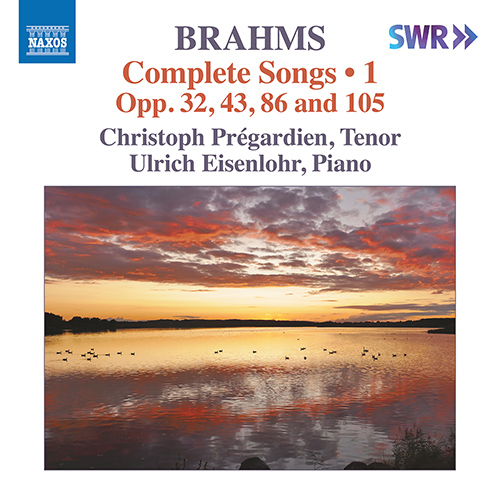

Complete Songs, Vol. 1
Opp. 32, 43, 86 and 105
This first volume of Brahms’ complete songs spans a period of nearly 25 years. A prolific composer of Lieder, Brahms’ adherence to traditional form was accompanied by a modern approach to compositional style. Thematically, most songs explore ideas of love, loneliness and solitude, perfectly exemplified by the Vier Gesänge, Op. 43. In a similar way the Sechs Lieder, Op. 86 share a common theme of a farewell to life. This volume contains some of his greatest songs, including Die Mainacht, as well as little-known jewels such as Versunken.
‘Prégardien’s warm and sweet sound, his pristine diction, and his sensitive shaping of phrases make this an album to savor. He is an intelligent singer who brings out the best in each song. Eisenlohr has established himself securely as one of the finest collaborative pianists for lieder.’
– American Record Guide
‘Tenor Christoph Prégardien gives an intelligent and perfectly weighted performance with pianist Ulrich Eisenlohr.’
– The Guardian ★★★★★






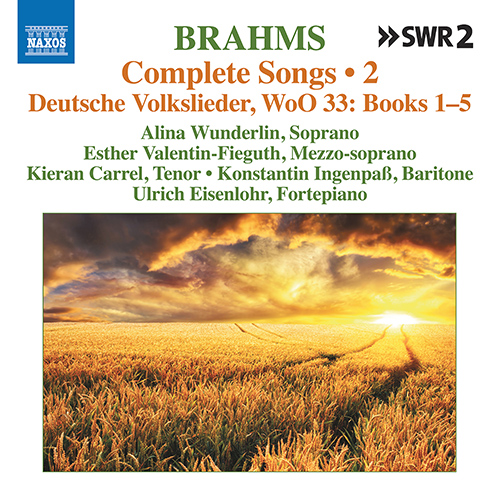
Complete Songs, Vol. 2
Deutsche Volkslieder, WoO 33: Books 1–5
Brahms was opposed to the Lied cultivated by the ‘New German’ circle of composers around Franz Liszt who developed it into a highly artificial art form. In the books of the 49 Deutsche Volkslieder Brahms discovered a repository of dialogue songs, narrative ballads, laments, and songs of disputation and love, some tragic, others comic, that appealed to his need for authenticity. The book from which he sourced the songs had a printed text and melody, so Brahms’ artistic contribution lay in his richly varied piano accompaniments which subtly comment, heighten, inflect or expand on the texts.
‘Eisenlohr’s singers – Alina Wunderlin, Esther Valentin-Fieguth, and Konstantin Ingenpaß – give us all the beauty of sound one could hope for, as well as (one guesses) deep sincerity and unaffected delivery. Tenor Kieran Carrel also has a beautiful voice… the results are winning.’
– Fanfare
‘Eisenlohr…demonstrates his excellence as a lieder collaborator. His care with details holds your attention as he distills the variety Brahms creates for each strophe, subtly altering the tone or mood of each, often with ingenious harmonizations.’
– American Record Guide
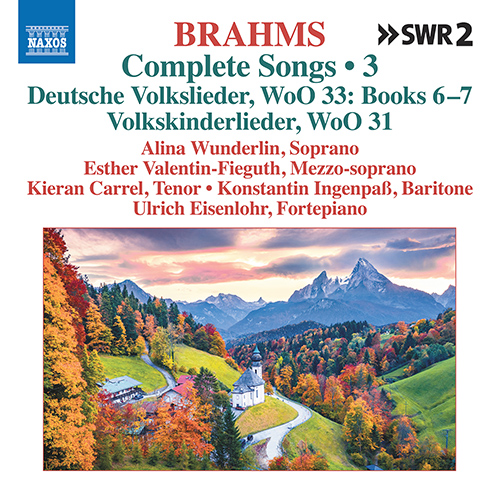
Complete Songs, Vol. 3
Deutsche Volkslieder, WoO 33: Books 6–7
Volkskinderlieder, WoO 31
For Brahms, folk songs were sources of musical inspiration, not subjects for academic study. The songs from Books 6 and 7 of the Deutsche Volkslieder exemplify how Brahms’ distinctive and expressive accompaniments brought unique qualities to these songs, how he intensified certain verses to draw out their power, or allowed the piano its own revealing melodic phrases. In Book 7 the songs are divided between a lead singer and a chorus, adding fresh musical possibilities. In the Volkskinderlieder (‘Children’s Folk Songs’) Brahms’ economy and deftness turn lullabies into works of art.
‘Alina Wunderlin is a wonderfully pure-voiced soprano, as we hear in “Es steht ein Lind in jenem Tal”… All in all, this is wonderful. The singers are superbly chosen and perfect for this repertoire. Eisenlohr does not put a finger wrong (he provides the fine booklet notes, too), and the recording is good, too.’
– Classical Explorer
Playing Time: 57:51
Price Code: NXP
Release Date: 1 Dec 2023

‘Discovering Johannes Brahms as a young man marked the inception of his illustrious career as a composer. His early compositions, such as his first Lieder opera, resonated with a delightful blend of joy, freshness, and light. While some of these early works may exude a certain naivety in both expression and execution, they consistently bear a deeply personal and straightforward quality. The sheer delight I found in exploring this early phase of Brahms' work was immeasurable.
Witnessing Brahms’ evolution as a composer was a remarkable journey. My heartfelt gratitude extends to the exceptional talents of my dedicated singers, Alina Wunderlin and Kieran Carrel. Collaborating with them in the creation, performance, and recording of Brahms’ enchanting music was an unadulterated pleasure.’
– Ulrich Eisenlohr
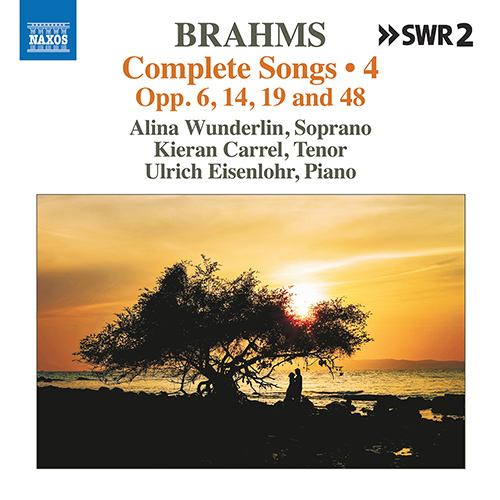
Complete Songs, Vol. 4
Opp. 6, 14, 19 and 48
Brahms’ early songs express an exuberance that may surprise those who are unfamiliar with this element of his music making. The Op. 6 set includes a Mediterranean-flavoured song in bolero rhythm and songs of hope and joy, displaying an apparent simplicity that was hard-won and the product of constant refinement. Based on folk songs, the Op. 14 collection is astonishingly varied, ranging from folk melodies to medieval harmonies and Baroque-styled richness. Elsewhere Brahms charts more melodious, elegiac settings in the Op. 19 set and confronts melancholy and loss in Op. 48.
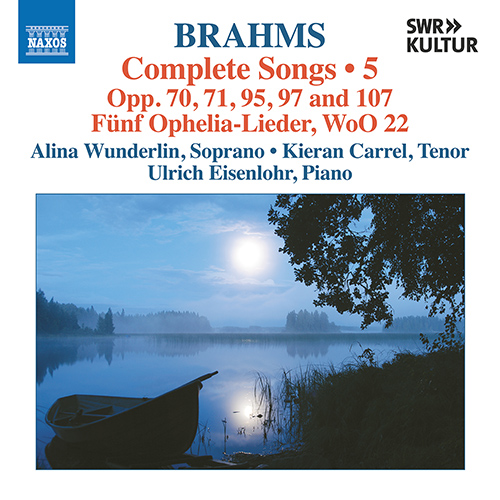
Complete Songs, Vol. 5
Opp. 70, 71, 95, 97 and 107
Fünf Ophelia-Lieder, WoO 22
In grouping his Lieder into sets with opus numbers, Brahms was concerned with thematic unity and poetic contrasts. The theme of Op. 71 is love, whether ardent, ironic or courtly, and contains one of his best-loved songs, Minnelied. In Op. 70 the connections are more subtle: past, present and future create the thematic framework. The serenity of Op. 95 is heightened through the use of Serbian folk songs, and for the Op. 107 set Brahms once again illuminates love in all its intensity and humour.
Playing Time: 68:32
Price Code: NXP
Release Date: 6 Dec 2024
Complete Songs, Vol. 6
Opp. 28, 58, 69 and 72
Brahms’ lifelong preoccupation with the solo voice can be heard to great effect in this sixth volume of his complete songs. The ghostly and dreamlike opening of the Four Duets, Op. 28 and moods of desolation and loss in the Nine Songs, Op. 69 are linked by the unusually disparate subjects in each set, while the playful spirit of southern Italy and Spain forms part of Op. 58. The programme ends with great musical beauty, depth, and even touches of crude humour in Five Songs, Op. 72.