
 Translate






























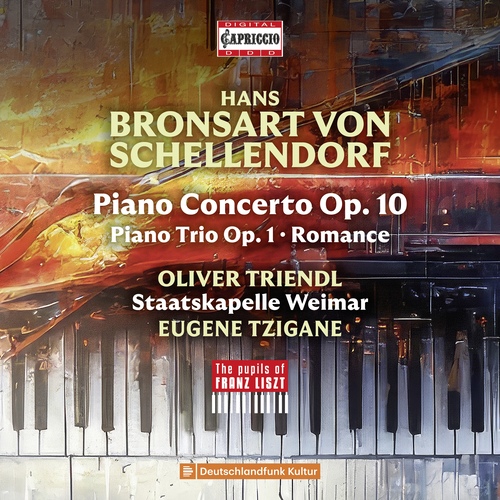

Hans BRONSART VON SCHELLENDORF (1830–1913)
Piano Concerto Op. 10
Piano Trio Op. 1 • Romance
Oliver TriendlStaatskapelle Weimar
Eugene Tzigane
It’s only recently that Bronsart von Schellendorf’s career as a composer has been more widely acknowledged. Liszt, however, was aware of Bronsart’s prowess, referring to his orchestral work Frühlings-Fantasie as ‘beautiful and invaluable’ and later declaring ‘I value him as a character and a musician.’ The Piano Concerto Op. 10 reveals ambitious dimensions and an extrovert musical language, while Bronsart’s piano writing gives ample opportunity for virtuoso display while delivering musical arguments with power and precision. Bronsart’s friend Hans von Bülow began touring the work in 1870, taking the concerto abroad and performing it at a concert in Manchester under the baton of Charles Hallé in 1877, by which time the work had secured a foothold in the repertory, albeit temporary.
II. Adagio ma non troppo
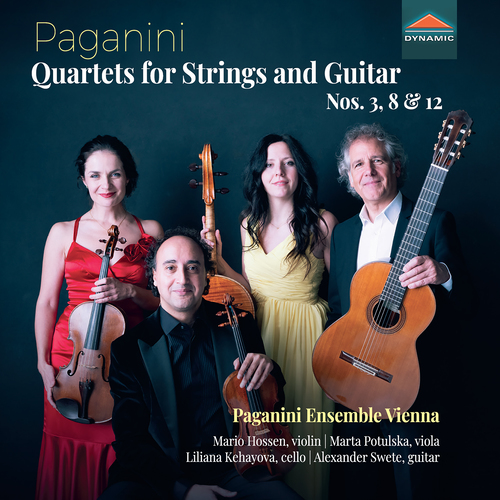

Nicolò PAGANINI (1782–1840)
Quartets for Strings and Guitar
Nos. 3, 8 & 12
Paganini Ensemble ViennaMario Hossen • Marta Potulska
Liliana Kehayova • Alexander Swete
Only six of Paganini’s fifteen quartets for violin, viola, guitar and cello were published during his lifetime, yet they represent his finest body of chamber works. Of the three quartets that comprise his Op. 4 set, No. 3 is a masterpiece, with French-style inspiration, rich lyricism and piquant invention. The virtuosic, almost concerto-like No. 8 embodies Paganini’s quatuor brillant writing, with its Rossinian resonances, while No. 12 is the most ‘symphonic’ of the three, containing formal originality, one of the composer’s most affecting slow movements, and his most serious-minded finale.
III. Minuetto: Allegretto mosso
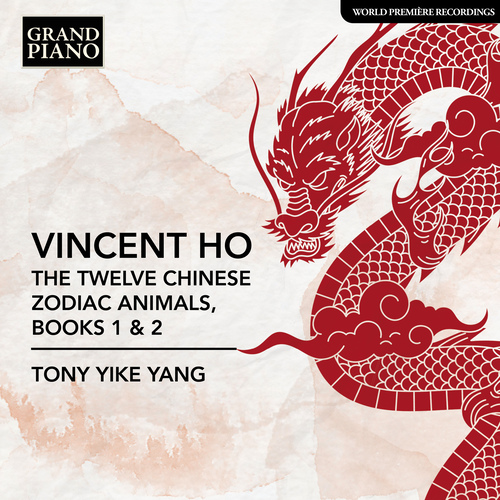
The music of multi-award-winning composer Vincent Ho has been described by The New York Times as ‘brilliant and compelling’, not least for its beauty and expressive breadth. Ho wrote The Twelve Chinese Zodiac Animals as a gift for his eight-year-old daughter, to enrich her musical education as a piano student and to introduce her to Chinese cultural themes and performance practices in pianistic form. The cycle presents the spirits of the animals with captivating musical caricatures in two books, the second of which is a selection of preludes and fugues for more advanced players. They are performed by Tony Yike Yang, one of Canada’s finest young pianists and the youngest laureate in the history of the International Chopin Piano Competition in Warsaw.
No. 10. Rollicking Rooster: Fugue


Richard STRAUSS (1864–1949)
Eine Alpensinfonie
Vier Lieder, Op. 27
Louise AlderFinnish Radio Symphony Orchestra
Nicholas Collon
Ondine’s award-winning recordings by the Finnish Radio Symphony Orchestra under their chief conductor Nicholas Collon continue with an album of two works by Richard Strauss. The first is Strauss’s longest and final major orchestral work, An Alpine Symphony, that requires at least 125 players, the largest ensemble in Strauss’s entire output. Unusual instruments include heckelphone, Wagner tubas, organ, cow-bells, wind machine, thunder machine and a battalion of off-stage horns, trumpets and trombones. This is paired with the Four Songs, Op. 27, which was the composer’s intimate wedding gift to his singer wife. The soprano soloist here is Louise Alder, ‘a terrific talent, combining a big, lustrous voice with flawless intonation and keen intelligence.’ (The Times)
No. 2 Cäcilie (version for voice and orchestra)