
 Translate

































During Liszt’s lifetime, marches could symbolise national identity or indeed national ambitions, and Liszt constantly arranged, transcribed and extended well-known marches and march themes. They were capable of engendering feelings of both heroism and reflective mourning, as with funeral marches and dramatic scenarios from operatic works. These types of works frequently occupied the final spot in Liszt’s own recitals.
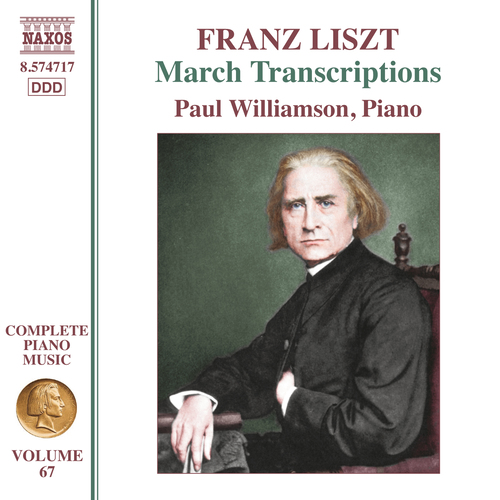
Franz LISZT (1811–1886)
Complete Piano Music, Vol. 67
March Transcriptions
Paul Williamson, PianoThis volume in the Complete Piano Music edition focuses on march transcriptions, a genre that often symbolised national identity and one that Liszt arranged and transcribed throughout his entire compositional career. Marches often appeared in Liszt’s recitals and allowed him to pay respect to the culture in which he was performing. These brilliant works are spiced with Hungarian timbres, suggesting native scalic patterns and the sound of the cimbalom, as well as Liszt’s Romantic flamboyance.

Included in CBC Music’s 2017 edition of 30 Hot Canadian Classical Musicians under 30, Paul Williamson has established himself as one of Canada’s promising young pianists. He received First Prize at both the 2014 Canadian National Music Festival and the 2017 Canadian Federation of Music Teachers’ Association National Piano Competition in addition to three semi-final awards. He is also a prizewinner of the 2020 WMC McLellan Competition and received Third Prize at the 2022 Shean Piano Competition and the 2023 Bader and Overton Canadian Piano Competition.
– MusicWeb International
– American Record Guide
Schubert Transcriptions
Three Marches • Hungarian Melodies
Cheli
– MusicWeb International
– Fanfare