
 Translate
































This month’s highlights include Nkeiru Okoye’s When the Caged Bird Sings – a vibrant, church-rooted celebration of resilience and triumph with University of Michigan forces under Kenneth Kiesler; Henrique Oswald’s radiant Symphony, Sinfonietta and Elegia performed by the Minas Gerais Philharmonic Orchestra under Fabio Mechetti; Domenico Cimarosa’s witty and charming L’Italiana in Londra; rediscovered Romantic works by Leokadiya Kashperova; the fourth and final volume of José Antonio Bottiroli’s Complete Piano Works; and a poignant tribute to Rodion Shchedrin with the Turku Philharmonic Orchestra; and more.


Nkeiru Okoye’s When the Caged Bird Sings is a ‘musical celebration’ that has its musical roots in the African American church, while also embracing minimalism and improvisational elements. With a message of adversity turned to triumph, it celebrates the transformative ability of African American women, partly evoking the experiences of the author and activist Maya Angelou. The work functions as a communal ritual that, like oratorio, opera and theatre, brings together vocal soloists, chorus and orchestra, in an experience that both commemorates and celebrates hope and possibility. The work was commissioned by the University of Michigan School of Music, Theatre & Dance as part of its Michigan Orchestra Repertoire for Equity initiative, founded in 2020 by Kenneth Kiesler, who conducts on this recording of the first performance. Part of a ten-year project to commission, premiere and record ten new orchestral works, When the Caged Bird Sings is the fourth commission in the enterprise.
Postscript: Distinguished baritone Jubilant Sykes, who was very recently killed in a tragic incident, can be heard here performing I thought this life would protect us from Part 3 of When the Caged Bird Sings. Collectors will readily recall his unrivalled performance as the Celebrant in Marin Alsop's landmark recording of Leonard Bernstein's Mass (8.559622-23)

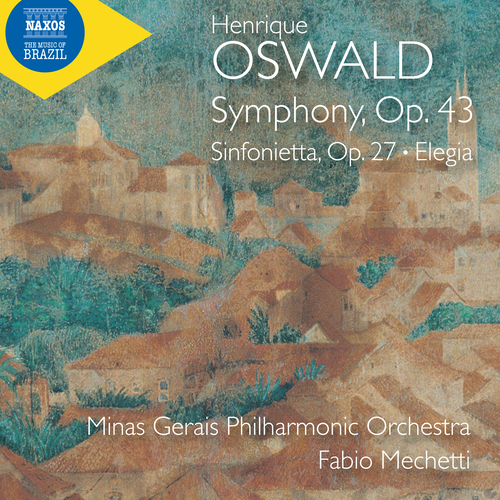
The Naxos Music of Brazil series continues with this fine album of orchestral music by Henrique Oswald, who was perhaps the most European of Brazilian composers, having spent a large part of his life in Italy; he also absorbed influences from France and Germany. The lyrical and at times overtly romantic and impressionistic nature of his music contributed to its falling out of favour in the mid-20th century, but it’s now seeing something of a revival. This programme features the radiant Sinfonietta; the orchestral version of Elegia, originally scored for cello and piano; and the Symphony, Op. 43, regarded as Oswald’s finest orchestral achievement and one of the most significant works in Brazilian orchestral literature. The Minas Gerais Philharmonic Orchestra, established in 2008, is now one of the most successful cultural institutions in Brazil and the recipient of numerous accolades and awards. Led here by artistic director and principal conductor Fabio Mechetti, the ensemble has made a significant contribution to The Music of Brazil series, including symphonies by Lorenzo Fernández (8.574412) in an album acclaimed for its ‘intense sonic energy’. (Diapason)

![CIMAROSA, D.: Italiana in Londra (L') [Opera]](https://cdn.naxos.com/sharedfiles/images/cds/hires/8.660586-87.jpg "CIMAROSA, D.: Italiana in Londra (L') [Opera]")
Domenico Cimarosa was one of the most-performed opera composers before the arrival of Rossini. He composed over 60 such works and was esteemed from Venice to St Petersburg where he was appointed to the Russian Court. L’Italiana in Londra (The Italian Girl in London) is a charming, sophisticated intermezzo that reflects an impressive understanding of comic situations and characters, highlighting English and Italian cultural stereotypes that are as identifiable today as they were in the 18th century. This album is the audio version of the audiovisual production that was first made available in January 2024, a recording that brims with humour and wit, generated in no small part by conductor Leo Hussain: ‘Hussain creates an extremely witty, punctuating ... discourse. [E]verything depends on the precisely timed punchline, and here director and conductor have worked together wonderfully, music and scene meshing like hand and glove.’ (Frankfurter Allgemeiner)
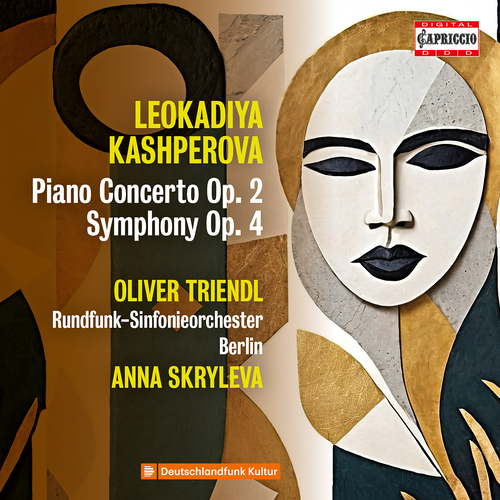
Leokadiya Kashperova was Igor Stravinsky’s piano teacher, having herself been a student of Anton Rubinstein. To this day, however, her compositions remain in the shadow of the male Russian masters, a fate shared by many other women of this era. Although her output is nowhere near as comprehensive as that of her contemporaries, what she did produce demonstrates incredible talent, mature skill and a deeply Romantic Russian idiom so typical of its time. The Berlin Radio Symphony Orchestra is conducted by Ann Skryleva, an internationally acclaimed artist who has won awards for expanding the standard orchestral repertoire; and there could be no better soloist in Kashperova's Piano Concerto than Oliver Triendl, a devoted champion of the works of neglected and rarely played composers, whose tireless commitment in this regard is reflected in his tally of some 150 recordings.
I. Allegro maestoso – Molto allegro
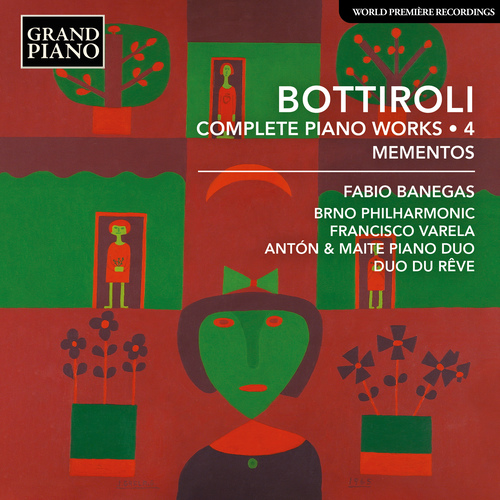
Pianist Fabio Banegas, protégé of Argentine composer José Antonio Bottiroli and now his greatest champion, compiled and catalogued Bottiroli’s complete works in 2011. This is the fourth and final volume in Banegas’ recordings of all Bottiroli’s compositions featuring the piano, encompassing works both with orchestra and with chamber ensemble, as well as works for solo piano and duet. This programme spotlights Bottiroli’s paraphrases of music by overlooked older composers, the creative refashioning and expansion of earlier works, and his use of Argentine folk dances. Short musical forms proved the ideal medium for his expression, which he infused with diverse moods, extreme subjectivism and intimacy. We confidently predict a repeat of the sentiment expressed following the release of Vol. 2: ‘There’s some lovely music here that other pianists should pay attention to.’ (American Record Guide)


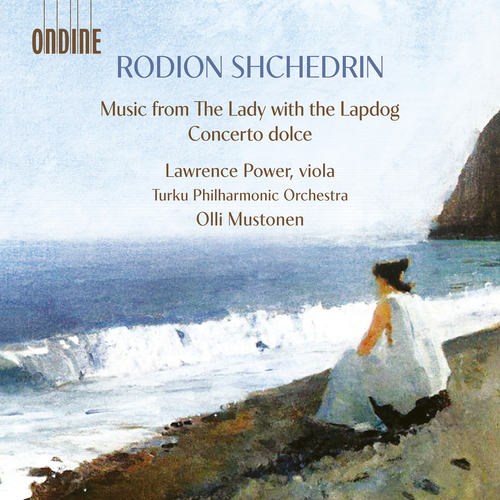
Rodion Shchedrin, who died in 2025, was one of the leading figures of post-war Soviet music who floated freely across styles, combining influences and materials from multiple sources. From 1973 to 1990 he was president of the Composers’ Union of the Russian Federation, succeeding no less a figure than Shostakovich. He described himself as ‘post-avant-garde’ and unlike many modernists was unwilling to anchor himself to strictly defined stylistic parameters. This album by the Turku Philharmonic Orchestra and conductor Olli Mustonen brings together four of his works, including material from his ballet The Lady with the Lapdog, as well as his viola concerto titled Concerto dolce, performed by Lawrence Power, one of the great violists of our time. Rodion Shchedrin passed away while this album was in preparation, which is a monument to the unique friendship and artistic collaboration that Olli Mustonen and Rodion Shchedrin cultivated over the course of three decades.