
 Translate






























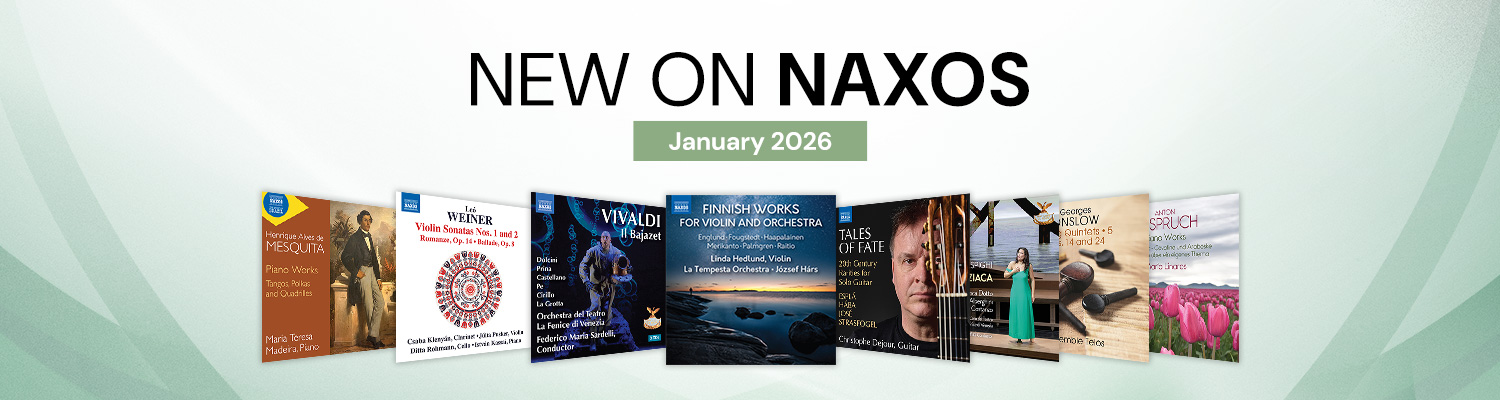
The January NEW ON NAXOS presents Finnish Works for Violin and Orchestra, a captivating collection showcasing the emotional depth, colour and inventiveness of 20th-century Finnish concertante music. Violinist Linda Hedlund joins the La Tempesta Orchestra under József Hárs in a richly varied programme where mysticism, modernism, folklore and experimentation converge. The recording features music by leading Finnish composers Selim Palmgren, Aarre Merikanto, Einar Englund, Väinö Haapalainen, Väinö Raitio and Nils-Eric Fougstedt – each offering a distinctive glimpse into Finland’s evolving national sound. The album continues Hedlund’s acclaimed exploration of Finnish repertoire, following her warmly received Evening Dusk Serenade with the same ensemble.
 Watch our monthly New on Naxos video to sample the highlighted releases of the month.

INCLUDES WORLD PREMIERE RECORDINGS
This recording explores the emotional depth, colour and inventiveness of Finnish concertante works for violin and orchestra. The pieces range across the transitional landscape of the country’s national music during the 20th century, where mysticism, modernism, folklore and experimentation co-exist. Major figures such as Selim Palmgren and Aarre Merikanto are represented, as is charming film music by Einar Englund, writing under a pseudonym. Distinctive works by Väinö Haapalainen, Väinö Raitio and Nils-Eric Fougstedt complete the programme.

Il Bajazet was commissioned in 1735 to open Verona’s carnival season. Vivaldi chose a libretto by Agostino Piovene drawn from the well-known story of the defeated Ottoman sultan, King Bajazet, captured by Tamerlane who duly falls in love with Bajazet’s proud daughter, Asteria. Vivaldi was in his late maturity when he completed the opera, modifying his music to suit contemporary taste, and using the pasticcio form, incorporating some arias written by other, mostly Neapolitan, composers. Repurposing of this kind was wholly acceptable at the time and such works enjoyed great popularity. The conductor and Vivaldi specialist, Federico Maria Sardelli, has integrated lost arias, clarified the use of historically appropriate orchestration, and brought the opera to rich theatrical life.

Ottorino Respighi’s Maria Egiziaca, described by the composer as a ‘mystery in three episodes’, narrates the life of Saint Mary of Egypt in a profoundly moving and deeply sensuous musical representation of Christian faith as seen through its various characters. This work, depicting Maria’s journey from prostitution to sainthood through sin, conversion and atonement, started out as a concert triptych and sits somewhere between an oratorio and an opera. The intensely dramatic and at times symphonic qualities of Maria Egiziaca are imbued with ancient Italian musical traditions, with two beautiful symphonic interludes separating the three episodes.

Acclaimed guitarist Christophe Dejour brings together four works that were premiered many years after they were composed, due to unpredictable and, in some cases, fateful circumstances. Both Óscar Esplá’s ground-breaking Tempo di Sonata and Ignace Strasfogel’s monumental Prelude, Elegie and Rondo were written for Andrés Segovia but remained hidden for decades, while Alois Hába’s neglected Guitar Sonata is a fantastic work of the highest musical quality. Antonio José’s music was banned under the Franco regime in Spain, yet his extraordinary Guitar Sonata, composed in 1933 and only rediscovered in the late 1980s, is revealed as a true masterpiece.

Leó Weiner’s legacy as an educator influenced generations of Hungarian musicians for a half century. His early work as a composer was internationally acclaimed for its new engaging sound, resulting from a unique synthesis of German and French Romanticism allied to a Hungarian musical language. These chamber works with piano are some of the best of his early opuses, from the ‘classical nobility and deep poetic substance’ of the Ballade, to the dramatic and stunningly beautiful Violin Sonata No. 2 – two pieces that were popular and widely performed in their day.

WORLD PREMIERE RECORDINGS
Georges Onslow’s reputation as the ‘French Beethoven’ was earned in the field of chamber music. His 34 string quintets build on a form perfected by Mozart, and are enhanced through Onslow’s suggested use of a double bass instead of a second cello, as heard in this recording. The String Quintet No. 14 in F major has an attractively genial quality, with distinctive themes contrasting with warmly emotive lyricism. String Quintet No. 24 in D major shows the influence of Beethoven in its theatrically dramatic moods.

Henrique Alves de Mesquita was a prolific composer who defied Brazilian society’s systemic exclusion of Black people to achieve prominence as one of the leading figures in the local musical scene of the 19th century. He was highly regarded for his sacred music and operas, which are rarely heard today. After study years in Paris, Mesquita turned his versatility and sophistication towards fashionable music theatre styles such as polkas, tangos and waltzes, conveying emotions ranging from contagious joy to gentle melancholy. It is these lighter pieces that are now considered by many scholars to be one of the main origins of modern Brazilian popular music.

A native of Frankfurt, Anton Urspruch was a student of Joachim Raff, later becoming one of Liszt’s favourite protégés. Urspruch’s style was more aligned with Mendelssohn and Beethoven, however, and he proclaimed that ‘you can’t understand modern music if you don’t understand Bach’. The Cavatine und Arabeske are delightful salon pieces, while the Variationen form an extensive canvas that revels in contrasting moods and constructional ingenuity. The short but emotionally packed Cinq Morceaux stand at the apex and final flowering of purely Romantic pianism in Europe.

and “The President’s Own” United States Marine Band
Gao Hong weaves ancient pipa traditions into full Western orchestral arrangements, as she composes, orchestrates, and performs four concertos for the instrument. Recorded at Abbey Road Studios with the Royal Philharmonic Orchestra, her works forge a striking cultural fusion, giving the Chinese lute a bold new voice in classical music. Symphony of Self also includes Celebration, performed by “The President’s Own” United States Marine Band, showcasing her remarkable versatility in writing for both orchestra and full band.
The New & Now playlist features all that is new and exciting in the world of classical music, whether it’s new music, new presentations or new performers. With more than 200 new releases each year, and artists from around the world, there is always something new to discover with Naxos.