
 Translate































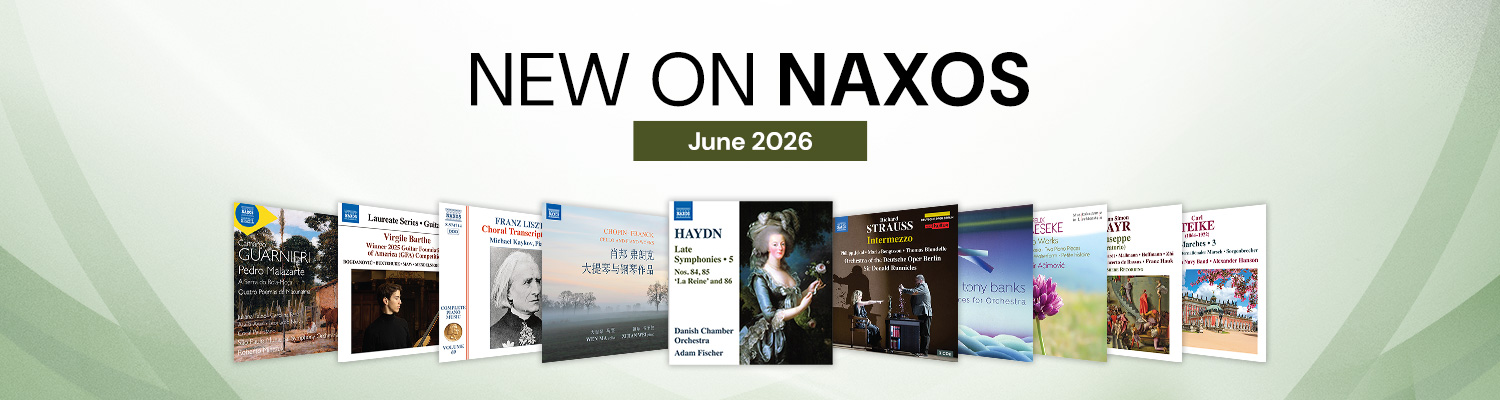
The June NEW ON NAXOS presents Franz Joseph Haydn’s Late Symphonies, Vol. 5, featuring Symphonies Nos. 84, 85 ‘La Reine’, and 86, performed by the Danish Chamber Orchestra under Adam Fischer. Renowned for their interpretations of Classical repertoire, Fischer and the orchestra bring exceptional clarity, dynamic contrast, and a chamber-like precision to these vibrant works. The series has been widely praised for its lively energy, razor-sharp ensemble, and characterful phrasing, with critics highlighting the engaging solo contributions and playful orchestral details that bring Haydn’s music vividly to life.
 Watch our monthly New on Naxos video to sample the highlighted releases of the month.

Haydn composed the three symphonies in this volume during the mid1780s in a spirit of triumph. Though still employed by the Esterházy family, he had recently been allowed to publish his music himself and to accept outside commissions. A number of symphonies were duly commissioned by a new, large ensemble recently established in Paris. Superficially similar, they reveal Haydn’s inexhaustible creativity whether in the astonishingly colourful introduction to No. 84, the rustic interludes in the trio section of No. 85 – a favourite of Marie Antoinette, or in the greatest of the Paris symphonies, No. 86, where the transition from the slow introduction to the main section is unequalled in his music.

Famous for his role as the keyboard player in rock band Genesis and as a solo artist, Tony Banks was always fascinated by the idea of writing orchestral music. His success in composing for films led to the acclaimed Seven – A Suite for Orchestra. The intense orchestral sound pictures in Seven, Six and Five rank among some of Banks’s most accomplished recordings marrying experimentation with form and structure, and a trademark melodic character that powerfully conveys both melancholy and joy.


Richard Strauss summed up his two-act opera Intermezzo as a ‘bourgeois comedy with symphonic interludes’. The soprano role of Christine with its shimmering cantilenas represents Strauss’s wife Pauline, while the successful Kapellmeister Robert Storch serves as Richard Strauss himself in a domestic drama that was avantgarde for its time but now resonates with the accessibility of today’s reality shows. This production from the Deutsche Oper Berlin was acclaimed for its lush orchestral sound and superbly characterful cast led by a formidable central performance from Maria Bengtsson.

INCLUDES WORLD PREMIERE RECORDINGS
A central expression of Franz Liszt’s multifaceted creativity was his lifelong engagement with transcription and transformation, using the piano as a medium capable of absorbing the sonorities, gestures and emotional weight of voices and orchestras alike. From the declamatory strength and driving rhythms of the earlier Schnitterchor aus dem Entfesselten Prometheus to various late meditations on An die Künstler, these works trace Liszt’s artistic evolution from the assertive rhetoric of his early maturity to the compressed, exploratory language of his final years.

This album presents a refined dialogue between cello and piano, featuring classic works by Fryderyk Chopin and César Franck. Performed by distinguished cellist Wen Ma and pianist Zijian Wei, winner of the 2024 Cleveland International Piano Competition, the album reflects the performers’ deep affinity for this classical repertoire. Throughout the recording, the dialogue between cello and piano is infused with a lingering romantic resonance.
* Only available for download and streaming

Virgile Barthe, winner of the 2025 Guitar Foundation of America Competition, presents works ranging from the Baroque to the 21st century performed with his impeccable virtuosity and artistry. This recital takes us from arrangements of Domenico Scarlatti’s deeply expressive sonatas and Buxtehude’s brilliant Suite, to the lyrical Songs without Words of Mendelssohn and the haunting Music of Memory by Nicholas Maw. The album closes with Dušan Bogdanović’s Third Sonata, a truly virtuoso piece with its quotes from Stravinsky and musical influences from the Balkans, jazz and the Renaissance.

Felix Draeseke’s early affiliation with the music of Liszt and Wagner permeated his own compositions of the period, not least his Sonata quasi fantasia in C sharp minor, a work of sumptuous Wagnerian candour as well as balletic lightness. It also marked a significant turning-point from a revolutionary style to something more conservative. As Liszt wrote to him, ‘Since Schumann’s F sharp minor sonata, I know of no more such significant work of this genre.’ The programme also includes a virtuoso Grande Fantaisie, two characterful Fantasiestücke and Chopin-like gestures in the Valse-Nocturne.

WORLD PREMIERE RECORDING
Giuseppe was composed by Mayr in 1829 for graduation concerts at the academy of music in Bergamo over which he presided. His inspiration was a Biblical opera that had won great popularity, Méhul’s Joseph, which had premiered in Paris in 1807, featuring prayers, hymns and unassuming arias. Mayr, however, drew on a much wider musical canvas to include grand arias, duets, a cavatina and a final chorus. He also repeatedly references popular melodies by his contemporaries Donizetti, Rossini and Bellini as befits a pasticcio oratorio.

Camargo Guarnieri loved writing for the human voice, composing hundreds of vocal works over the course of his long and distinguished career. The works in this programme all use texts by Mário de Andrade – a hugely influential writer who was Guarnieri’s friend and long-term collaborator. The comic opera Pedro Malazarte is representative of an attractively unconventional and colourful Brazilian modernism that sets it apart from Romantic traditions. Alongside other powerful settings, A Serra do Rola-Moça is one of Guarnieri’s finest dramatic vocal works, narrating the tragic story of two young people who die on their wedding day as they and their horses plunge into a ravine.

FINAL VOLUME
Famous for composing one of the world’s greatest marches, Alte Kameraden (available on Volume 1 in this series, 8.574317), Carl Teike wrote a body of works that have enriched the German concert march repertoire. They imbue the medium with both diversity and charisma marrying thematic invention with clarity of structure and richness of tone colours. For the 43rd anniversary of his death, a 1918 march was disinterred, and named Neue Kameraden, while Sorgenbrecher is a tribute from Teike to his contemporary, the admired composer Paul Lincke. This is the final volume in the series.


The New & Now playlist features all that is new and exciting in the world of classical music, whether it’s new music, new presentations or new performers. With more than 200 new releases each year, and artists from around the world, there is always something new to discover with Naxos.