
 Translate































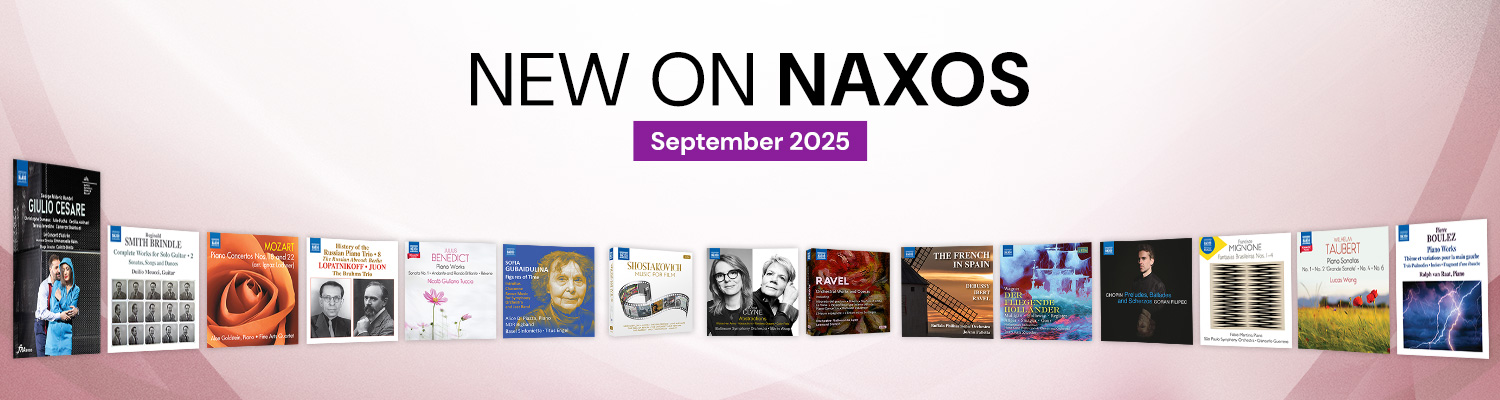
The September NEW ON NAXOS spotlights Anna Clyne’s Abstractions, recorded with the Baltimore Symphony Orchestra under Marin Alsop. Described by The New York Times as a ‘composer of uncommon gifts and unusual methods,’ Clyne has become one of today’s most sought-after voices, blending tradition with postmodern techniques in music that feels both adventurous and rooted. From the elegiac tenderness of Within Her Arms to the defiant energy of Restless Oceans, this album highlights Clyne’s breadth of expression and her close collaboration with Alsop. Also featured are Color Field and the title work Abstractions, originally commissioned by the orchestra.
 Watch our monthly New on Naxos video to sample the highlighted releases of the month.

Anna Clyne, described as a ‘composer of uncommon gifts and unusual methods’ by The New York Times, is one of the most in-demand composers today, working with orchestras, choreographers, filmmakers and visual artists around the world. Clyne’s unique voice combines tradition with postmodern techniques, giving her listeners a sense of musical adventure that is grounded in the past. From the beautiful elegy Within Her Arms to the defiant power of Restless Oceans, Anna Clyne’s music strikes a positive and resilient tone.


This album presents orchestral works by three French composers who saw Spain as a paradise of warmth, fragrance and colour, whether real or imagined. From the vivid evocations of Debussy’s Images and Ibert’s Escales, to the dances and landscapes that inspired Ravel’s Rapsodie espagnole, these masterpieces of Impressionism show the considerable impact Spanish culture had on French composers in the early 20th century.

Sofia Gubaidulina was an iconoclastic maverick whose work is synonymous with unprecedented openness and autonomy. The rarely performed Revue Music for Symphony Orchestra and Jazz Band is an eclectic subversive masterpiece that caused a scandal at its premiere in the USSR in 1978 – the official reaction to which posed a considerable threat to Gubaidulina’s entire family. It contrasts greatly with the sensual piano concerto Introitus, heard here in the revised version created by the composer in collaboration with Alice Di Piazza. Worlds collide in Figures of Time – a work that combines chaotic effects with unifying harmony. The programme also includes the Chaconne for solo piano with its atmospherically dense process of transformation.

Francisco Mignone became a leading figure in the Brazilian music scene after his return in 1929 following lengthy studies in Europe. His four Fantasias Brasileiras for piano and orchestra are part of his nationalist phase, with the first in the cycle initiated by soloist João de Souza Lima, who asked Mignone for a work with Brazilian flavour. These works share a festive and exuberant style to which the composer would return in his Burlesca e Toccata, which requires acrobatic virtuosity from the soloist in music that surprises by juxtaposing atonality with popular themes.
Visit the mini-site
![RAVEL, M.: Orchestral Works and Operas [8 Discs]](../../../sharedfiles/images/naxos-images/2025/sep/8.508022_3d_front.png "RAVEL, M.: Orchestral Works and Operas [8 Discs]")

This collection of Leonard Slatkin and the Orchestre National de Lyon’s complete Ravel recordings on Naxos includes critically acclaimed performances of the composer’s best-loved works. Featured alongside perennial favourites such as Boléro, the two piano concertos, Tzigane, Ma Mère l’Oye and Daphnis et Chloé, among others, are Ravel’s masterful orchestrations of Mussorgsky’s Pictures at an Exhibition and works by Schumann, Debussy and Chabrier. Ravel’s one-act operas, L’Heure espagnole and L’Enfant et les Sortilèges, are also included.
![HANDEL, G.F.: Giulio Cesare in Egitto [DVD]](../../../sharedfiles/images/cds/hires/2.110779.jpg "HANDEL, G.F.: Giulio Cesare in Egitto [DVD]")
Set during the Roman Civil War (49–45 BCE), Handel’s Giulio Cesare is an intense drama filled with romance, tragedy and political intrigue. The plot centres on Cleopatra’s campaign to seduce Julius Caesar in order to enlist his support in her becoming Queen of Egypt. Handel’s music breathes the atmosphere of the Baroque with virtuosic vocal fireworks and subtle arias. This acclaimed production is given a modern setting populated by power-hungry oligarchs who are placed by director Calixto Bieito into ‘a digital dream world in a desert paradise’.

The Flying Dutchman was Wagner’s breakthrough opera. Though Wagner still employed independent arias and choruses, his operatic concept transcended earlier works such as Rienzi, which was influenced by French grand opera. The supernatural tale of the Dutchman, condemned to roam the seas unless redeemed by a wife who will be faithful to him unto death, inspired an ambitious work in which Wagner was able to unite his dramatic and musical vision with a powerful combined effect for the first time.

The extreme delicacy and finesse of Chopin’s pianistic style was unusual in an era when star pianists such as Liszt and Anton Rubinstein were developing more virtuosic and experimental effects. It led some performers of the day to adapt Chopin’s works to suit the context of their time. Goran Filipec has traced the practices of these pianists to fashion a programme of Chopin’s works performed in the spirit of the ‘grand style’.


Julius Benedict studied with Hummel and Weber, beginning as a virtuoso pianist and then becoming a conductor and operatic composer. In 1835 he moved to England where he spent the next 50 years as a much-admired composer, teacher and writer. His most famous work is the opera The Lily of Killarney but the music for his own instrument displays a precocious talent. This is most evident in the Piano Sonata No. 1 in E major, where novelty and beguiling modulations co-exist with the influence of his teachers. The smaller pieces exhibit his taste, finesse and maturity, while the Andante and Rondo Brillante is a glittering showpiece.

INCLUDES A WORLD PREMIERE RECORDING
Berlin is the focus of this eighth volume of the History of the Russian Piano Trio, which features two Russian composers who lived in the city. Nikolai Lopatnikoff’s symphonies were premiered by Bruno Walter and Serge Koussevitzky, and he was once ranked alongside Stravinsky. Lopatnikoff’s Piano Trio in A minor is an archetypal example of Russian modernism, unparalleled in its use of allusions, tonalities and form. Paul Juon’s Suite in C major is full of elegant and vivid theatrical imagery, while his Piano Trio No. 1 in A minor employs charming stylised folk material influenced by Brahms.

WORLD PREMIERE RECORDINGS
Ever mindful of the accessibility of his works for amateur musicians, Mozart wrote, in a letter to his father, that his Piano Concertos Nos. 11–14 could be performed ‘a quattro’, with the accompaniment of string quartet rather than with full orchestra. Ignaz Lachner, a contemporary and associate of Schubert, saw great potential in chamber music arrangements and produced performing versions for piano, string quartet and double bass of many of the Mozart piano concertos. His considerable skill as a composer enabled these concertos, among them Nos. 18 and 22, to flourish in a more intimate setting.

WORLD PREMIERE RECORDINGS
Wilhelm Taubert was a significant composer and teacher in Berlin during a period when the city began to rival Vienna and Paris as a European musical powerhouse. Though it was also a time when the piano had reached its zenith in size and tonal depth, Taubert’s graceful, conservative style was perfectly suited to the instrument. His sonatas fuse Beethovenian elements with those of Weber, and feature slow movements that draw on rich operatic lyricism reminiscent of Rossini or Cherubini.

INCLUDES WORLD PREMIERE RECORDINGS
Pierre Boulez’s early ambitions to become a concert pianist provided the impetus to write piano music as a composition student at the Paris Conservatoire. The Thème et variations pour la main gauche and Trois Psalmodies reveal his extraordinary talent in their compelling mix of energy, drama and playfulness. Presenting these works alongside two later compositions provides a unique glimpse into the full arc of Boulez’s musical journey. These pieces are powerful, their emotions raw and unfiltered, offering listeners a chance to experience the early foundations and mature reflections of a master composer.

INCLUDES WORLD PREMIERE RECORDINGS
Reginald Smith Brindle pursued a distinguished academic career with numerous scholarly publications, but as a composer it was the impact of Italy and his studies with Pizzetti and Dallapiccola that coloured much of his music. Works such as Vita Senese (‘Siena Life’) and the Sonatina Fiorentina express the cultural and architectural magnificence of these great Italian cities. The later guitar sonatas expand into ever deeper emotions and moods as Smith Brindle explores the entire range of the guitar to stunning effect.
![SHOSTAKOVICH, D.: Music for Film [7 Discs]](../../../sharedfiles/images/naxos-images/2025/sep/8.507016_3d_front.png "SHOSTAKOVICH, D.: Music for Film [7 Discs]")
Shostakovich composed music for film throughout his life, from his teenage years as a pianist accompanying silent films in Leningrad until the early 1970s. New Babylon provoked a political and artistic storm upon its release in 1929 but remains one of Shostakovich’s finest film scores, performed here complete and uncut. Popular favourites The Gadfly and Hamlet are heard in premiere recordings of the complete scores. Also included is the music for Alone, The Girlfriends, Love and Hate and The Fall of Berlin in premiere recordings that have garnered international critical acclaim.


The New & Now playlist features all that is new and exciting in the world of classical music, whether it’s new music, new presentations or new performers. With more than 200 new releases each year, and artists from around the world, there is always something new to discover with Naxos.