 Translate





























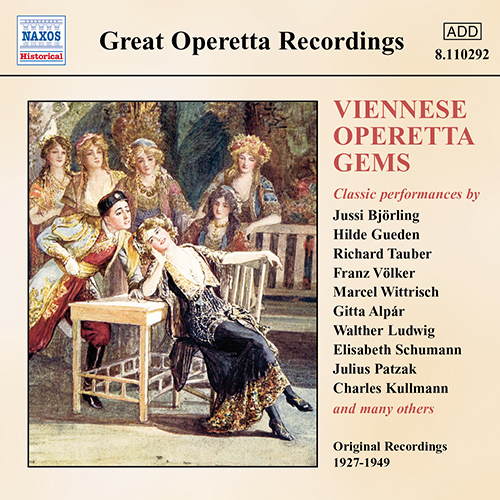

Not available in the United States due to possible copyright restrictions
 | Loading... |
VIENNESE OPERETTA GEMS (1927-1949)
Sparked by such imported French successes as Offenbach’s Orphée and nourished by Viennese dance traditions, operetta sprang to life in Vienna in the mid-1870s with Die Fledermaus and other key works by ‘Waltz King’ Johann Strauss II. The new genre flourished with Suppé, Millöcker, Zeiler and Ziehrer, and evolved via Lehár (whose 1905 masterpiece Die lustige Witwe is still rated the finest Viennese musical comedy) and Kálman until the 1930s when, with the advent of the film-musical, it reached an even wider audience.
VIENNESE OPERETTA GEMS
Original Recordings 1927-1949
Mythical Vienna and operetta have long been synonyms and our
brief survey of the Viennese Operette therefore appropriately begins with
well-known samples from the landmarks of the Viennese �Waltz King� Johann
Strauss II (1825-1899). Strauss was already a f�ted exponent of Viennese dance
music before he turned to operetta, with Indigo, in 1871. He was born, spent
most of his days and died in Vienna where, with the exception of Eine Nacht in
Venedig (Berlin, 1883), the premi�res of his operettas all took place. His
masterpieces and the quintessence of the Viennese genre, Die Fledermaus and Der
Zigeunerbaron date from 1874 and 1885 respectively. From the former comes Rosalinde and Alfred�s Act 1 �Drinking
Duet� (featuring Frankfurt-born tenor Franz V�lker (1899-1965), an intermittent
star of the Vienna State from 1931 to 1950) and the maid Adele�s coquettish Act
2 Mein Herr Marquis (sung here in the true soubrette style by Merseburg-born
soprano Elisabeth Schumann, 1888-1952); from the latter, Barinkay�s swaying
opening waltz, crowned with a telling top C from the still underestimated
American tenor Charles Kullman (1903-1983), an erstwhile star of the Berlin
State, is followed by the Act 2 duet with Saffi and some caressing mezza-voce
for which the Swedish Jussi Bj�rling (1911-1960) won world renown.
In
parallel with, and often rivalling, the younger Strauss, a constellation of
other composers active in Austria and Germany continued the trends originally
set by Offenbach, introducing ad hoc in response to popular demand more of the
traditional �Viennese� elements of comedy and Singspiel. Among the most
prolific of these was Franz von Supp� (really Francesco Ezecchiele Ermenegildo,
Cavaliere Supp�-Demelli, 1819-1895). An aristocrat-turned-conductor of Dalmatian
origin, Supp� penned more than 200 works for the stage, including thirty-odd
light operas and operettas of which several enjoyed high popularity in Vienna.
His 1860 work Das Pensionat has, rightly or wrongly, been pinpointed as �the
first Viennese operetta�, but his most enduring success was Boccaccio (1879),
from which comes the superbly lyrical Hab� ich nur deine Liebe, seamlessly
delivered by Vienna-born star tenor Julius Patzak (1898-1974).
Prominent
in the next generation, and all Austrians, were Karl Zeller (1842-1898; born at
St. Peter-in-der-Au), Richard Franz Joseph Heuberger (1850-1914), Karl
Mill�cker (1842-1899) and Karl Michael Ziehrer (1843-1922), the last two both
natives of Vienna. An official in the Austrian Ministry of Education, music for
Zeller was only a hobby until his greatest success, Der Vogelh�ndler, was given
in Vienna in 1891. Initially a civil engineer, Heuberger turned to music in
1876 following his appointment as chorus-master of the Vienna Gesangverein. A
noted music critic, editor and sometime professor of music at the Vienna
Conservatoire, his sole operetta success, Der Opernball, was first heard at the
Theater an der Wien, in 1898. The son of a Viennese jeweller, Mill�cker was
variously a flautist and conductor before being appointed, at Supp�s
recommendation, musical director of the Theater an der Wien, a post he held
from 1869 to 1883. In its superbly integrated blend of burlesque and romance,
his greatest success Der Bettelstudent (1882) has been rated the Viennese
counterpart to Lecocq�s French op�rette masterpiece La fille de Madame Angot.
Self-taught, from 1863 Ziehrer toured Austria and Germany with his own dance
orchestra before promoting popular concerts in Vienna. The composer of about
600 marches and waltzes he also wrote operettas, his most celebrated Die
Landstreicher (1899).
By
the second decade of the last century Viennese operetta was dominated by two
figures, both Hungarians by birth and ancestry: Franz (originally Ferencz)
Leh�r (1870-1948) and Emmerich (originally Imre) K�lm�n (1882-1953). A native
of Si�fok, K�lm�n studied with organist-composer Hans Koessler in Budapest and
settled in Vienna where he wrote a succession of tuneful Viennese-style
operettas, beginning with Ein Herbstman�ver, first given in Budapest in 1908.
While his subsequent Vienna successes include Die Csardasf�rstin (1915), Die
Bajadere (1921 � in the Act 1 finale Hungarian soprano Gitta Alp�r (1903-1991)
is joined by Swiss tenor star of German radio Herbert Ernst Groh, 1905-1982)
and Die Zircusprinzessin (1926), his finest and most often performed work,
Gr�fin Mariza (Vienna, 1924) contains several rousing tunes, not least Komm�,
Z�gan� (a fine vehicle for Belgian-born star of the Berlin State Opera, Marcel
Wittrisch, 1903-1955).
Born
in Kom�rom, like his father before him Leh�r served for a time as a military
band-master. Earlier, he had studied violin, piano and composition at the
Prague Conservatory and harmony and counterpoint, privately, under Zdenko
Fibich and Antonin Dvorˇ�k. His first opera, a flop, was produced at
Leipzig in 1896 but by 1903, when he took up the musical directorship of the
Theater an der Wien, he was already famed for his popular waltz �Gold und
Silber� Op.75. In 1905, after five moderate operetta successes, his fortuitous
assumption of a libretto rejected by Heuberger altered the dir-ection of
Viennese operetta. Die lustige Witwe first ran at the Theater an der Wien in
1905 for a record-breaking 483 performances. From 1907 it ran in London for 778
and on Broadway for 416 and by 1909, when it hit Paris, it had sparked new
crazes in women�s fashion and altered global trends in operetta writing.
Leh�r�s
subsequent hits included Der Graf von Luxemburg (1909) and Ziguenerliebe (1910
� its tenor solo is sung here with panache by the Romanian Joseph Schmidt,
1904-1942), in addition to several vehicles for Linz-born tenor Richard Tauber
(1891-1948), including Paganini (1924 � from this the solo Liebe, du Himmel, is
sung by the Viennese star of more recent revivals, Hilde Gueden, 1917-1988),
Friederike (1928), Sch�n ist die Welt (1930 � in this Tauber�s partner was
Gitta Alp�r and Giuditta (in this, Leh�r�s swansong attempt at opera-writing
staged at the Vienna State Opera in 1934, Tauber shared the honours with
Czechoslovakian opera soprano, and subse-quent singing film-actress Jarmila
Novotn� (1907-1994).
During
the 1930s, with works by Robert Stolz (1880-1975), Nico Dostal (1895-1981) and
others, Viennese operetta made its first entr�es into the new medium of the
film musical. Scion of a musical family, Dostal first worked in Berlin as a
conductor and arranger. He also wrote for stage and film before his first
operetta success, Clivia, was premi�red in Berlin, in 1933, starring his
wife-to-be, the Viennese coloratura Lillie Claus. Among his subsequent
successes were Die Vielgeliebte (1935) and Monika (1937 � filmed in 1942 as
Heimatland, its hit-song is sung here by the Bohemia-born star of the Berlin
operetta stage Anni Frind, 1900-1987). Although only one of his stage works
(Liebesbriefe, 1955) was premi�red in Vienna, all are moulded in the Viennese
tradition. His last operetta, Rhapsodie der Liebe, was first heard in Nuremberg
in 1963.
A pupil of Robert Fuchs in Vienna and Humperdinck in Berlin, Graz-born Robert Stolz started his musical career as a r�p�titeur. A fine pianist, he won early note as a conductor (including the premi�re of Leh�r�s Die lustige Witwe). For twelve years musical director at the Theater an der Wien, by 1940 he had emigrated to the USA, returning to Vienna only in 1946. His work in the genre, however, endured until 1969, long after the heyday of the Operette was past. Marked by a characteristic penchant for the nostalgic and languid, Stolz�s anachronistic but highly popular works in the Viennese idiom, which were variously mounted in Budapest, Berlin, Vienna, London and Zurich, include Der Tanz ins Gl�ck (1920), Venus in Seide (1932) and Zwei Herzen im Dreivierteltakt (1933). Outstanding among his many film-musical successes were Das Lied ist aus (1930), Liebeskommando (1931) � both featuring Wittrisch � and Zauber der Boh�me, a 1937 re-vamp of Puccini�s opera with extra material by Stolz (including Ich liebe dich) originally conceived for Polish opera and film tenor Jan Kiepura (1902-1966) and his Hungarian soprano spouse, Marta Eggerth (born 1912).
Peter Dempsey, 2003
Loading...