The most comprehensive classical music streaming service
Chill with exquisite performances from over 32,000 jazz musicians, from legends to contemporary stars
Explore vibrant ethnic and world music from all across the globe
A collection of beautifully told stories by extraordinary storytellers
Indulge watching the best productions of opera, ballet, classical concerts and documentaries
Your go-to site for information about orchestral and chamber music works
A terrific resource for kids to instill a lifelong love of music
Naxos for Education is a portal for educators and practitioners, students and music lovers alike to access free resources and information about the wealth of our products & services.
Naxos has transformed the classical market place in the last decade. As the world’s leading classical music label, we can offer you an unparalleled range of repertoire for licensing.
Sells high quality sheet music editions of classical music
Catalogue of sheet music editions from the world’s leading classical music company
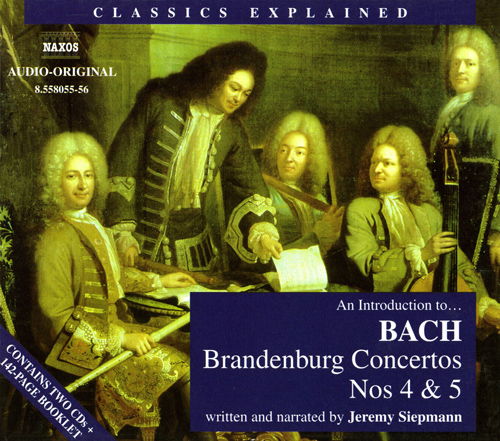
Classics Explained: BACH, J.S. - Brandenburg Concertos Nos 4 and 5 (Siepmann)
Ever since the advent of the LP in the 1950s with its expanded capacity, the six Brandenburg Concertos have been Bach’s runaway hit. They were not written as a set but form a collection. Nos 4 and 5 are the brightest, the most buoyantly happy and the danciest, but in some ways they are also the most complex. Concerto No. 5 is also notably the first work to promote the harpsichord from its position as an accompanimental instrument to a virtuosic solo role. By putting these concertos under the musical microscope we can discover how their many ingredients combine to make two of the most irresistible works in the repertoire.
A series exploring, in words and music, the major classical works of the concert hall. In an accessible and lively manner, Jeremy Siepmann looks at the history and the form of the great masterpieces of Western music.
Tracklist
Disc 1
Bach, Johann Sebastian
Siepmann, Jeremy (reader)
1
The Brandenburgs as concerti grossi
01:28
Siepmann, Jeremy (reader)
Siepmann, Jeremy (reader)
2
Introduction: Melody, Theme and Motif; Bach's opening gambit
02:15
Siepmann, Jeremy (reader)
3
Onwards and upwards: Motif No. 2 and its function
00:51
Siepmann, Jeremy (reader)
4
The two elements of Motif No. 2 and the effect of their combination
00:28
Siepmann, Jeremy (reader)
5
The 'motto' rhythm hidden even within the opening bar
01:07
Siepmann, Jeremy (reader)
6
Motif No. 3, introduced by the two recorders, has a kind of 'hovering' character
00:26
Siepmann, Jeremy (reader)
7
Motif No. 3 repeated for a second, 'directed' listen
00:23
Siepmann, Jeremy (reader)
8
Bach reminds us of the opening
00:17
Siepmann, Jeremy (reader)
9
Motif No. 4 - a steadily rising derivative of Motif No. 1
00:19
Siepmann, Jeremy (reader)
10
Motif No. 5, a lovely, bouncy, syncopated flourish, in which all the instruments join
00:23
Siepmann, Jeremy (reader)
11
Opening Ritornello (complete)
01:47
Siepmann, Jeremy (reader)
12
Episode 1 begins with virtuoso entry of the solo violin, made up of alternating arpeggios
01:15
Siepmann, Jeremy (reader)
13
Motif No. 3 returns, courtesy of the recorders, recently sidelined by the violin
00:47
Siepmann, Jeremy (reader)
14
Ritornello 2, a varied repeat of Ritornello 1, arrives after much harmonic movement
00:43
Siepmann, Jeremy (reader)
15
Episode 2, Part 1, preceded by the 'fanfare' motif from which its first theme derives
00:59
Siepmann, Jeremy (reader)
16
Episode 2 continued, with more bravura dazzle from the solo violin
01:05
Siepmann, Jeremy (reader)
17
Repeat of section for purposes of hearing the harmonic movement
00:47
Siepmann, Jeremy (reader)
18
Ritornello 3, with the prominent participation of the soloists
00:47
Siepmann, Jeremy (reader)
19
Episode 3 proves retrospective, featuring transposed repeats of earlier material
00:49
Siepmann, Jeremy (reader)
20
Ritornello 4, not altogether what it might seem; solo violin takes 'motto' motif
00:48
Siepmann, Jeremy (reader)
21
Episode 4. Cue to Part 1, focusing on 'soloistic' counterpoint provided by the continuo
00:56
Siepmann, Jeremy (reader)
22
Return to Ritornello 4 to hear sources of Episode 4, Part 2
00:36
Siepmann, Jeremy (reader)
23
Episode 4 continued, with emphasis placed on conversational interchanges
00:28
Siepmann, Jeremy (reader)
24
Return to opening Ritornello in order to enhance awareness of the contrast
00:53
Siepmann, Jeremy (reader)
25
Ritornello 5, beginning
00:10
Siepmann, Jeremy (reader)
26
Ritornello 5 continued, with emphasis on the determined banishment of B Minor
00:56
Siepmann, Jeremy (reader)
27
Cue to complete performance of First Movement
00:46
Siepmann, Jeremy (reader)
28
First Movement (complete)
06:19
Siepmann, Jeremy (reader)
Siepmann, Jeremy (reader)
29
Introduction: Rhythmic Motif provides basis for whole movement
01:17
Siepmann, Jeremy (reader)
30
The melody not much to write home about; nor is the meek 'answer' offered by the soloists
00:14
Siepmann, Jeremy (reader)
31
Putting the two together, thereby establishing a relationship
00:21
Siepmann, Jeremy (reader)
32
Contrast and syncopation - their relationship in opening section
02:18
Siepmann, Jeremy (reader)
33
Listening from the 'botton up'
02:48
Siepmann, Jeremy (reader)
34
The intertwining and alternation of solo and orchestra; the irregularity of metrical groupings
02:14
Siepmann, Jeremy (reader)
35
The next orchestral phrase; slowing the pace but not the tempo
00:28
Siepmann, Jeremy (reader)
36
The First Section (complete)
01:36
Siepmann, Jeremy (reader)
37
The next section; foreground symmetry and background variety
01:29
Siepmann, Jeremy (reader)
38
The central section's groupings are hugely asymmetrical
01:12
Siepmann, Jeremy (reader)
39
Cue to Second Movement as a whole
00:11
Siepmann, Jeremy (reader)
40
Second Movement (complete)
03:17
Siepmann, Jeremy (reader)
Siepmann, Jeremy (reader)
41
Introduction to the Third Movement...
04:57
Siepmann, Jeremy (reader)
42
Fugue subject
01:04
Siepmann, Jeremy (reader)
43
First counter-subject
00:31
Siepmann, Jeremy (reader)
44
Second counter-subject
00:51
Siepmann, Jeremy (reader)
45
Bass entry of the subject
00:14
Siepmann, Jeremy (reader)
46
Exposition (complete)
00:33
Siepmann, Jeremy (reader)
47
First Episode; the use of fragmentary derivatives
00:33
Siepmann, Jeremy (reader)
48
The difference a detail can make!
00:15
Siepmann, Jeremy (reader)
49
Harmonic Rhythm defined; back to the beginning to find the seed...
01:06
Siepmann, Jeremy (reader)
50
...and now the blossom
00:21
Siepmann, Jeremy (reader)
51
The First Solo Episode; a confusion of terms; onwards, to the introduction of the solo episode
01:59
Siepmann, Jeremy (reader)
52
Ritornello 2 complete
01:11
Siepmann, Jeremy (reader)
53
Solo Episode 2 dominated by thrilling virtuosity from the solo violin
01:47
Siepmann, Jeremy (reader)
54
Ritornello 3: highly contrapuntal and dominated by subject-derivatives, with much harmonic fluidity
00:46
Siepmann, Jeremy (reader)
55
Ritornello 3 continues: engine of harmonic motion repeated at higher pitch
00:06
Siepmann, Jeremy (reader)
56
More on Ritornello 3: the use of long, sustained, slightly syncopated notes in upper strings
00:21
Siepmann, Jeremy (reader)
57
Ritornello 3 (complete)
00:31
Siepmann, Jeremy (reader)
58
Solo Episode 3 - less solo than earlier ones, what with (albeit very discreet)
00:28
Siepmann, Jeremy (reader)
59
The two recorders converse in canon, accompanied for six exhilarating bars by cello 'continuo'
00:22
Siepmann, Jeremy (reader)
60
Finishing Solo Exposition 3: orchestral cellos introduce what sounds
00:33
Siepmann, Jeremy (reader)
61
Approaching the final Ritornello; stretto explained
00:56
Siepmann, Jeremy (reader)
62
Cue to Finale Ritornello, noting tension-building 'pedal point' in cellos and double bass
01:02
Siepmann, Jeremy (reader)
63
Coda - the 'tail-piece', with its surprising 'hammer strokes'
Fugal writing and the compatibility of parts; the Exposition
01:35
50
Episode 1, taken by soloists, contains important 'seeds'
00:37
51
The orchestra enters at last, but by stealth
01:19
52
Stretto and musical football
01:02
53
Key changes to B Minor, introducing extensive Middle Section
01:24
54
The Middle Section a precursor of the Mozartian 'development'
03:05
55
The Fugue Subject out in force: first four immediately consecutive entries yet
01:51
56
Ambiguity of mode and a Scottish twist
00:38
57
Middle Section sontinued; harpsichord dominates
02:10
58
Cue to Last Movement
00:19
59
Last Movement (complete)
04:55
Total Playing Time: 02:31:18
Loading...
Product Not Available
The product you are trying to view is either unavailable or not yet released. If you require more details, send e-mail to customer.service@naxos.com
Privacy Notice
Our translation service is provided by Google. When you load the translation service, Google may set cookies or store information about your usage on their servers. The operators of Naxos.com do not have access to this information.
Would you like to load the translation service?

 Translate