
 Translate




























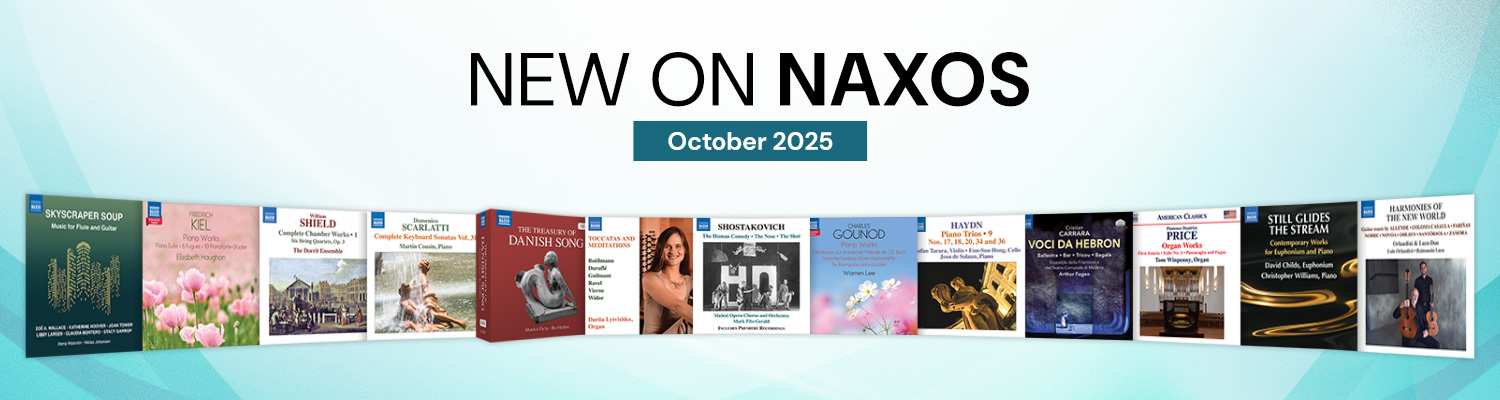
The October NEW ON NAXOS highlights Dmitry Shostakovich’s The Human Comedy, conducted by Mark Fitz-Gerald with the Malmö Opera Chorus and Orchestra. This vibrant work – alongside reconstructed selections from The Nose and the playful The Shot – captures the spirit of 1920s Leningrad with its bold theatrical energy and Parisian flair. Fitz-Gerald, recognised as a leading interpreter of Shostakovich’s stage music, brings these rare gems to life with insight and precision. The release also concludes with a compelling reconstruction of March of the Anarchists from The Vyborg Side.
 Watch our monthly New on Naxos video to sample the highlighted releases of the month.



* FIRST STUDIO RECORDING
INCLUDES WORLD PREMIERE RECORDINGS
Shostakovich was known for his fun-loving attitude during his early years as a composer. The colourful incidental music for The Shot – reconstructed by Mark Fitz-Gerald from the original piano scores – vividly evokes the raucous life of experimental youth theatre in Leningrad during the late 1920s. This carefree world had changed dramatically by 1934 when Shostakovich completed his music for The Human Comedy – a work that creates a charming atmosphere of Parisian escapism. Discarded movements from his first opera The Nose form an entire orchestral suite. The programme concludes with Mark Fitz-Gerald’s reconstruction of the March of the Anarchists, transcribed by ear from the film The Vyborg Side.

WORLD PREMIERE RECORDING
Cristian Carrara is one of the most original Italian composers of his generation. The opera Voci da Hebron (‘Voices from Hebron’) is set during the Israeli-Palestinian conflict. Carrara’s expressive depiction of this scenario is one in which fear, anger and incomprehension sit side-by-side with the need for communication, at a time when dialogue is difficult and peace is, at times, a mirage. This land that is home to grief and misunderstanding is also a place in which love can survive and ultimately flourish.

During his time in Italy and later in Leipzig, Charles Gounod was drawn by the balance of sonic beauty and proportion to be found in the music of Palestrina and J.S. Bach. He developed an innate desire for simple directness as can be heard in the excerpt from the Messe solennelle de Sainte Cécile and the Méditation sur le premier Prélude de J.S. Bach, now better known as Ave Maria. Gounod’s talents for melody and mood painting are demonstrated in his Romances sans paroles, while his sense of wit can be heard in the famous Marche funèbre d’une marionnette.

The illustrious French organ tradition is celebrated in this album of toccatas and meditations, including masterpieces drawn from across the repertoire. Charles-Marie Widor was the founding father of the French Organ School, and his Toccata from Symphony No. 5 is a cornerstone of the repertoire. The Méditation by his contemporary Louis Vierne is among the highlights of Romantic organ works. Duruflé, Boëllmann and Guilmant are also represented, as is a beautiful Ravel arrangement. They’re played on the magnificent Grenzing organ at Bauernkirche Iserlohn by Dariia Lytvishko – a Ukrainian-born virtuoso and one of the most lavishly gifted organists of her generation.

FINAL VOLUME
Haydn’s Piano Trios were intended for domestic use but the composer was typically inventive in subverting expected norms, bringing striking changes of mood, the use of unusual keys, and rich ornamentation to the supposedly placid world of the trio. Haydn also had a fondness for dance patterns, as his use of the polonaise in this volume shows; and he exploits the technical prowess of his pianist dedicatee, Maria Theresa née Hohenfeld, Dowager Princess Esterházy in Trio No. 20 in B flat major. The Trios are played by the three First Prize winners of the prestigious Enescu Competition (Bucharest, 2014) who bring a fusion of historical insight and Romantic sensibility that offers a fresh perspective on Haydn.

No one redefined the limits of contemporary keyboard writing in the 18th century more radically than Domenico Scarlatti, whose formal innovation, harmonic daring and virtuosic brilliance set him apart from his contemporaries. In this selection of sonatas Martin Cousin presents a multifaceted portrait of Scarlatti’s full creative range. Along with scalic runs, extended trills, dramatic dynamics and playful syncopations, we also meet the impish, quasi-improvisational and introspective composer capable of great nobility and lyrical beauty, one who bridged Baroque traditions with the new Classical style.

INCLUDES WORLD PREMIERE RECORDINGS
Florence Price had worked for some years as a silent film organist before she won admiration in 1932 for her Symphony No. 1 in E minor. Works for organ form one of the largest parts of her output; the Sonata attests to her virtuosic command, as does the Passacaglia and Fugue which, while clearly indebted to Bach, reveals personal ideas of her own. Price’s gift for writing miniatures is also obvious – Adoration has heartfelt melodic beauty, and the dainty Caprice exemplifies light music at its best. Variations on a Folksong is a tour-de-force and her only organ work to be based on a pre-existing melody, a spiritual. A digital EP featuring four additional miniatures for organ is also available for streaming and download (9.70389).


INCLUDES WORLD PREMIERE RECORDINGS
William Shield rose from relatively humble beginnings to become the ‘house’ composer to Covent Garden, for which he wrote stage works full of panache and tunefulness. He met and befriended Haydn who was to prove a lasting influence. In 1782 Shield published his Six String Quartets, Op. 3, some of the most richly rewarding works of their type in 18th-century England. The transparency of parts, use of imitation, infusion of Sturm und Drang elements as well as the bucolic and folkloric writing, all demonstrate Shield’s art, as does the progressive writing of the last of the six, in C minor.

INCLUDES WORLD PREMIERE RECORDINGS
This programme showcases the euphonium’s warmth, emotive quality and astonishing agility with a vibrant tapestry of contemporary chamber music that amply demonstrates its unique character. From the jazz-inflected grooves of Simon Parkin’s Skunk to meditative reflections such as Einaudi’s renowned evocation of sunsets in Due Tramonti, this collection brings together composers from diverse backgrounds whose works reimagine the sonic potential of this versatile instrument. Whether exploring nostalgia or joy, virtuoso fireworks or serene tranquillity, each piece contributes to a compelling narrative of the euphonium’s modern journey.

Friedrich Kiel enjoyed great prestige as a professor of composition in Berlin where his many students included Stanford and Paderewski. As a teacher he remained broadminded and undogmatic. These elegantly poised works show a rather conservative craftsman but one who absorbed the influences of the best of his contemporaries – Chopin, Mendelssohn, Schumann and Liszt. The Suite is Beethovenian in style, while his approach in the Six Fugues is largely lyrical. A digital EP of the Six Impromptus is available to stream and download (9.70385).


INCLUDES WORLD PREMIERE RECORDINGS
The guitar has established itself as a national instrument in Latin American countries. Its sonorities can be considered a miniature orchestra, but two guitars can generate an even greater range of possibilities. Each composer in this widely contrasting programme explores these qualities to the full, with elements such as the South American rhythms in Marlos Nobre’s Três Danças Brasileiras, and Guido Santórsola’s blending of Baroque form with a Romantic aesthetic in his Suite all’antica. The works by Ohlsen, Coloma Casaula and Novoa were all specially composed for the Orlandini & Luco Duo.

INCLUDES WORLD PREMIERE RECORDINGS
Six acclaimed female composers from North and South America present a diverse selection of works for the unique combination of flute and guitar. From Katherine Hoover’s evocation of the Old West in Canyon Echoes, via Libby Larsen’s jazz-infused Blue Third Pieces, and to Stacey Garrop’s dramatic and lyrical Sueños de Flamenco – the imaginative potential of these instruments is explored in a joyful union of memorable textures and fresh inspirations.
![The Treasury of Danish Song [18 Discs]](../../../sharedfiles/images/naxos-images/2025/oct/8.501805_3d_front.png "The Treasury of Danish Song [18 Discs]")
This encyclopaedic survey represents Bo Holten and Musica Ficta’s 25-year odyssey to collate and record the magnificent wealth of Danish part-songs. The project began in 1996 to much acclaim – Gramophone wrote: ‘Musica Ficta cannot put a foot wrong’ – and since then they have continued to earn admiration as one of the finest vocal ensembles in Europe. Stretching back to the glories of the Middle Ages and forwards to today’s leading Danish composers, these recordings encompass the Romantic era as well as traditional songs, motets, folk songs, Christmas hymns and carols, children’s songs and the great contributions of Carl Nielsen and Thomas Laub, to form a cornerstone collection of Danish song.


The New & Now playlist features all that is new and exciting in the world of classical music, whether it’s new music, new presentations or new performers. With more than 200 new releases each year, and artists from around the world, there is always something new to discover with Naxos.