
The Music of Brazil

 Watch video trailer
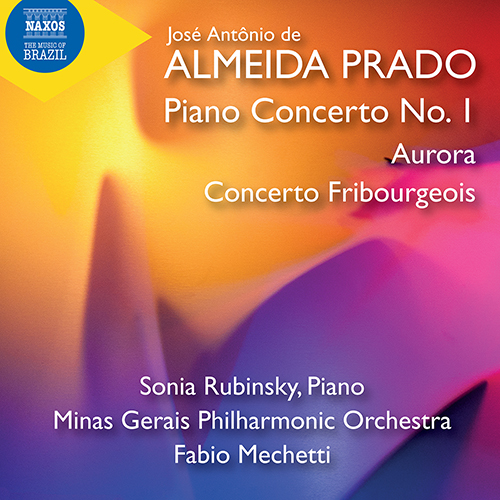
José Antônio de ALMEIDA PRADO (1943–2010)
Piano Concerto No. 1 • Aurora • Concerto Fribourgeois
Sonia Rubinsky, Piano • Minas Gerais Philharmonic Orchestra • Fabio Mechetti
At the time of his death in 2010, Almeida Prado was one of Brazil’s most internationally admired composers, one who created music of unique sonority and colour, rooted in his native country. In Aurora (‘Dawn’) he employs his newly developed ‘transtonality’ to radiant effect, while the Concerto Fribourgeois features a collage technique. In his Piano Concerto No. 1 Almeida Prado explores a cogent structure in which the soloist opens up, rips apart or transforms the theme and variations, in a work that is both grandiose and luminous.
‘This collection of works for piano and orchestra showcases the composer’s startling musical imagination and is performed with mastery and poise by Brazilian pianist Sonia Rubinsky and the Minas Gerais Philharmonic Orchestra.’
– BBC Music Magazine ★★★★
‘Pianist Sonia Rubinsky possesses a phenomenal technique, an immeasurable palette of colours in her touch and an irrepressible spirit. She is thus somewhat reminiscent of her colleague Martha Argerich.’
– www.klassik.com








Release date: AUG 2020
Camargo GUARNIERI (1907–1993)
Choros, Vol. 1 • Seresta
Davi Graton, Violin • Claudia Nascimento, Flute • Alexandre Silvério, Bassoon • Olga Kopylova, Piano • São Paulo Symphony Orchestra • Isaac Karabtchevsky
Camargo Guarnieri’s catalogue of works represents a legacy of incalculable worth for Brazilian culture, as has his influence as a teacher on several generations of younger composers. His association with the poet and musicologist Mário de Andrade led to the birth of the Brazilian Nationalist School and the ideals of using traditional Brazilian music in classical forms. The series of seven Choros and the Seresta for Piano and Orchestra represent Guarnieri’s personal approach to the concerto form, with striking contrasts between potent rhythm and dense, emotionally charged soundscapes and melodies full of Brazilian inspiration. This volume forms part of the first complete recording of the Choros.
‘Isaac Karabtchevsky and the São Paulo Symphony, who were responsible for the complete and splendid Villa-Lobos symphony for Naxos, together with the main soloists, offer an authentic performance in the service of the man Copland defined as “the most interesting ‘unknown’ talent in South America”.’
– Scherzo
‘The performances are excellent. The soloists are members of the São Paulo orchestra and Isaac Karabtchevsky boasts a long pedigree in conducting Brazilian music. (He led the same orchestra in Naxos’ first-rate series of the complete Villa-Lobos symphonies.)’
– Fanfare





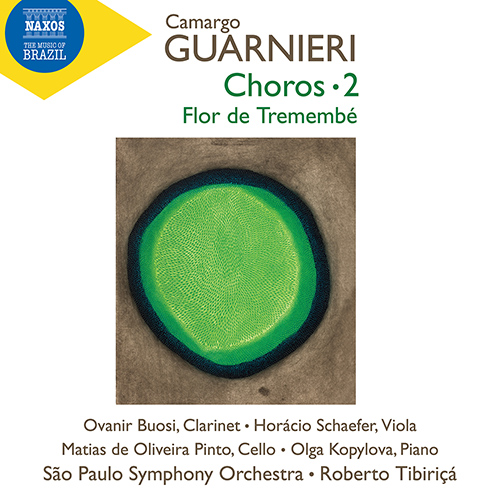
Camargo GUARNIERI (1907–1993)
Choros, Vol. 2 • Flor de Tremembé
Ovanir Buosi, Clarinet • Horácio Schaefer, ViolaMatias de Oliveira Pinto, Cello • Olga Kopylova, Piano
São Paulo Symphony Orchestra • Roberto Tibiriçá
In his Choros, Guarnieri wrote music that conjures up the landscape and essence of Brazil. These very personal concertos reveal the composer’s refined instrumental combinations and elegant contrapuntal writing, while their dance rhythms are vivacious, drawing on the baião, maracatu and embolada. The Choros in this second volume represent all stages of Guarnieri’s compositional development. Also included is the delightful and inventive Flor deTremembé, an early work with choro-like features.
‘Performances throughout are thoroughly idiomatic and the four soloists genuinely seem to revel in the music. Roberto Tibiriçá guides them through it with the sureness of one who knows the scores inside out, and the recording...is both clear and resonant.’
– Gramophone
‘These pieces represent the lifework of the composer who tried to integrate modernism with his musical roots – folk elements, and his own personality. The soloists and the orchestra play with virtuosity and devotion.’
– Record Geijutsu
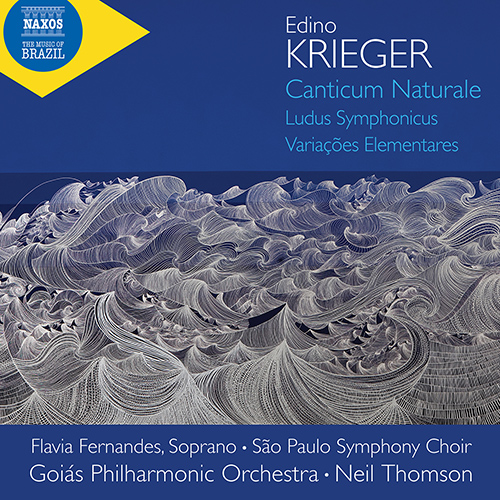
Edino KRIEGER (1928–2022)
Canticum Naturale *
Ludus Symphonicus • Variações Elementares
Flavia Fernandes, Soprano * • São Paulo Symphony ChoirGoiás Philharmonic Orchestra • Neil Thomson
Edino Krieger was a leading figure in Brazilian music as both composer and arts director who influenced a generation of his compatriots during his long life. Krieger’s works can be divided into three phases: serial, neo-Classical, and a fascinating synthesis of traditionalism and the avant-garde. From the second category comes the transitional Variações Elementares whereas his final creative phase, his peak of artistic maturity, is represented by the remainder of the programme. Included is one of his most emblematic pieces, Canticum Naturale, an expansive Amazonian painting in sound, and the virtuosic and expressive Ludus Symphonicus.

Release date: JUL 2024
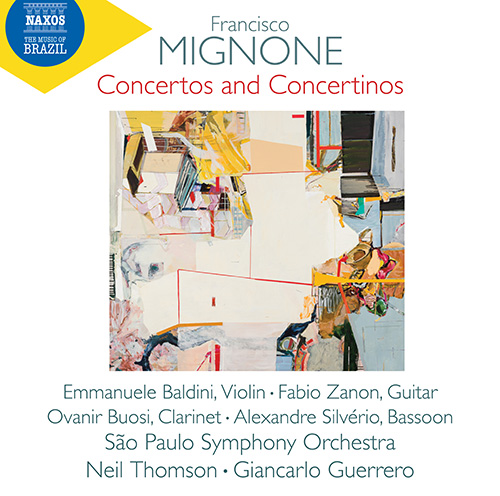
Francisco MIGNONE (1897–1986)
Concertos and Concertinos
Emmanuele Baldini, Violin • Fabio Zanon, GuitarOvanir Buosi, Clarinet • Alexandre Silvério, Bassoon
São Paulo Symphony Orchestra
Neil Thomson • Giancarlo Guerrero
Sentimental, dynamic, exuberant, multi-talented and extremely eclectic, Francisco Mignone, whose Italian background brought a sense of universality to his musical nationalism, was a leading figure in the Brazilian music scene during the 20th century. The Clarinet Concertino and Bassoon Concertino share a nationalist idiom: the dialogues between soloist and orchestra extend into expressive duets with the exciting use of rapid embolada – a Brazilian form of poetry and song. The elegant Guitar Concerto is filled with drama and vitality, while the Violin Concerto was summed up by one critic as ‘the greatest work of this challenging genre in the history of Brazilian music’.
Release date: SEP 2025
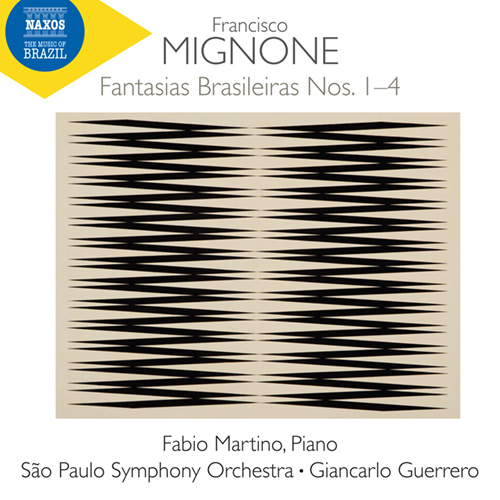
Francisco MIGNONE (1897–1986)
Fantasias Brasileiras Nos. 1–4
Fabio Martino, PianoSão Paulo Symphony Orchestra
Giancarlo Guerrero
Francisco Mignone became a leading figure in the Brazilian music scene after his return in 1929 following lengthy studies in Europe. His four Fantasias Brasileiras for piano and orchestra are part of his nationalist phase, with the first in the cycle initiated by soloist João de Souza Lima, who asked Mignone for a work with Brazilian flavour. These works share a festive and exuberant style to which the composer would return in his Burlesca e Toccata, which requires acrobatic virtuosity from the soloist in music that surprises by juxtaposing atonality with popular themes.
 Listen to Podcast
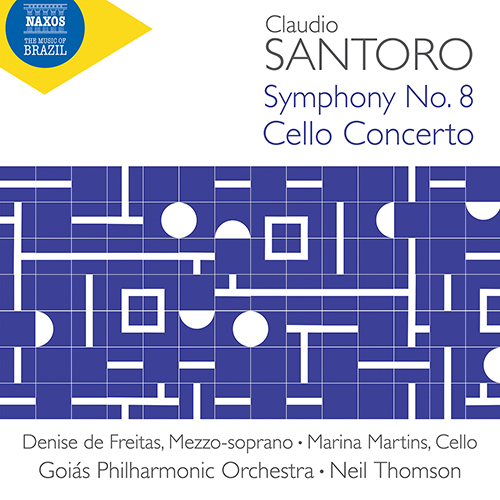
Claudio SANTORO (1919–1989)
Symphony No. 8 1 • Cello Concerto 2
Três Abstrações • Interações Assintóticas
Denise de Freitas, Mezzo-soprano 1 • Marina Martins, Cello 2Goiás Philharmonic Orchestra • Neil Thomson
The 1960s proved to be a significant decade in Claudio Santoro’s ever-eventful life. The charged atmosphere of the Cello Concerto can be attributed to his experiences in East Berlin at the moment construction started on the Berlin Wall. Despite its challenging solo writing, the concerto is the most symphonically proportioned of all his concertante works. Exceptionally for Santoro, the dramatic Eighth Symphony combines serial techniques with an openly Expressionist idiom. Três Abstrações explores timbres and dynamic contrasts with string orchestra, while Interações Assintóticas is Santoro’s only work to use quarter-tone tuning for some remarkable effects.
Heitor VILLA-LOBOS (1887–1959)
Guitar Concerto • Harmonica Concerto
Sexteto Místico • Quinteto Instrumental
Manuel Barrueco, Guitar • José Staneck, Harmonica • OSESP EnsembleSão Paulo Symphony Orchestra • Giancarlo Guerrero
The concertos and chamber works on this album show Villa-Lobos’ unceasing enthusiasm for new colours and sonorities in his music. The Concerto for Guitar and Small Orchestra was his last work for the instrument and written for Segovia. A cornerstone of the repertoire, it contains soaring melodies and rhythmic vitality couched in virtuosic writing. Exploring the instrument’s full harmonic and chromatic possibilities, the Concerto for Harmonica is also deftly orchestrated. New and daring sonic combinations are to be heard in the two chamber works demonstrating the composer’s extraordinary gift for seductive lyricism.
‘The uniformly first-rate performances by members of the São Paulo Symphony under the vital and sensitive direction of Giancarlo Guerrero are excellently engineered, making the whole disc a joy from start to finish – a true voyage of discovery and delight.’
– ClassicsToday.com
‘Villa-Lobos’ enthusiasm for new colours and textures is on display in this new release of concerti and chamber works… Villa-Lobos has a genuine claim to historical significance, and is by far the most well-known South American composer.’
– Limelight ★★★★



Heitor VILLA-LOBOS (1887–1959)
Cello Concertos Nos. 1 and 2
Fantasia for Cello and Orchestra
Antonio Meneses, CelloSão Paulo Symphony Orchestra • Isaac Karabtchevsky
The Cello Concerto No. 1 was Villa-Lobos’s first major orchestral work. Filled with youthful energy and displaying an eclectic style, it is the sound of the composer finding his voice. Three decades later and with his reputation at its height, the inspired melodies and flowing style of the Fantasia sees Villa-Lobos giving free rein to his vivid imagination. Composed for the Brazilian cellist Aldo Parisot, the no less inventive and lushly scored Cello Concerto No. 2 from 1953 suggests man’s solitude when facing the vastness of nature.