
 Translate
































In addition to its own wide-reaching monthly new releases, Naxos also distributes several leading labels in many countries around the world. Here is a choice selection of recent releases from some of these distributed labels.

Cantaloupe Music is the record label created and launched in March 2001 by the three founders of New York’s legendary Bang on a Can organization – composers Michael Gordon, David Lang and Julia Wolfe – with Bang on a Can managing director Kenny Savelson. The label has made a massive impact in the new music community, and has been recognized by critics and fans worldwide for its edgy and adventurous sounds.
Celebrating its 25th anniversary in 2026, Cantaloupe’s goal is still the same: to provide a home for contemporary classical and post-classical music that is, in the words of Michael Gordon, “too funky for the academy.”
![LANG, D.: note to a friend [Opera]](https://cdn.naxos.com/sharedfiles/images/cds/hires/CA-21216.jpg "LANG, D.: note to a friend [Opera]")
David Lang’s note to a friend was commissioned by the Japan Society in New York and the Tokyo Bunka Kaikan centre in Japan, and is inspired by the famous letter written by short story author Ryunosuke Akutagawa to a fellow writer, announcing his intention to take his own life.
Conceived as a chamber opera for solo vocalist and string quartet, the work is also the perfect vehicle for singer Theo Blackmann, who brings a profound emotional weight to his performance, in collaboration with the inimitable Attacca Quartet. The result is a stunning and haunting monodrama that addresses our eternal human fascinations with love, death, family and the phantoms of our daily existence.

Widely regarded among the most important chamber works of the 20th century, Olivier Messiaen’s Quatuor pour la fin du temps is a world within itself, a profound rumination on the concept of eternity – and, owing to its legendary and mythical stature as a work of resistance, an integral part of the European classical standard repertoire for several generations.
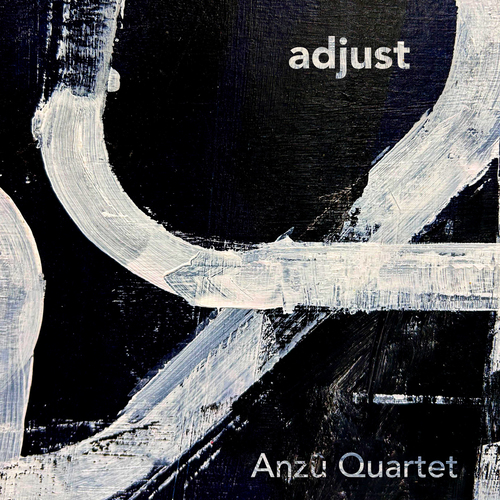
As such, the Quatuor is still the oldest piece in the repertoire of New York’s Anzû Quartet, whose members – Olivia De Prato (violin), Ashley Bathgate (cello), Ken Thomson (clarinet) and Karl Larson (piano) – view the work as a catalyst for much of the contemporary music they perform today. Inspired by the lauded 1976 recording by the TASHI quartet, the group follows in some giant footsteps while digging deep into the original score with a renewed sense of rhythmic vitality, seeking to render Messiaen’s pivotal work as powerful today as it was when he first composed it as a prisoner of war in 1940–41.

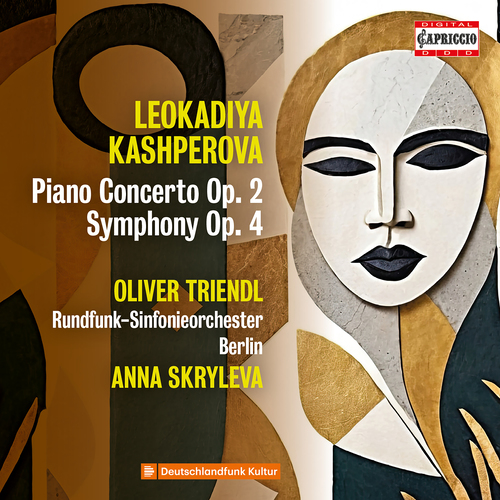
Leokadiya Kashperova was Igor Stravinsky’s piano teacher, having herself been a student of Anton Rubinstein. To this day, however, her compositions remain in the shadow of the male Russian masters, a fate shared by many other women of this era. Although her output is nowhere near as comprehensive as that of her contemporaries, what she did produce demonstrates incredible talent, mature skill and a deeply Romantic Russian idiom so typical of its time.
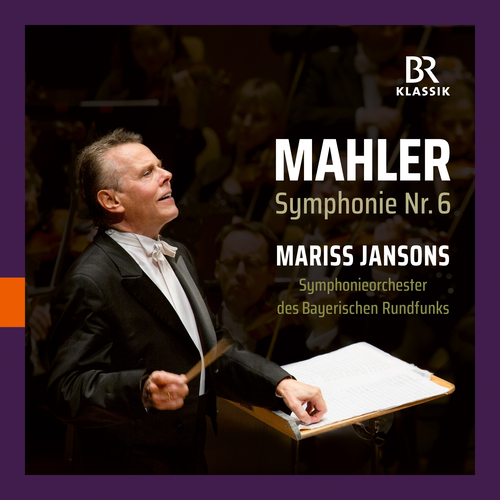
Gustav Mahler’s Sixth Symphony is perhaps the darkest work he ever wrote – its nickname is “The Tragic”. And there is something almost destructive about the final movement. “But strangely enough,” says Simon Rattle, “it is also a very classical symphony. Yes, it is extreme, but for long stretches it is less wild than other works of his – although of course it does convey a harrowing message. But it’s like a lot of great works: there are always different ways of reading them. I've been conducting the Sixth for forty years now, and over time I’ve come to realise that it also contains hope.”
Mahler composed his Sixth Symphony during the summers of 1903 and 1904 at his “composer’s cottage” in Maiernigg, near Klagenfurt. At the Vienna performance in 1907 (the third under his baton), he called it the “Tragic Symphony” – a nickname that soon became the stuff of legend. In particular, the darkness and devastating hopelessness of the finale – written at a time when he was at the high point of his life, both professionally and personally – are puzzling. Even his wife Alma could not quite explain the contradiction. As always, it was in and through music that Mahler came to terms with his experiences, exploring themes such as farewell, the meaning of existence, death, redemption, the afterlife, and love.
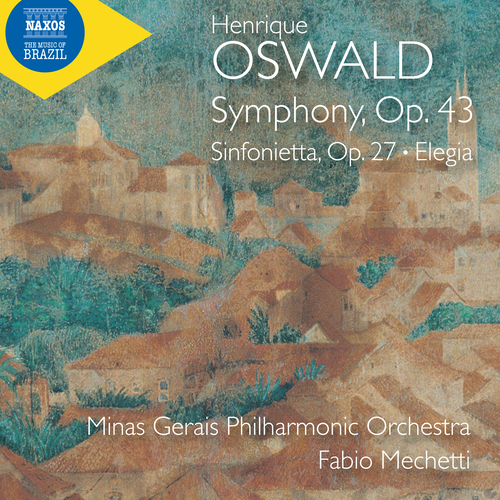
Henrique Oswald was perhaps the most European of Brazilian composers, having spent a large part of his life in Italy; he also absorbed influences from France and Germany. Oswald’s music always retains a lyrical character with qualities of elegance and radiance, which can be heard in the Sinfonietta. The expressive Elegia, originally conceived for cello and piano, is dedicated to the memory of a friend. With its contrasts between darkness and light, coupled with undeniable beauty, the Symphony is regarded as Oswald’s finest orchestral achievement and one of the most significant works in the Brazilian orchestral literature.
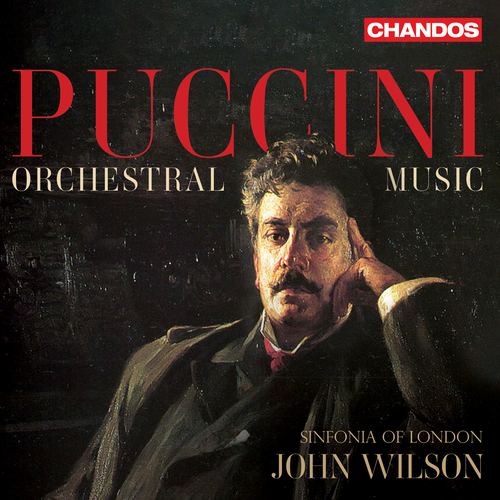
Puccini is renowned as one of the greatest opera composers of all time and his early works – before Manon Lescaut catapulted him to international fame – offer a fascinating insight into his development as a composer. John Wilson and Sinfonia of London explore this repertoire with characteristic style and commitment, leading us on a journey through student compositions and orchestral extracts from his earliest operas. Studying under Amilcare Ponchielli at the Milan Conservatory from 1880 to 1883, he created the Preludio sinfonico (loosely based on Wagner’s Prelude to Lohengrin), the Scherzo, Trio, and Adagetto, and Capriccio sinfonico, his graduation piece, which famously pre-echoes the opening of La bohème by a decade. The one-act opera Le villi was composed for a competition launched by the publisher Sonzogno (Puccini didn’t win), whilst themes from the contemporaneous Tre minuetti and Crisantemi (both for string quartet) were subsequently re-cycled in Manon Lescaut. Verdi’s publisher, Ricordi, bought the rights to Le villi, and commissioned a new work at the same time: Edgar, which, largely owing to the absurd plot, is arguably Puccini’s only failure, despite some fully mature music easily the match of the more celebrated scores.
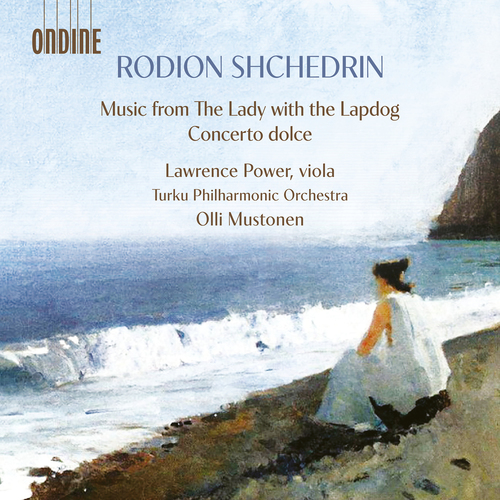
Composer Rodion Shchedrin (1932–2025) was one of the leading figures of post-war Soviet music. This album by the Turku Philharmonic Orchestra and conductor Olli Mustonen brings together four of his works, including music from his ballet The Lady with the Lapdog, as well as a viola concerto, Concerto dolce, performed by Lawrence Power, one of the greatest violists of our time. Rodion Shchedrin passed away while this album, which is a monument to the unique friendship and artistic collaboration that Olli Mustonen and Rodion Shchedrin cultivated over the course of three decades, was in preparation.
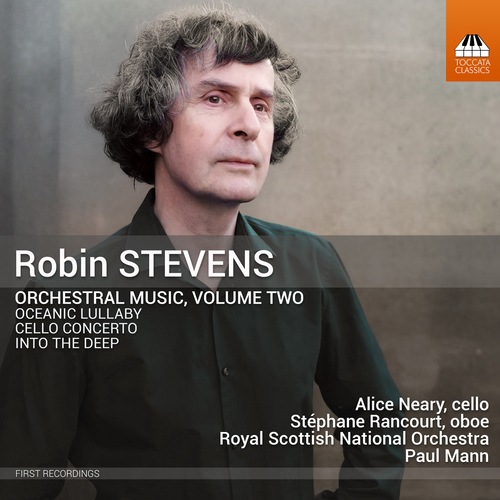
The compositional career of Robin Stevens, Welsh-born (in 1958) and Manchester-based, is divided into two periods, separated by a period of illness. The first mainly produced chamber music and works for the church that employed him; restored to health, he found an appetite for larger forms, writing three substantial concertos and a number of other orchestral works. Stevens’ substantial, four-movement Cello Concerto is something of a symphony with cello, casting the orchestra in kaleidoscopic discussion with the soloist. Here the Concerto sits between a charming orchestral miniature and a searching symphonic poem.
![CIMAROSA, D.: L’Italiana in Londra [Opera]](https://cdn.naxos.com/sharedfiles/images/cds/hires/8.660586-87.jpg "CIMAROSA, D.: L’Italiana in Londra [Opera]")
Domenico Cimarosa, one of the last great exponents of the Neapolitan School, was also one of the most-performed opera composers before the arrival of Rossini. He composed over 60 such works and was esteemed from Venice to St Petersburg where he was appointed to the Russian Court. L’Italiana in Londra (‘The Italian Girl in London’) is a charming and sophisticated intermezzo that displays an incredible understanding of comic situations and characters, satirising different cultural stereotypes that are as identifiable today as they were in the 18th century. Humour and wit abound in this acclaimed production.
![STRAUSS, R.: Elektra [Opera]](https://cdn.naxos.com/SharedFiles/Images/cds/hires/CHSA5375.jpg "STRAUSS, R.: Elektra [Opera]")
First performed in Dresden in 1909, Elektra was Strauss’s first collaboration (of many) with the librettist Hugo von Hofmannsthal, and is the most modernist of all of his operas. Based on the (heavily reworked) play by Sophocles, Hofmannsthal’s version concentrates on the inner thoughts and feelings of Elektra as she holds individual conversations with other members of her family. Strauss’s score is exceptionally adventurous harmonically, and famously features the Elektra Chord (a simultaneous combination of E major and C sharp major). The orchestration is exceptionally lavish – even by Strauss’s standards – featuring eight horns, six trumpets, double timpani and two harps. The performance was recorded live in Bergen in December 2023, Edward Gardner conducting a cast led by the great Swedish dramatic soprano Iréne Theorin, one of the finest Elektras of our time. Recorded in Surround Sound and released on Hybrid SACD.
![THOMALLA, H.: Dark Fall [Opera]](https://cdn.naxos.com/sharedfiles/images/cds/hires/OC2000.jpg "THOMALLA, H.: Dark Fall [Opera]")
Dark Fall is an opera about love and longing in old age. The story centres on Ellen, a married woman who is showing the first signs of Alzheimer’s disease. Despite these symptoms, or perhaps because of them, she falls in love with Owen, an old friend who visits Ellen and her husband.
Dark Fall questions notions about love and partnership in old age: When are we too ill or too old to be allowed to fall in love again? to start a new life with a new partner and be able to leave someone else? when are we too limited in our autonomy to freely decide our lives?
Together with Dark Spring (UA Mannheim 2020), Dark Fall is conceived as the second part of a theatrical Diptych of Desire. The pieces can be performed either separately or together as a double feature.
![VINCI, L.: Artaserse [Opera]](https://cdn.naxos.com/sharedfiles/images/cds/hires/CDR90000-242.jpg "VINCI, L.: Artaserse [Opera]")
“Among the most impressive period-performance ensembles around today” (Musical America), Haymarket Opera Company presents early-18th-century master Leonardo Vinci’s rare operatic gem, Artaserse (1730). A prominent figure of the Neapolitan School of opera, whose work influenced composers such as Johann Adolph Hasse and Giovanni Battista Pergolesi, Vinci’s three-act opera seria centres on the Persian prince, Artaserse, who must bring his father’s murderer to justice amidst betrayal, deceit, and mistaken identity.
Celebrated as a classic in its time with multiple revivals into the 1750s, Artaserse features a libretto by Italian poet and librettist Pietro Metastasio, who was regarded as one of the most important librettists of 18th-century Europe. The opera, comprising 29 arias, one duet, four orchestrally accompanied recitatives, and a final chorus, offers dazzling vocal writing and highlights Vinci’s talent for dramatic intrigue.
![WEBER, C.M. von: Der Freischütz [Opera]](https://cdn.naxos.com/sharedfiles/images/cds/hires/VOX-NX-2819.jpg "WEBER, C.M. von: Der Freischütz [Opera]")
![VERDI, G.: Ballo in maschera (Un) [Opera] (Highlights) (Ciminelli, Discacciati-Gianni, Rocchi, Rome Lyric Opera Chorus and Orchestra, Brizio)](https://cdn.naxos.com/sharedfiles/images/cds/hires/VOX-NX-2849.jpg "VERDI, G.: Ballo in maschera (Un) [Opera] (Highlights) (Ciminelli, Discacciati-Gianni, Rocchi, Rome Lyric Opera Chorus and Orchestra, Brizio)")
![VERDI, G.: Otello [Opera] (Highlights) (Sarri, Pollo, Serra, Landi, Rome Opera House Chorus and Orchestra, Paoletti)](https://cdn.naxos.com/sharedfiles/images/cds/hires/VOX-NX-2850.jpg "VERDI, G.: Otello [Opera] (Highlights) (Sarri, Pollo, Serra, Landi, Rome Opera House Chorus and Orchestra, Paoletti)")
The publication of the pieces included in this album aims to promote and disseminate a lesser-known chamber music repertoire among national and international concertgoers, a repertoire that undoubtedly deserves cultural and musical appreciation in every era for its intrinsic originality.
The two composers featured in this edition certainly need no introduction: Francesco Cilea, tied to the operatic tradition and bel canto, author of famous operas such as L’Arlesiana and Adriana Lecouvreur, and Alessandro Longo, the first to revise all 555 Domenico Scarlatti’s harpsichord sonatas, as well as the author of the well-known 12-volume Tecnica Pianistica. Longo was also the founder of the renowned Neapolitan musical journal L’Arte Pianistica.
Gianfrancesco Federico on violin, Giuseppe Currao on clarinet and Ugo Federico on piano guide us through these compositions, which are of great interest for understanding the Italian musical landscape of the early 20th century.
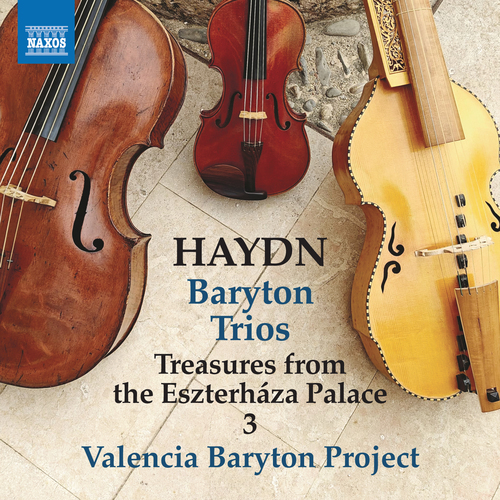
It was Prince Nikolaus of Esterházy’s increasing infatuation with the baryton that compelled Haydn, the prince’s Kapellmeister, to write an unprecedented body of 125 works for baryton trio. The instrument is more like a viola d’amore than a bass viol and has extra strings behind the neck that provide resonance and opportunities for plucking effects. The six works in this album are intimate expressions of great beauty with a sustained level of invention, all of which reflect the prince’s increasing confidence in the instrument. Volumes 1 and 2 are available on 8.574188 and 8.574504.
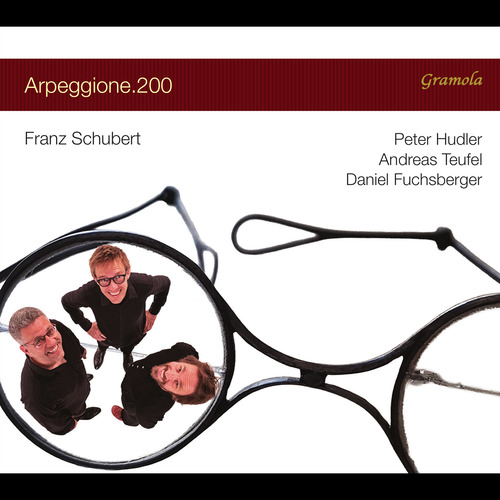
The idea of performing Franz Schubert’s music on the rare arpeggione, accompanied by a “Wiener Packl” (or “Viennese posse”) of Schrammel harmonica and contraguitar, might seem far-fetched at first glance. However, upon closer inspection, this unique combination is not so outlandish. The historical connections are surprisingly strong: Johann Georg Stauffer, the inventor of the arpeggione, also made the earliest attempts at developing the contraguitar. Furthermore, the Schrammel harmonica was also invented in Vienna around the very same time.
This unique historical convergence is explored on the album Arpeggione.200, featuring musicians Peter Hudler, Andreas Teufel, and Daniel Fuchsberger. The trio performs Schubert’s beloved Sonata for Arpeggione and Piano alongside various Ländler and their own arrangements of classic songs such as “Trockne Blumen,” “Du bist die Ruh,” and “Sei mir gegrüßt.”
Through this imaginative instrumentation, the musicians open a gateway to a distinctly poetic and lyrical sound world. Their performance not only offers a fresh perspective on these familiar works but also beautifully highlights the close relationship between Schubert’s compositions and traditional Alpine folk music.
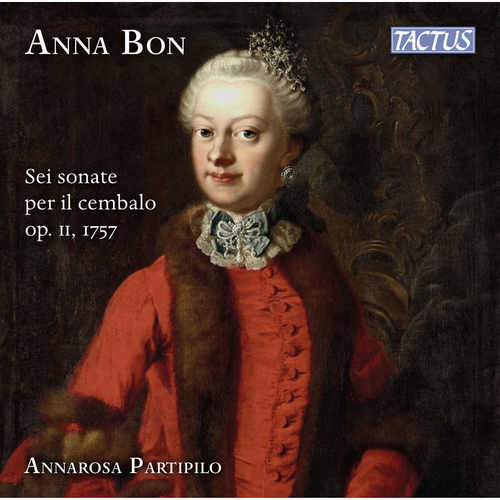
A fascinating and still enigmatic figure, Anna Bon di Venezia was one of the few professional female composers of the 18th century to secure a place in European courts. A virtuoso, singer, and composer, her career unfolded across Venice, Bayreuth, and Nuremberg, where she published her three collections of works between 1756 and 1759. Little is known about her: the only definitive biographical details come from the dedications and title pages of her publications. Anna studied under Candida della Pietà, a viola teacher and former student of Antonio Vivaldi. Even in her early years, she was recognised as a talented musician and soon distinguished herself as a composer. The collection presented here, Six Sonatas for Harpsichord, op. 2, was published in Nuremberg in 1757 during Anna’s stay at the court of Bayreuth. The sonatas are dedicated to Ernestina Augusta Sophia, Princess of Saxe-Weimar, who was Anna Bon’s pupil before marrying the Duke of Hildburghausen. Annarosa Partipilo excels in her meticulous performance, playing a late 18th-century fortepiano.
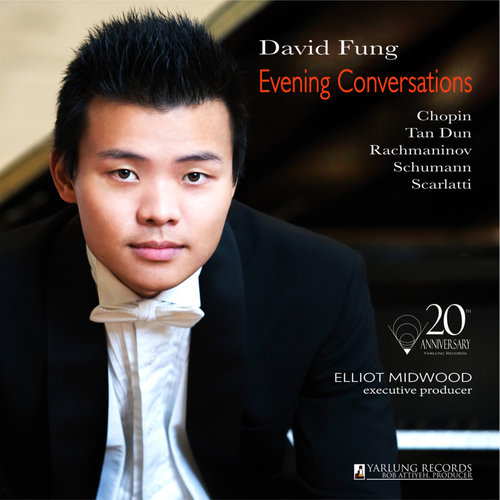
This recording was hailed as the “Best Piano recording I have ever heard” by John Casler. And in the year-end American Record Guide review of new piano recordings, James Harrington says of David Fung’s playing: “My reviewing process has produced an overall favorite, and that is David Fung. Consistently good from start to finish, his playing impressed me for its phrasing and musicality… It is clear that Fung’s heart and soul belong in the romantic era. The variety of his touch and articulation is well displayed in this music… I shall return to this recording many many times and will watch for future releases from this talented artist.”
It is a rare treat when a music writer and critic twists a producer’s arm to re-release an early album in a record label’s catalogue. David Fung’s Evening Conversations put Yarlung Records on the audiophile map, and it was last released in 2012. Mr Rushton Paul was the friendly arm-twister in our case, and encouraged us to release a fresh mastering of Evening Conversations in honour of Yarlung’s 20th Anniversary. What a treat it was to revisit the original takes and bring them to life with equipment Yarlung didn’t have at the time of the original recording. This is an edition I suspect will stand the test of time. Zipper Hall at Colburn School in Los Angeles has wonderful acoustics, as I think you will hear in Evening Conversations, and Yarlung has recorded about 12 albums there to date. Rush gives us a taste from this special 20th Anniversary release: “David Fung is extraordinary – his playing soars on wings of the greatest delicacy, nuance, insight, and emotion. He combines a refined elegance with intensely poetic and expressive nuance. The clarity with which he navigates passages is breathtakingly liberating. Listening after all these years, I am once again awestruck by the musicianship, the intelligence, the technical excellence of these performances.”
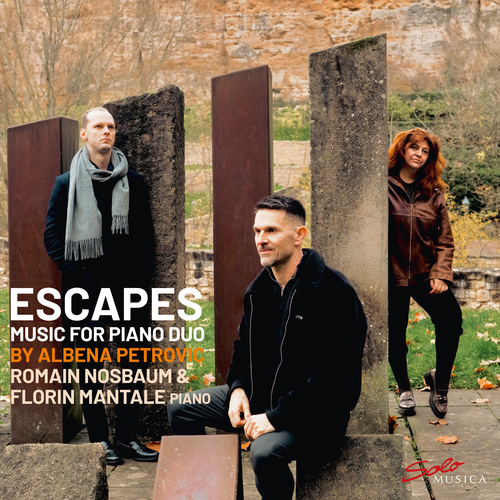
The album ESCAPES, like all the albums composed by Albena Petrovic, bears a very personal and unique imprint, inspired and built according to the idea of escaping, of leaving; in a mental and poetic way rather than physically, by pursuing the ‘fil rouge’ that runs through each work and with the same message: to escape from reality and dive into another, more beautiful world – the world of dreams and fantasy. The themes with dark painful states of mind where loneliness and fear of abandonment prevail are the ones that most often inspire me. Is the desire to leave, to leave never to come back, a real feeling, or rather an imaginary one?
The inspiration for a large part of her music comes from autobiographical elements. It follows Albena during her life journey and has been part of her personal destiny since she took the path of leaving her native country, Bulgaria. Like her paths in life, where she had to separate herself from everything and reinvent herself, her dreams and fears take a central place in her work. As a result of her own destiny as a loner ‘displaced’ because of the crisis of the ’90s due to the destruction of the entire political and cultural system of the East, her artistic personality was built on this perspective. The snippets of memories are more like fiction than her real life.
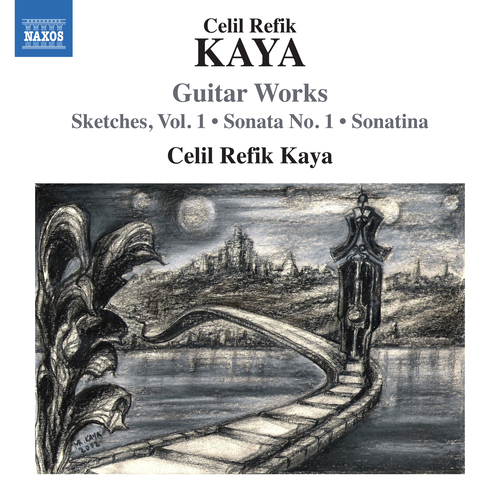
Celil Refik Kaya is a contemporary guitarist and composer in the great tradition of artists who have created their own unique contribution to the repertoire. Sonata No. 1 is characterised by various stylistic resemblances which include South and North American composers, jazz chord progressions, French impressionism and Spanish folk music, whereas the Sonatina expresses more personal emotions. Kaya’s Turkish background can be heard in his variations on the folk song Yavuz Geliyor Yavuz, which, like the Sketches, has its origins in art and music close to the composer’s heart.
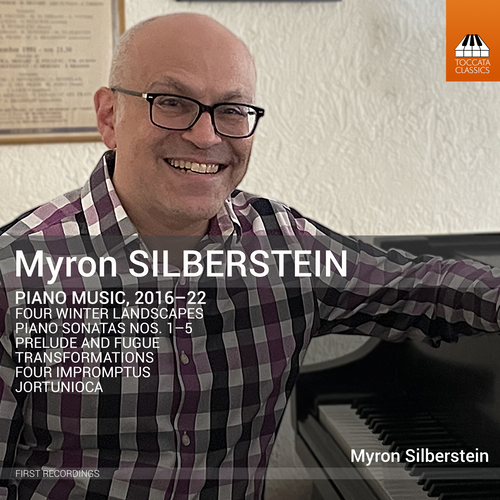
Myron Silberstein, Brooklyn-born (in 1974) and a long-term resident of Chicago, belongs to that centuries-old tradition of the composer-pianist. But here the distant roots are not so much in Mozart and Beethoven as in Copland and Barber. Silberstein’s language echoes the tradition of earlier American composers like Creston, Mennin and Persichetti, and his tonal harmony may remind some listeners of mid-twentieth-century jazz, especially in its sense of improvisatory freedom. Like much of American culture more generally, it is open, outgoing and often positive in spirit.
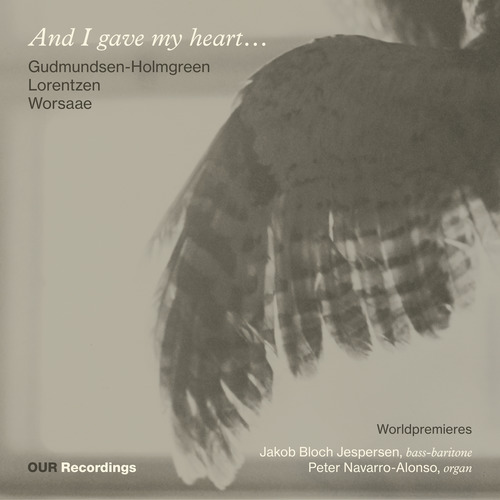
It is a great pleasure that OUR Recordings is releasing this exceptional album that has been on its way for 10 years, a tribute to organist Jens E. Christensen. When one imagines the sound of a magisterial bass voice accompanied by a pipe organ, one cannot help but imagine a glorious Vox Dei proclaiming eternal truths from the numinous beyond. In this extraordinary recital by Danish-Spanish organist and composer and acclaimed Danish bass-baritone Jakob Bloch Jespersen, however, Eros and Agape are twined and intertwined. Three profoundly contrasting song cycles by outstanding Danish composers explore this unique sound world. The late Pelle Gudmundsen-Holmgreen is represented by what may well be his musical Last Will and Testament: a set of transcriptions from his opera Sun Rises, Sun Sets, based on the biblical Song of Solomon. The late Bent Lorentzen, one of the key figures and pioneers of early Danish electronic music, explored themes of love, sensual and divine, in a manner at times reminiscent of a Nordic Messiaen in his song cycle Erotic Hymns. The recital concludes with Nicolai Worsaae’s emotionally and sonically devastating theatre piece for bass voice and organ, A Shipwreck. This work explores themes of life, death, and resurrection, pushing the magnificent organ at Our Saviour’s Church (Vor Frelsers Kirke), Copenhagen, to its expressive limits. The performance is captured with striking immediacy by one of Denmark’s most celebrated recording engineers, Preben Iwan. A MUST-HEAR for vocal and organ aficionados! Bass-baritone Jakob Bloch Jespersen trained at the Royal Danish Academy of Music, debuting in 2002 at the Royal Danish Theatre. A highly sought-after concert and opera singer across Europe, his repertoire spans Baroque to contemporary music, with a special focus on Buxtehude and Bach. He is an award-winning artist and an active lecturer at leading Danish music academies. On this album Jacob is playing all the percussion instruments while singing. Danish-Spanish organist and composer Peter Navarro-Alonso studied at the Royal Danish Academy of Music and the Real Conservatorio Superior de Música de Madrid. He has given over 400 recitals across Europe and the US, focusing on contemporary music and premiering around 100 commissioned works. Since 2021, he has served as organist at Our Saviour’s Church in Copenhagen.
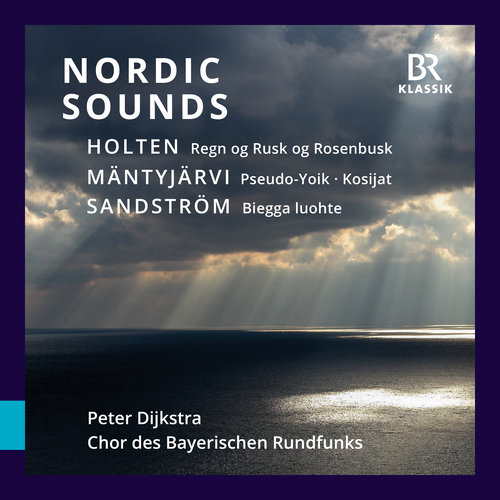
Joik – Gods, Spirits, and Shamans
A journey through mysterious mythological worlds, represented by works from Bo Holten, Jaakko Mäntyjärvi and Jan Sandström. In Regn og Rusk og Rosenbusk for solo voices and mixed choir, Bo Holten evokes the transience of earthly existence. Jan Sandström’s work is more tempestuous: his fall-wind joik references the ancient singing traditions of the Sami people; Jaakko Mäntyjärvi’s Pseudo-Yoik, on the other hand, takes an ironic look at these traditions. Mäntyjärvi also delves into the world of Finnish Kalevala poetry, in which the image of a young girl has long been considered the embodiment of the Finnish nation.
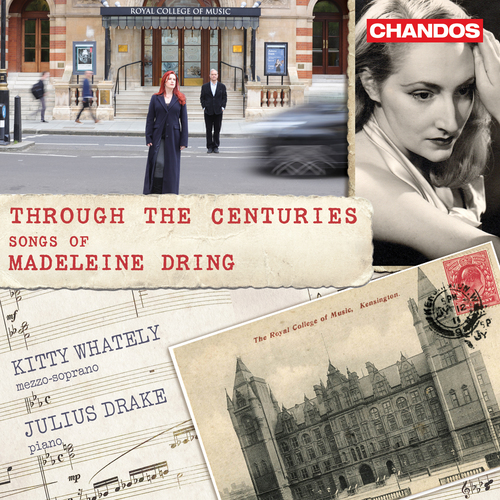
English mezzo-soprano Kitty Whately presents an album of songs by Madeleine Dring. Born in 1923 to a theatrical family, Dring was admitted to the Royal College of Music at the age of nine. She went on to study composition with Herbert Howells, also taking lessons from Gordon Jacob and Ralph Vaughan Williams. She made her career in the theatre, earning a reputation for being able to create catchy numbers at short notice. Sadly, she died at the early age of fifty-three, of a brain aneurysm. The disparate nature of her musical legacy is often attributed to the piecemeal nature of her career; consequently, resurgence of interest in her work has lagged behind that of her contemporaries Elizabeth Lutyens, Elizabeth Maconchy, Grace Williams, and Ruth Gipps. Kitty Whately and Julius Drake have chosen widely from among her output, and end with Dring’s version of Cole Porter’s ‘In the Still of the Night’.
WORLD PREMIERE RECORDING
Tekla Griebel Wandall (1866–1940) made her debut as a composer in the 1890s and she continued to compose throughout her life despite struggling with depression and poverty. This album of world premiere recordings spans songs performed at her debut to the esoteric vision of her later years. It features a superb line-up of rising Danish singers, breathing life into these vivid songs. From the macabre irony of a Heinrich Heine setting to the profound emotional journey of J.P. Jacobsen’s poetry, Griebel Wandall grapples with seemingly irreconcilable opposites while toying with both form and feeling.

WORLD PREMIERE RECORDING
Nkeiru Okoye’s When the Caged Bird Sings is a large‑scale contemporary concert work that follows the journey of Cerise, whose story weaves together personal and collective aspects of Black experience. Through movements such as ‘The Beatitudes’ and ‘Sometimes Life Gets Ugly,’ the piece explores adversity, resilience, and transformation with a musical language rooted in classical and operatic traditions and enriched with African American folk‑music influences and minimalist processes. Scored for vocal soloists, chorus, and orchestra, the work blends elements of oratorio, opera, and communal expression to create an expansive, emotionally resonant narrative inspired in part by themes found in the life and writings of Maya Angelou.
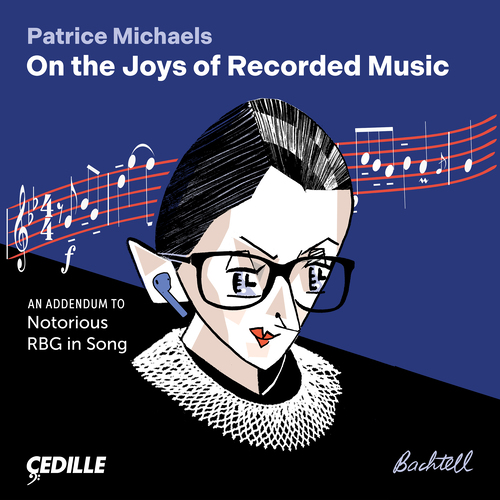
Cedille Records augments its 2018 release, Notorious RBG in Song, critically proclaimed “an engrossing, episodic portrait” (WQXR) and “vivid and beautiful” (Classics Today) – with a digital single, “On the Joys of Recorded Music,” released on March 6, in anticipation of what would have been Justice Ruth Bader Ginsburg’s 93rd birthday (March 15). Written by soprano and composer Patrice Michaels, praised as “a formidable interpretative talent” (The New Yorker), this standalone single features “luminous” (The New York Times) soprano Alisa Jordheim and Chicago collaborative pianist extraordinaire Kuang-Hao Huang.
The song is set to Michaels’ lightly adapted text of a 1999 letter from Justice David H. Souter to James Ginsburg, founder and President of Cedille Records – and son of RBG. In the letter, Justice Souter expresses his admiration for the emotional power of Rachel Barton Pine‘s Cedille debut recording of the complete Handel Violin Sonatas, and his utter amazement that a recording could move him as deeply as a live performance. Initially composed for, but then excluded from Michaels’ cycle, THE LONG VIEW: A Portrait of Ruth Bader Ginsburg in Nine Songs, because Justice Souter denied permission for publication during his lifetime, the piece could not be included on the original recording. After Souter’s passing in 2025, the rights to the letter transferred to the recipient, creating this opportunity for the song’s release. The original CD includes other world-premiere recordings of songs honouring Justice Ginsburg by Stacy Garrop, Vivian Fung, and Derrick Wang, plus an extant song by Lori Laitman complementing Michaels’ THE LONG VIEW portrait of RBG. Offered as a coda to the original song cycle, “On the Joys of Recorded Music” is a delightful meditation on Souter’s perspective about his friendship with RBG, the value of musical styles, and the possibilities for deep engagement through listening.

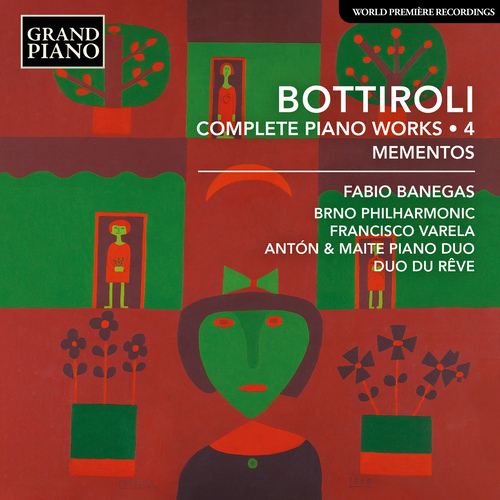
José Antonio Bottiroli’s protégé and greatest champion, Fabio Banegas, presents this fourth volume of his mentor’s complete piano works. In this wide-ranging collection we hear works with orchestra and with chamber ensemble, as well as pieces for piano solo and duo. Symphonic Impressions for piano and orchestra offers lyricism and virtuosity, while the remainder of the programme focuses on Bottiroli’s contrapuntal mastery, the creative refashioning and expansion of earlier works, and his use of Argentine folk dances such as the chamamé. Together they present musical mementos of his own life experience.
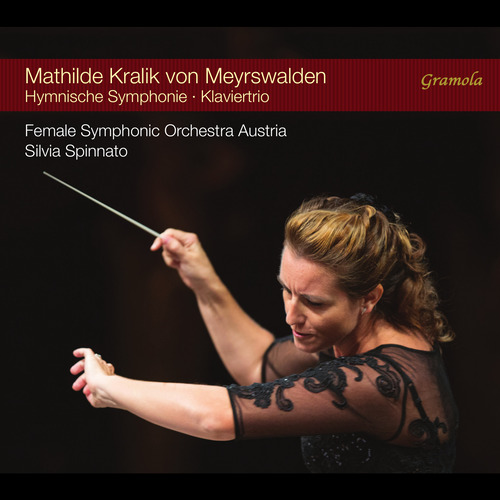
It was nothing short of a sensation: In the autumn of 2021, the Female Symphonic Orchestra Austria (FSOA), under the direction of its founder and chief conductor Silvia Spinnato and featuring Jacquelyn Wagner – one of the most sought-after and successful sopranos in the lyric and youthful-dramatic repertoire – gave the posthumous world premiere of the Hymnische Symphonie (Hymnic Symphony) by Bruckner’s student Mathilde Kralik von Meyrswalden at the International Brucknerfest in Linz. This performance came more than 80 years after the final version was completed. “A sensational symphonic rediscovery,” proclaimed the Oberösterreichische Nachrichten, and the concert audience cheered. Now, the live recording of this concert is being released, paired with the Piano Trio in F major, also composed by Mathilde Kralik. Her early chamber music, after all, was well-received by Eduard Hanslick, the universally feared music critic, and her songs, which form the main part of her oeuvre, were popularly sung. In contrast, the few symphonic works from her pen almost without exception ended up in a drawer and, after her death in Vienna in 1944, fell into near-total obscurity until today.

Since his breakthrough at the Eurovision Song Contest in 2004 with Can’t Wait Until Tonight, Max Mutzke has been regarded as one of the most versatile voices on the German music scene. Whether it’s soul, funk, pop or jazz, Mutzke moves effortlessly between genres while always remaining his distinctive self.
With his latest album Soul | Viel | Mehr, he elevates his artistry to a new level. Together with the award-winning SWR Big Band, he presents a work full of energy, emotion and musical sophistication. Opulent arrangements lend fresh brilliance to Mutzke’s own songs, such as Welt hinter Glas and Marie, while giving classics a radiant new shine.
Following its initial release as a CD (SWR19169CD) in November 2025 – which sold out within just a few weeks and after several reprints – a curated selection of tracks is now being reissued as an exclusive heavyweight LP.
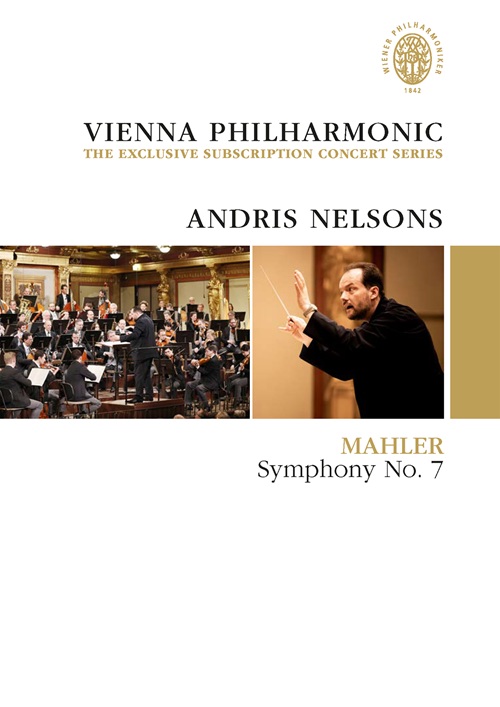
The Subscription Concert Series of the Wiener Philharmoniker from the Golden Hall of the famous Musikverein are special concerts reserved for subscribers. Due to the exceptional quality of the concerts and the limited offer, the average waiting time for subscribers is more than 10 years. With this series, these very special concerts are made available for the first time audiovisually to a wider audience worldwide. Mahler’s unusually expansive five-movement Symphony No. 7 is among the composer’s most ambiguous and enigmatic works, often regarded as his most challenging to perform. Andris Nelsons leads the orchestra in a new chapter of their Mahler cycle, reaffirming his stature as “one of the most celebrated conductors of our time” (Salzburger Nachrichten). Under his baton, the Seventh becomes “magic in the Golden Hall. […] Rarely has one heard this work so finely chiselled, so dynamically balanced. An event.” (Kurier).
Make sure to subscribe to Naxos newsletters for other great offers.